Whether setting up your personal defensive firearm or mounting an optical sight on your home carbine or hunting rifle, you need to know some basics.
Pick Your Ammunition
I like to start by finding a load that works and then sticking with it, as switching ammunition can cause major changes in point of impact. Different bullet weights and velocities will cause major shifts in where your bullet hits. While not as noticeable at the shorter ranges on which we commonly fire handguns, these differences are much more pronounced in rifles fired at longer ranges.
Establish a Zero
What’s zero? It’s how we adjust the sights on a gun so the trajectory of the bullet coincides with the line of sight at a given distance. With most handguns, the zero range is either 15 or 25 yards. With long guns, that zero is commonly 100 or 200 yards. To show you how this works, here’s an example using a typical .223/5.56 carbine with a red-dot sight, zeroed at 200 yards:
• At the muzzle, the bullet will be 2.5 to 3 inches below the line of sight.
• At 25 yards, the bullet will be 1.5 inches low.
• At 50 yards, the bullet will first cross the line of sight—called the initial intersection.
• At 100 yards, the bullet will be 1.5 to 2 inches high.
• At 200 yards, the bullet will cross the line of sight again, and this is the zero range.
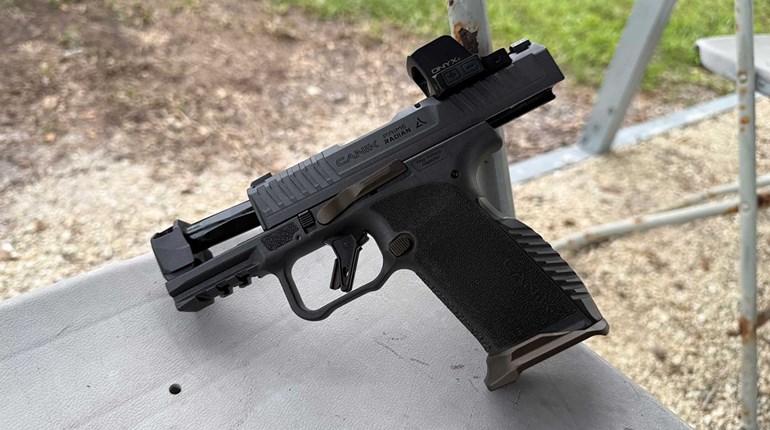
Handguns are less complicated because typical sights are closer to the center of the barrel, meaning there is less offset; however, should you mount a red-dot sight on the handgun, it would create a 1.5-inch difference. So, if you use a 15-yard zero, the bullet will strike about 1.5 inches below where you see the dot on the target at 3 yards. The offset gradually gets smaller as you move back, until you arrive at your zero range.
Don’t Worry About the Little Things
My mentor, Jeff Cooper, called it “PII” (preoccupation with incidental increments). While you might be tempted to pore over ballistic tables looking for “better” loads or bullets, it might not be a worthwhile endeavor for a defensive shooter. Let’s say, for example, Load A is said to shoot 1 or 2 inches “flatter” than Load B at 300 yards. Considering you can’t hold well enough under field conditions to appreciate it, such a difference is likely inconsequential. The same is true of taking lots of time to make a perfect pistol shot or shooting quickly to achieve a hit that will stop a fight. “Perfect” is the enemy of “good enough.” Balancing speed and accuracy considerations—that is, getting a quick hit that’s good enough—should be your goal as a defensive shooter.
How to Dial In
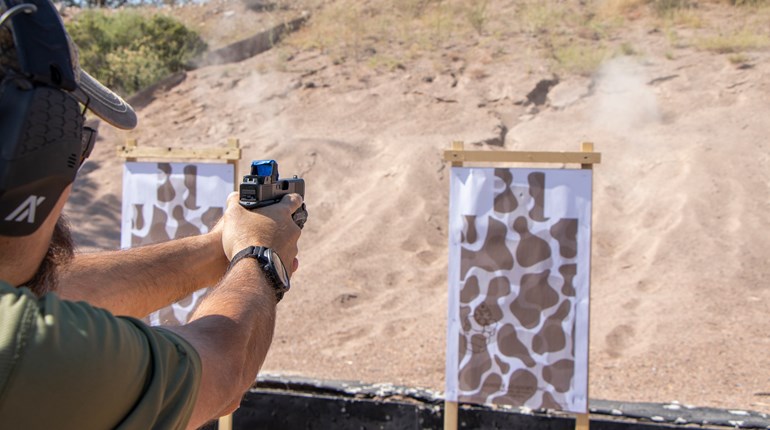
Having settled on the ammunition you’re going to use and figuring out your zero, next comes shooting to adjust the sights and confirm the gun is properly zeroed. I suggest starting close in and moving back; for example, if you install an optical sight, you need to make sure you’re on the paper. I generally check handguns at 7 yards and rifles at 25 yards to see if the sights are even close. Then I may move back to 15 or 25 yards with a handgun and to 100 yards with a rifle to fine-tune the zero.
While “iron sights” on handguns don’t generally come with fine adjustments, you may need to move the rear sight left or right. Move the rear sight in the same direction you want the bullet to go. If your shots are printing left, move the rear sight to the right to move the bullets right. If the rear sight is adjustable for elevation, it can be moved up or down as needed as well, and the same rule applies.
Optical sights usually have fine adjustments. When you look at the scope, or its instruction sheet, you’ll find that each “click” of adjustment is regulated for 1 inch, ½ inch or even ¼ inch at 100 yards. Assuming a 1-inch adjustment, here’s how far the point of impact will change for each click:
• 200 yards: 2 inches
• 100 yards: 1 inch
• 50 yards: ½ inch
• 25 yards: ¼ inch
Using this example, if you were shooting at 25 yards and wanted to move the point of impact 2 inches, it would require 8 clicks.
Following these steps should save you time and expense and get you zeroed with a minimum of ammunition.
This appeared in the February 2022 issue of America's 1st Freedom.
Most Popular