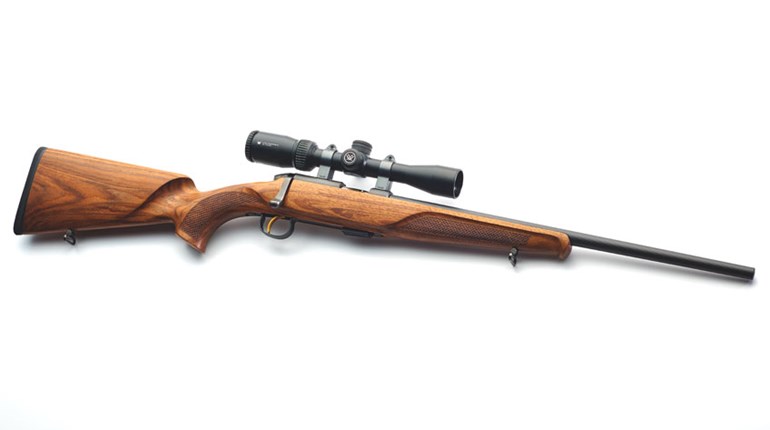
We took a break last week from our discussion of some crucial fundamentals to bring you an interesting rifle from the print version of America’s 1st Freedom, but now we’re back to it—the Three P’s. Getting these right won’t just help you with carry or defensive shooting, but anytime a pistol is the tool at hand.
As we said in Part I, this relates to an item on our list of most frequently-asked questions: Some variation on, “I‘m not happy with my handgun results.” Certainly there are lots of factors here, but none of them will help much if your bedrock skills are flawed. We’ll argue with just about anybody that there’s little of consequence more basic than what we call the “Three P’s”: Press, Press, Press. … the sights will now be driven down, not merely allowed to settle in your follow-through.
A quick review of the first “P” is in order. Here, “Press” means to press the hands/palms together around the grip of the pistol. While we posit many benefits, recollection of the goal is most important: This method traps the majority of recoil energy forward of the elbows where it belongs, and is in fact useful in keeping a semi-automatic pistol running correctly. The crucial element is to resist the temptation to fully extend the master or “strong” side arm. While that feels (and even looks) steadier, it introduces a host of problems in body mechanics, particularly beyond the first shot, and is especially disadvantageous to smaller or less physically powerful shooters. Pull that pistol in a little by bending the elbows, and pervasive advantages come into play.
Press(ing) the thumbs toward the target is the second “P.” It is certainly easier to explain, as well as a smaller change for most. But make no mistake: Without it, our first “P” gripping method has little chance of affecting nearly as much useful change.
A couple of things can bugger this up, and the first is remarkably common, even taught. “Burying” the thumb—where the strong side thumb winds up under the weak side palm—sabotages the first “P” very effectively. Note that we assume both thumbs are on the weak-hand side of the pistol: Never cross the thumbs at the back of any handgun. We know this remains common among some revolver-trained shooters, but it’s a terrible idea not least because of the very real possibility of injury if this grip method is applied to an auto-loading (reciprocating slide) pistol.
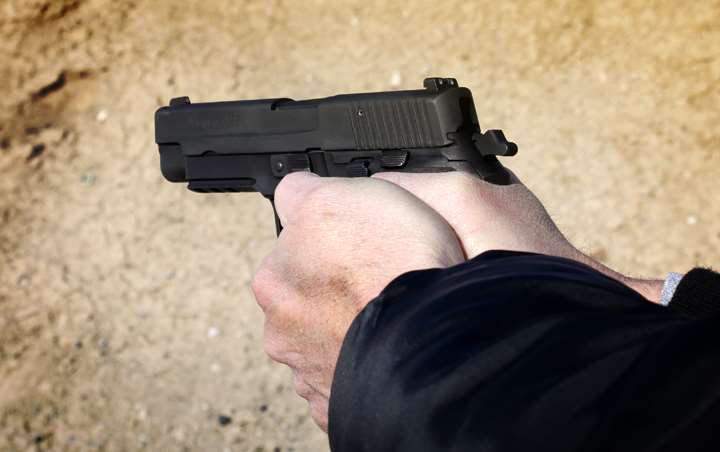
Instead, make sure you contact the left-side grip of the pistol with the fleshy part of the weak side thumb and palm, and point the thumb itself downrange, tensioning the weak side wrist. Let the strong hand thumb ride above the weak (often murkily called “thumb over thumb”). Before you ask: No, even if this higher/farther forward thumb position causes you to touch the slide as it cycles, it won’t hurt you. We demo this all the time without injury. It’s mostly “lore” too, that this will cause malfunctions (on rimfire, or very under-powered handloads, maybe …). Press with the palms, not try to grip with the thumbs, and this never comes up to begin with. (Proper grip architecture and grip mechanics help with this, too.)
Mainly, this gets more of “you” on the gun, but there are also other obvious and not-so-obvious benefits. Foremost in the “obvious” group is an overall reduction of felt recoil—a logical and mathematical result. Because more of “you” is on the gun, less recoil energy per unit area is sensed. Don’t worry about this hurting the web of your hand, either: If it does, it means you’re still pushing the pistol out too far. Bend those elbows more, pull the pistol in and apply more first “P.”
Less obvious benefits also pile up in pressing the thumbs forward. Two occur only in the strong side hand. The first is getting “high and deep” in the gun. Done properly, any beavertail on your autoloader now will make a depression in the web of the hand—no space at all is the goal. (Any space means you need to move the strong hand up on the pistol.) This aligns muscle and bone in the wrist and forearm higher and closer to the bore axis. Remember the first “P” bit about keeping energy in the pistol? Bingo! This is the last crucial component. It is important to observe that this is not “point shooting.”
The tension that the both-sides-thumb-push creates and how it keeps energy in the gun can hardly be overstated. Once you get the feel for this, it’s hard to miss how much more effectively you can resist the upward/rearward rotation of recoil, and easily see it’s more effective than any finger-based gripping action can be. If you do this in a short-sleeved shirt, the nuts-and-bolts of “why” are readily apparent: You can see the added tensing in the top of the wrist and forearm for sure, but some folks can feel it/observe it to midway up the upper arm. Merely adding finger-based grip tension clearly cannot keep pace for most, ending as it does at mid-forearm. More recoil-dissipating dynamic tension is now part of your platform, and attacks any residual so-called limp-wristing like nothing else.
As we said in Part I, not only will this keep your auto-loader running better (and especially in non-traditional hand positions common to competitive or carry/defensive shooting), but the sights will now be driven down, not merely allowed to settle in your follow-through.
A remaining benefit of pressing the thumbs toward the target is perhaps the truest gem, but also the most subtle. We tend to think of the aiming process as mainly neuro-optical, that is, a cycle where the eyes and brain work together through successively smaller, more precise “loops” that guide the muscles and firearm into eye/sights/target alignment. Boom. Do it again.
There’s nothing wrong with this notion as far as it goes. Except that, relatively speaking, it’s slow. Even very slow.
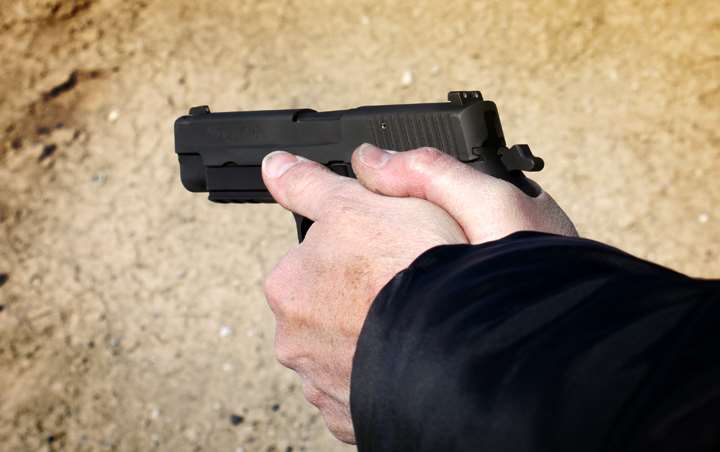
We suggest that pressing the thumbs offers a very practical aiming shortcut. Other than the index finger—which is kinda busy, you may recall, with that trigger thing (and the third “P”)—the thumb is the most accurate “pointing” digit. The second “P” takes advantage of this. A highly developed reflex (nearly subconscious), this pointing action is extremely efficient. With practice, you’ll find that much, indeed most, “gross” aiming can happen in this way: Point those thumbs. To complete a precise, accurate shot, very few of the more expensive (at least neurophysiologically speaking, we suspect) aiming “loops” are actually required.
It is important to observe that this is not “point shooting.” A shot made in the fashion we suggest remains aimed, but only at the very end of positioning the firearm for the shot. Pointing the thumbs at the target gets you close (often very close), and with practice only a single brief visual “proofing” of alignment will be required. Moreover, you may find this effective to astonishing distances. The trick here is to trust your pointing reflex, and not default back to multiple, slower, eye/sights/target alignment loops.
And that’s it: two P’s down. A couple of provisos, however, may be due to properly knit them together. As you transition into first “P” from something else, make your goal equal pressure left vs right/weak vs strong hand. In the short run, this won’t mask the forces and feel you’re trying to acquire with the second ”P.”
In the longer term, though, you’ll actually want more gun retention strength to come from the (supposed) weak side—“why” will become clear when we talk about the third “P.” But just getting even pressure and pressing both thumbs toward the target will likely yield a large improvement, yet not have you steering the pistol hither and yon. Up to this point, that improvement should look like fewer malfunctions, less sight movement in recoil and less time to align on a new target.
For now, Press, Press and Carry on.
Read Part III here