Understanding the different ways your sights can be used will help you become a faster, more-proficient shooter.
Most of us were taught what I like to call the “bullseye” sight picture, where we carefully align the front sight to be perfectly centered and level in the rear sight. While this isn’t wrong, it certainly isn’t fast. The opposite is using your body’s position to direct fire onto your target without the use of your sights whatsoever. This is fast, but less precise. Finally, there is a middle ground, where shooters completely ignore their rear sight and use the front sight only. A target’s size and distance will dictate which sight picture is the best to use for a given scenario, and the best shooters will instinctively know when to change gears.
This drill uses two targets and three sight configurations, but—as perhaps, with all drills—it has only one goal: getting us better at staying alive.
Setup
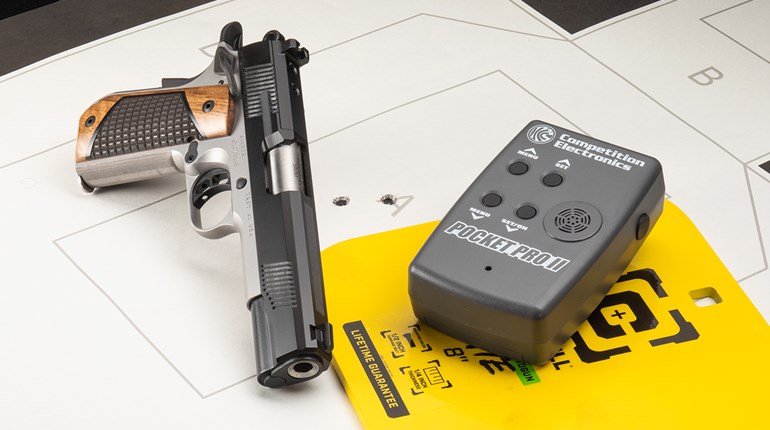
For this routine, all you need is one full-sized target, one 50% target and a shot timer. These could be steel—Allen’s makes an affordable system called the EZ Aim Hardrock that works well for this application—or you can substitute paper versions of similar dimensions, though, of course, you’ll spend more time walking downrange to confirm your hits. Place the full-sized target at 5 yards and the 50% target to the left of it at 20 yards. With just these two targets, you’ll have a playing field that will force each sight-picture configuration.
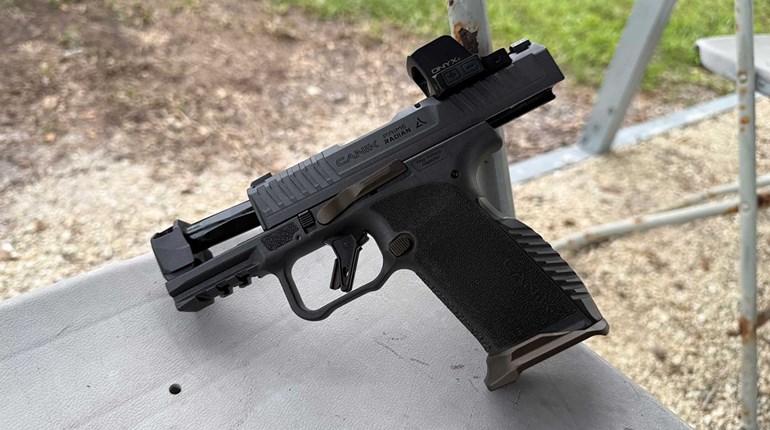
For this drill, those that hail from the fellowship of the red-dot can equate “no sights” to using just the window of their optic at eye level, “front-sight only” to seeing the dot but not explicitly holding it still on the target and “both sights” as the dot still on one specific part of the target. The main objective is to produce random target distances and shapes to force yourself to decide how much effort is needed to quickly produce acceptable accuracy for the target you are presented.
The “ready” position for each of the following phases will be with a holstered and concealed firearm with your arms relaxed at your sides.
Warm-Up
1. At the start tone, draw and present onto the close-range target the same as you would if you were using the sights.
2. Once the gun is at eye level, fire your first shot before the sights are in alignment.
3. Immediately after the trigger is depressed to the rear, allow it to travel forward to the reset and press it again, also without a sight picture.
4. Carefully reholster and repeat four more times.
5. Each pair should take under two seconds to complete with hits in the “C” zone or better.
Slow Change
1. At the start tone, draw and fire two rounds at the close-range target. Each pair is to be fired without the use of sights.
2. Immediately bring your eye to the head portion of the target.
3. Acquire just the front sight.
4. Fire again.
5. Carefully reholster and repeat nine more times.
6. Each drill should take no more than 2.25 seconds with center-mass hits in at least the “C” zone.
Hard Change
1. At the start tone, draw and fire two rounds at the close-range target. Each pair is to be fired without the use of sights.
2. Swing your eyes to the distant steel target.
3. Align both front and rear sight as quickly as possible.
4. Fire the third round.
5. Carefully reholster and repeat nine more times.
6. Each drill should take no more than 2.75 seconds with center-mass hits in at least the “C” zone.
This training routine will help to keep things constantly changing, as you will never use your sights the same way to engage two consecutive targets or target areas. Those who practice it will begin to build in an instinctive judgment as to how intently they need to use their sights at which distances.