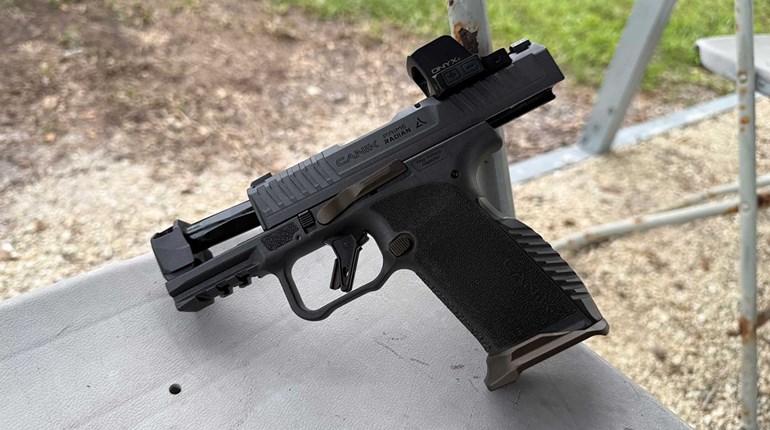
What are the main things to consider when selecting a concealed-carry handgun? Concealed-carry comfort, reliability, “shootability,” effectiveness and price are the primary considerations, and while categorizing these features can help simplify your decision, there’s some overlap that complicates things. Let’s examine each factor, from what I consider the most to the least important, and try to put all of this in some perspective, so you can choose the carry gun that best suits you.
Most so-called experts will tell you reliability is the most important thing. And while it is very important, the most reliable handgun in the world cannot help you if you don’t have it with you. When it comes to selecting a concealed-carry handgun, I believe you should consider the concealed-carry comfort aspect first.
1. Concealed-Carry Comfort
The easiest handguns to comfortably carry and conceal are usually the least effective defensively and the most difficult to shoot fast and accurately. Conversely, larger, more-powerful handguns are often easier to shoot fast and accurately, because their grips are larger and because they’re heavier. This also makes them more difficult to carry and conceal. Your goal is to find a compromise that works for you.
We’ve historically categorized handguns based on barrel length. Duty/full-size guns had 4-inch or longer barrels, compacts had 3.5- to 4-inch barrels, subcompacts had a 3 to 3.5-inch barrels and guns with shorter barrels were ultra-compacts or pocket pistols. These categories have begun to blur as polymer handguns and concealed carry have become more popular. As manufacturers satisfied demand for larger-caliber and higher-capacity handguns that were smaller and easier to conceal, handgun weight has became a better classifying metric.
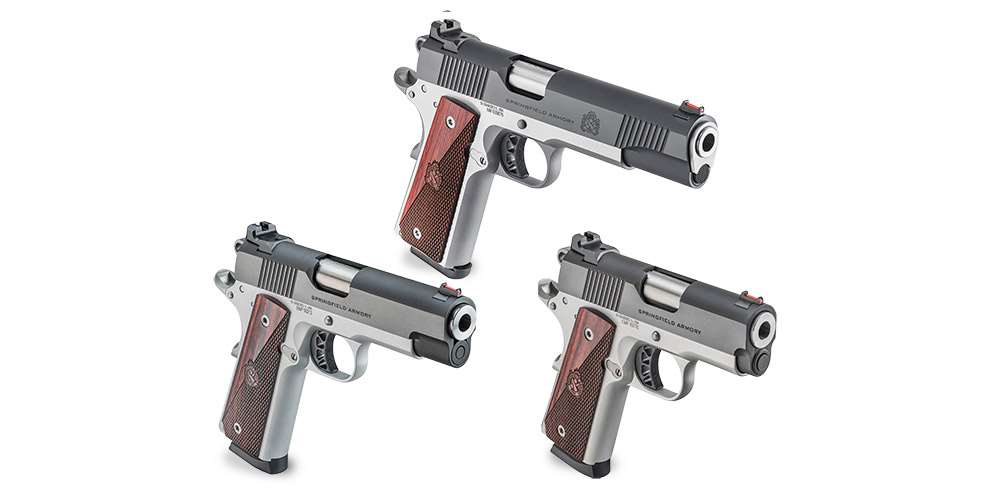
For example, an ultra-compact handgun, like a Ruger LCP, can weigh less than a pound. Subcompacts, like the Glock G43X, weigh between a pound and 24 ounces. Compact handguns, like a Colt Viper or a 3.25-inch Wilson Combat SFX9, weigh between 24 and 32 ounces. And duty/full-size handguns, like a Glock G47 or a 5-inch 1911, typically weigh more than 32 ounces. But the weight that matters is the fully loaded weight, as that’s what you’re actually carrying. These differences can be extreme. A Glock G23, for example, weighs less than 24 ounces unloaded, but about 32 ounces fully loaded.

You must consider your body size and wardrobe when choosing a carry gun, but unfortunately there are no fixed rules, because, in defiance of weight, some handguns just carry better than others. The Browning Hi-Power and modern clones, like the Springfield Armory SA35, are perfect examples. These pistols have thin slides, and many find they carry very comfortably. Given my body size and how I dress, a Hi-Power is more comfortable for me to carry than a compact Glock G43X.
Trying different handguns is the practical answer, but buying various guns and holsters can get expensive. That’s why it’s smart to establish relationships with other shooters or an accommodating gun shop so you can try different combinations. In the end, you must balance the weight and size of your carry gun with shootability and effectiveness, which takes capacity, barrel length and cartridge choice into account. We’ll address those things too, but the next most important thing is having a gun that works.
2. Reliability
Reliability is the simplest consideration because a self-defense handgun must be 100% reliable. Now, handguns can be fickle things. Some might not like certain loads, and that’s okay if your gun is reliable with the defensive load you’re carrying. Also, reliability does not have to extend infinitely. If your pistol has reliability issues when it gets dirty, say after 250 rounds, that’s okay, too. Just don’t carry your pistol dirty. If you can put at least 100 rounds of carry ammo through your handgun without a stoppage, you can consider it reliable with that ammunition.
Some handguns are more reliable than others. Though revolvers are not jam-proof, they fail less frequently than pistols. Also, with pistols, cheap, worn or damaged magazines are often the cause of reliability issues. Additionally, you can be part of the problem. When I worked the street, I always wore gloves, and when I shot my duty Glock, my thumb sometimes inadvertently engaged the slide stop. Admittedly, this was a training issue and something I continually grappled with. You might have a similar problem; for example, shooters with big hands can struggle when shooting and manipulating smaller handguns.
If your handgun is not reliable when you shoot it, you either need a different gun, different ammunition, more training or maybe all three.
3. Shootability
Shootability relates to shooting comfort, and the speed and accuracy you can deliver with a handgun. This is very subjective because more-experienced shooters will be able to manage smaller or harder-recoiling handguns better. It’s also subjective because everyone’s hands and their ability to tolerate recoil and muzzle blast are different. I carried various Glock pistols on duty for 13 years, but I never found one that fit my hand comfortably.
If a handgun does not feel good in your hand or is painful to shoot, it’s not the right gun for you—period.
With experience, you might be able to tolerate more-intense recoil, but it’s a generally accepted fact that a recoil impulse of about 7.5 foot-pounds—roughly the kick of a full-size 1911 in .45 Auto—is about as much as most people can shoot comfortably and quickly.
Most will find a recoil “sweet spot” between four and six foot-pounds. This is one reason law enforcement transitioned from the .40 S&W back to the 9 mm and also partly why subcompact 9 mm pistols are so popular for concealed carry.
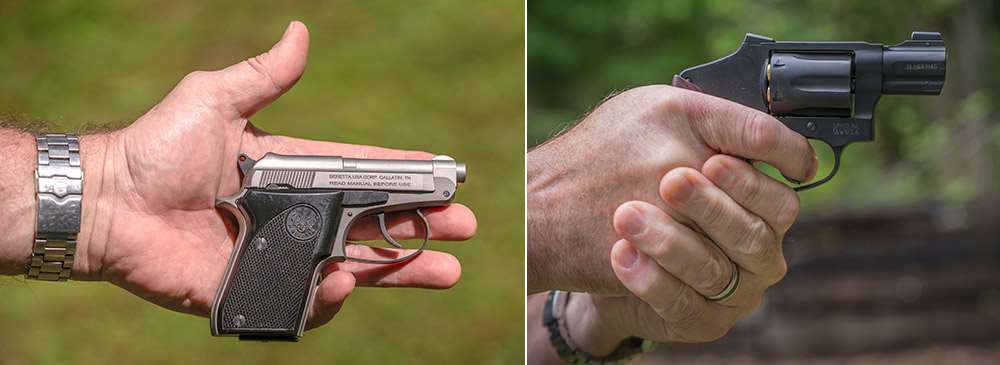
I’ve conducted a lot of testing to determine how recoil impacts shootability, particularly as it relates to sustained fire. I’ve conclusively proven that the increase between the time it takes you to fire multiple accurate shots is proportional to any increase in recoil. But another factor related to accurate shooting is the distance between the rear and front sights. Less sight separation (sight radius) makes fast and correct sight alignment more difficult. A reduction in sight radius of just one inch can make a handgun 10% more difficult to shoot accurately.
Sight radius is determined by barrel length—the longer the barrel, the better—but longer-barreled handguns can be more difficult to conceal. You can partially offset the negatives of a short barrel with a red-dot/reflex sight, but there are pros and cons to battery-powered optical sights on carry guns. Felt recoil, on the other hand, is determined by the handgun’s weight, the cartridge and the ammunition. Less-powerful cartridges recoil less and are often considered less effective, but how much effectiveness do we need?
4. Effectiveness
Are some handgun cartridges more effective than others? Yes, but it’s complicated.
It’s complicated because a single bullet’s ability to penetrate or damage tissue is not the only thing that matters. Shot placement is paramount—and that is determined by shootability, sight radius and recoil. A long-barreled .44 Magnum is unquestionably more effective than a 9 mm for one ideal shot, but the gun will be heavy, kick like a mule and be nearly impossible to comfortably carry and conceal.
This answer is also complicated because “better” is hard to define, and because minute differences in terminal performance appear more significant in ballistics tests than in real-world situations. One of the best ways to address this question is to look at what’s generally considered the baseline or accepted threshold of terminal performance. Within law enforcement, it’s a handgun bullet that will penetrate to at least a foot and upset (expand) to about 1.5 times its original diameter in a viable testing medium. This performance is obtainable with most of today’s self-defense cartridges, but it does not mean they’re all equal.
Because there are so many different types of ammunition for so many different cartridges, and because we cannot predict how a human will react when shot, a formula illustrating cartridge effectiveness does not exist.
Capacity is part of effectiveness too, because running out of ammo in a gunfight is not a good thing. Though statistics suggest most civilian defensive gun use incidents involve fewer than five rounds, more ammo is always better. The trade-off, of course, is that this makes handguns larger and heavier.
Because of all this, a practical approach is choosing the most powerful cartridge that fits in the highest-capacity handgun you can comfortably carry and conceal, and that you can shoot accurately and fast. But, when you find that handgun, how much should you pay for it?
5. Price
Most handguns considered suitable for concealed carry cost between a couple of hundred bucks and as much as 20 times that. Some people just want a tool they can trust to save their life; others take a great pride in the firearms they use and want the best aesthetic and functional example they can afford.
Most adult men can comfortably carry a 10-round Glock 43X. It’s reliable and only costs about $500. A 3.25-inch Wilson Combat SFX9 is just as reliable and about as easy to carry, but costs about three grand. Other than the price, what separates these guns? One has a plastic frame and the other a metal frame. The SFX9’s trigger is substantially better, and the gun will deliver better precision and has a manual safety. Also, when you order an SFX9, you can personalize it with customization. It’s a great example of defensive handgun exceptionalism, but is it worth the money? Maybe.
It’s sort of like buying a new vehicle. A Nissan Versa costs less than 20 grand. It has four doors, four wheels, air conditioning and a radio, and that’s about it. A fully loaded Mercedes G Wagon is about 250 grand. Most of us will opt for something in the middle, but we would all prefer to pay for the Nissan while driving the Mercedes. So, buy what you want and can afford, but just as importantly, buy what you like. Because the more you like your handgun, the more likely you are to train with it and carry it. And, in the end, that’s what matters most. Your everyday carry gun cannot save you if you cannot shoot it well and don’t have it with you.
Situational Carry Strategy
Unless you have a very simple life and wear the same clothes and do the same things all the time, it’s unlikely a single handgun can effectively serve you all year and wherever you’re going. Can you comfortably conceal your Glock 17 while on vacation in hot and humid Florida? Can your itty-bitty pocket pistol push a bullet through several layers of clothing during a Minnesota winter? A comprehensive approach to concealed-carry handgun selection might mean you need more than one gun.
In jacket weather, I often carry my Wilson Combat SFX9 in an outside-the-waistband holster. I like its capacity and I shoot it very well. When it is warmer, I usually carry a lightweight Browning HiPower that rides comfortably inside my waistband. Both are single-action pistols with manual safeties that operate the same, which is a practical consideration with multiple carry guns; however, when the temperature and humidity are stifling, I’ll often stick an 11-ounce Diamondback DB380 in my pocket. It’s not the most shootable or most effective handgun, but in some situations, it’s my best option for comfortable concealed carry.
Concealed carry is not a one-size-fits-all practice. It’s a learning process as you build skills and discover what guns and gear fit you and your lifestyle. Don’t be afraid to evolve as you learn and become exposed to different handguns.