Compensators, muzzle brakes and flash hiders are no sort of new or secret gizmos. Whether you know it or not, the technological basics are the same on everything from a 50s-era M48 Patton tank main gun tube to a Barrett M82A1 .50 BMG to that odd-looking, scalloped muzzle cut on authentic AK-47s. They all have variations on the same job – redirecting and repurposing projectile propulsion gases.
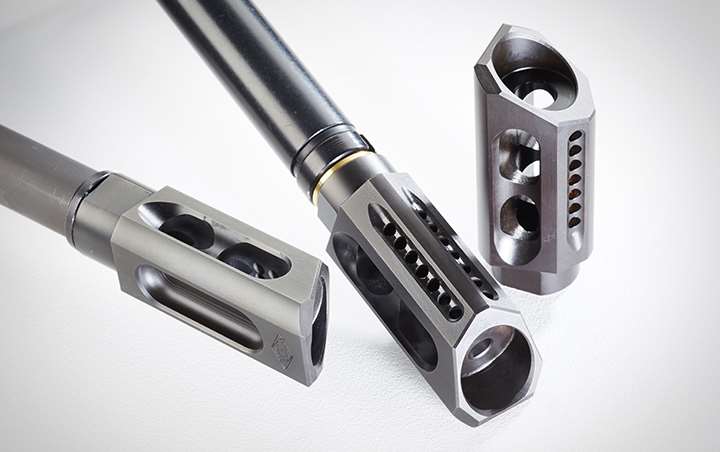
They’re also seriously misunderstood. The story continues to circulate that their “dangerous” appearance and the belief that they hid shot flash signatures from those being shot at resulted in their (effective) banning as part of the 1994 Crime Bill. It's untrue and just plain silly, of course, but that’s another article. Simply, the flash hider – different from either a brake or comp – is meant to decrease flash mainly from the shooter’s perspective as an aid to better aiming. As such, it applies mainly to select fire where repeated muzzle flashing is the issue. Solid-bottomed flash hiders also reduce dust signature – that puff of dust that can give a military shooter’s prone position away to an enemy at a distance, or throw detritus at the shooter himself as he fires. The “A2” birdcage is the classic design, and very familiar to M16/M4 and AR-15 users.
Why they’re popular now is no mystery either. With record numbers of new shooters appearing at ranges around the nation, methods and devices that make shooting more comfortable and enjoyable are in high demand. Muzzle brakes and comps especially fit this bill.
The difference here is subtle. A comp(ensator) is a type of muzzle brake that is particularly designed to keep the muzzle of a rifle or pistol flat during recoil. It therefore mainly directs gas upward behind the projectile as it departs the bore in order to rotate the firearm back into an expected next-shot position.
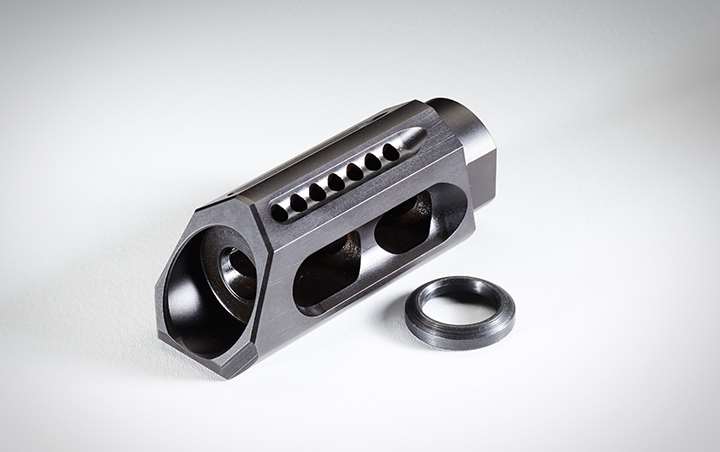
A muzzle brake vents combustion pressure behind the projectile in a similar fashion, but axially (along the direction of the barrel). The intention here is to impede rearward movement of the gun. It’s a pretty subtle distinction, and in fact, most comps and brakes do some of both. Even the venerable A2 flash hider is better than most folks think – the anti-dust, solid bottom directs gas upward, and keeps the muzzle flatter than you’d guess. Shoot a plain-muzzled AR, and you’ll feel the difference in a hurry.
All of which brings us to Yankee Hill Machine. Not too long ago, they got wind of some rifle tests we were doing, and offered us their Slant Muzzle Brake. After a few very deliberate picoseconds of consideration, we said, “Sure.”
One of the great things about brakes/comps in the modern era is that they are easy to test and compare: Some caution, a wrench, a vise block and a few washers (so-called “crush” or other types) allow you to test and tune pretty much to your heart’s content.
Which didn’t take long, in this case. We spun an A2 clone off a 7.62 semi-auto, replaced it with an appropriate Slant brake and promptly, rapidly shot everything we could safely designate as a target, from CQB to middling ranges. As far as we could tell, not only did the brake make rapid multiples easy, but introduced no troublesome barrel harmonics with their detrimental effect on accuracy. We base this conclusion on several rapid strings at a 2/3-size MGM reactive steel – all (easy!) hits. The last of these particularly impressed: a ~1/2 MOA, 425-yard 3-shot string in a smidgeon over nine seconds. That’s relatively hard to do in any case, but without superb “quieting” of the muzzle? Try it and draw your own conclusions.
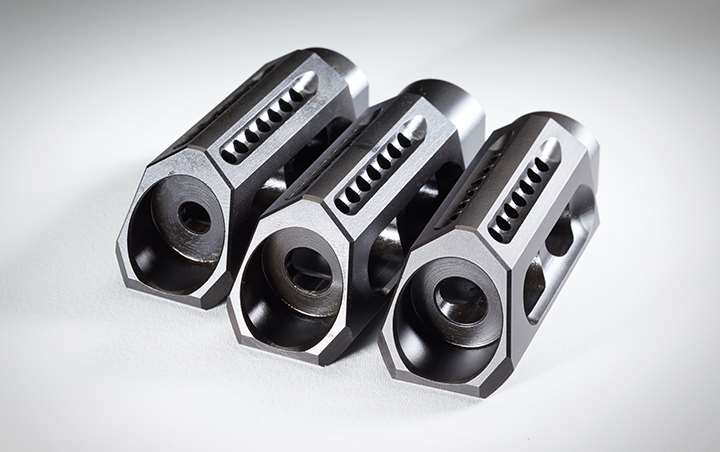
We tried the 5.56 brake on more than one rifle, with very similar results. On two AR-pattern guns, the brake performed very well. Where it was most impressive, however, was on a bull-pup design. We had two other shooters vet our impressions, and the opinion was uniform: These shorter rifles put
the muzzle noticeably closer to the shooter and can be both physically and perceptually disconcerting. With the Slant brake, this simply goes away as a barrier to good shot placement. Overall dissipation of muzzle movement was so effective that rapid pairs out to distances of 100 yards were reduced to essentially reflexive shots.
A few closing thoughts if you decide to add or change a brake on your rifle. First, be double-darn sure of caliber. Match this to your rifle with extreme care (barrel thread pitches are designed to help with this – the threads on a 5.56 brake usually won’t match a 7.62 barrel); it’s your responsibility to be certain no matter what anybody else says or writes. Second, while recoil will be noticeably reduced, concussion and noise won’t be – especially for neighboring shooters. Make sure your hearing protection is up to the task, and be considerate of those nearby.
Lastly, use the correct tools. A selection of washers may be necessary to get the “up” side properly up, and so-called clocking of the device to account for right- or left-handedness introduces more variables. Best and simplest: Once your excellent YHM Slant Brake is in hand, give a shout to your local gunsmith. Then shoot (and rest) easy.
Frank Winn is the Guns & Gear editor for NRA American Warrior magazine.