Drawing a pistol both rapidly and safely is not an easy thing to learn to do well. Worse, if you don’t think through both the technique and how you practice it, any attempt to go faster adds danger long before speed.
First, let’s shuck some stuff you absolutely don’t need:
Grip
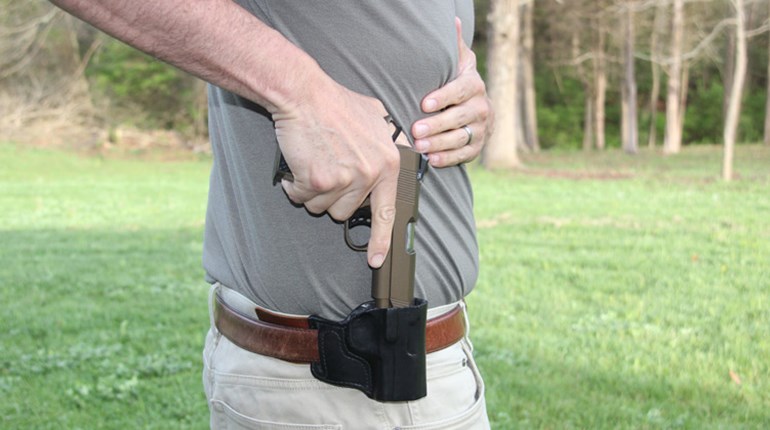
This sounds easy, but this is where lots of folks have their nearest and most mortifying mishaps. When you first go for the pistol, get a proper grasp with the master hand before you ever leave the holster. Fix any grip problems right there. The price of not doing this is at best a dropped gun, at worst, an entangled one leading to a negligent discharge. You won’t like any aspect of the latter.
Obviously, the index/trigger finger is along the bore axis, and not inside the trigger guard.
Casting
This is where the muzzle is elevated above the target as it moves forward into the final firing position and the sights are allowed to “settle” onto the target. If you think about the last third or so of this motion, you’ll quickly understand where the name originated, and you can see it in almost any film or TV episode involving a firearm made before, oh, say, yesterday. Bad examples are absolutely everywhere.Draw types vary, but the building blocks of a good safe one, don't.
We think it actually originates from subsequent shots (anything after the first) as recovery from recoil, and mainly with one-handed revolver technique. Whatever, it just never seems to die. Point is, don’t do it. It’s both slow and dangerous; not just a lot of extra motion (the “slow” part), but results in an up-muzzle attitude just as the finger is mounting the trigger. Any too-early shot will quite likely be tripped over the berm (the dangerous part). Like we said: Don’t do it.
Joining The Hands
There is a very real propensity to join the hands too soon. We understandably focus on the master/strong side, and as this hand has more to do, it often finds the off/weak hand waiting somewhere out there in front of us when the strong hand arrives with the gun. Bad plan, sports fan: You just swept yourself—and probably just about the time you were starting to mount the trigger. Yikes.
The fix here is to move the hands at the same speed, or find an intermediate “stop” for the weak hand. This is the reason so many instructors want to see that weak hand actually touch somewhere on the torso between the belt-buckle and chest. This motion slows the weak hand, and a no-sweep join is now possible.
Mounting The Trigger
This is a sequential step that occurs after the hands join and the muzzle is essentially parallel with the ground. It’s the first part of “trigger prep,” too. Simply, it’s when you turn the index finger loose to find the trigger face and begin the actual shot. But there’s no point in trying to do it any earlier (plenty of time for this as sight alignment occurs), and as we pointed out above, early initiation invites a finger-on-the-trigger sweep of the weak hand.
Figuring out if any of these apply to you is a (relative) cinch compared to the old days: Have a shooting pal use that smartphone camera. If a slow motion mode is an option, better still. Any of these foibles are likely to leap out. A note: Make sure your erstwhile videographer is in a safe position.
If you discover any of these shortcomings, make sure your prep to repair them is appropriate. First is an inert firearm (or better, blue gun or other non-firing simulator). We promise, you will drop it: There’s no sense in messing up the real thing. If you use your actual firearm, apply the Golden Rule of dry fire—absolutely no ammunition in the same room where you practice.
Next, go slowly, especially at first. This is the only way to be sure you aren’t merely sketching in whatever changes you need. And expect to practice a lot if you’re overcoming some of these poor techniques. The urge to speed tends to submerge bad habits as so-called muscle memory, and consequently they’re more difficult to reprogram. Monitor for improvements using that willing videographer.
Next week, we'll put the pieces back together.
Now Carry on.