Last week’s Carry Life deconstructed some persistent problems we’ve seen in draw technique over the years. Now, maybe, you’ve had a trip to the range and discovered a few chinks in your go-to-guns armor. So putting it back together is today’s task: The right thing looks like what, precisely?
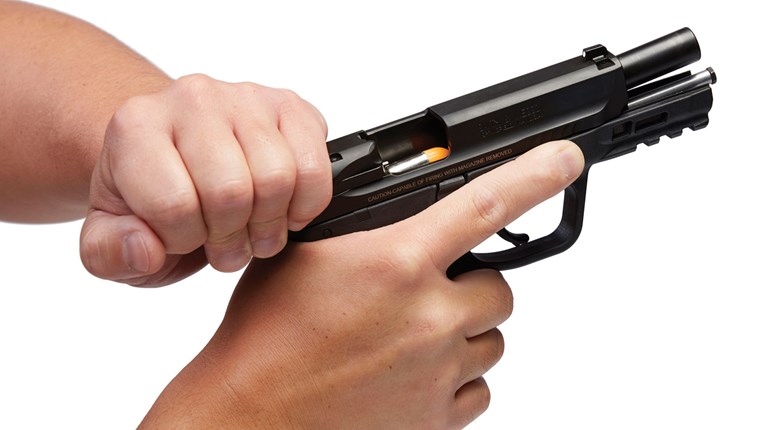
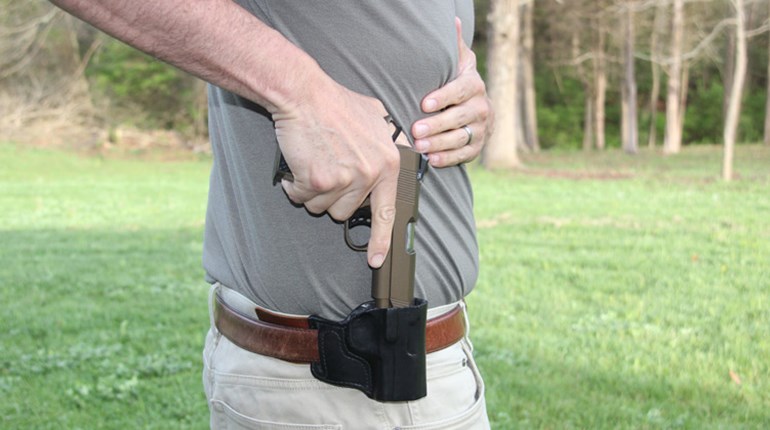
Grip the pistol securely with the strong hand, but no trigger contact. Draw the pistol straight up to the point where it clears the holster (make sure there’s no tendency to angle the pistol inward toward your hip). The weak hand has moved to its “timing” position so that it doesn’t get ahead of the strong hand.
The strong hand elbow drops, rotating the pistol to horizontal at slightly below armpit height. It’s a good idea to separate this motion from bringing the pistol up the rest of the way, as this is where the unhelpful “cast” often begins. Notice that there’s virtually no wrist movement/angulation here. Once the muzzle is parallel to the ground, start pushing the pistol toward the target. As the muzzle is now downrange of the weak hand, movement to join hands can start.
Your visual focus to this point should be the target, but roughly as the hands merge, the front sight appears in the lower peripheral field; visual focus should draw back to the front sight. The path of the gun, now with hands joined, is a very shallow, angled push out (and very slightly up) toward the shooting position. When the front sight starts to cover the target, begin trigger “prep”—that is, your index finger goes to the trigger face and starts to take up any slack.Overly aggressive holstering almost always involves sweeping yourself, so slow this action waaaaaay down.
Now is the time for the wrist to go to work keeping the nose of the pistol from climbing above horizontal—you’ll just have to tilt it down again in a few hundredths of a second. Ideally, though, your draw is now complete: All that remains are small sight picture adjustments, and completion of the trigger press.
Two tendencies can emerge just preceding the shot. The first, we suggest, is absolutely unhelpful, though extremely common (we fight it ourselves)—the urge to bring the head down to complete sight alignment. In its most radical form, you’ll hear it called “tactical turtle”: the dropping of the head forward between the shoulders. Mind, you will see some superb shooters do this, especially those trained in the military or law enforcement. While it’s a stress reflex and does present a slightly smaller target to an aggressor, it actually complicates sight alignment: Two things (head down to hands, hands up to sight line) are moving instead of one.
In other words, it’s slower.
The second tendency is to sweep the pistol up to the target after the earliest possible joining of the hands, rather than push it out. This isn’t wrong, and can be faster because it’s a slightly shorter path to final gun/firing position. What makes it tougher to learn to do well is the sight acquisition part of the equation: The nose of the pistol is farther away, and moving faster on a steeper vector when the sights enter the visual field. The brain, therefore, has less time to complete its alignment task. Essentially, it’s a point-shooting technique embedded in the draw—theoretically faster, but harder to learn and much more gun-dependent.
As you practice drawing, resist the temptation to get in high reps by racing back to the holster to start again. This is a dangerous habit in and of itself. Overly aggressive holstering almost always involves sweeping yourself, so slow this action waaaaaay down. Look at the holster as you replace the pistol, and don’t sweep your hip with an inward, off-vertical motion.
The last thing to remember in your draw development is that we’ve talked about only the back end of the draw. What we’ve described will work great for practice and many forms of competition. The front end, of course, may be a very different story: Your style of carry may have its own exigencies based on cover garment and holster type, to say nothing of purses.
We leave those for another time, but be assured that very little backing up will be required to add a safe, rapid draw to those specialized circumstances as well.
Now Carry on.