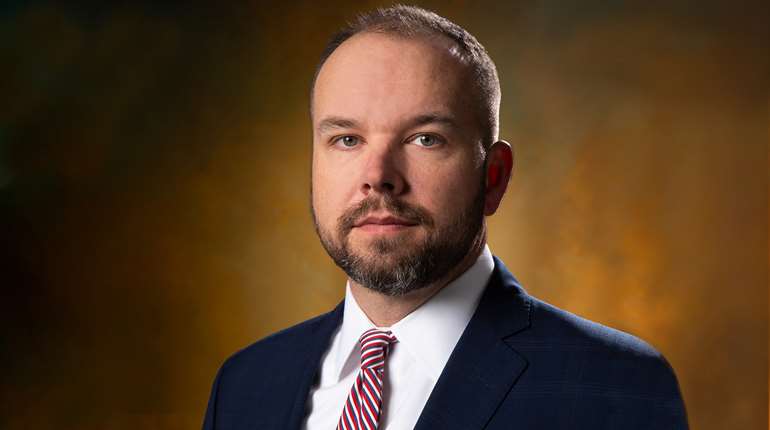
Governor Andrew Cuomo at Northwell Health Imaging at the Center for Advanced Medicine.
Northwell Health has reportedly refused to disclose what the questions will be, although the responses will be “scored and embedded into the patient’s electronic health record” and used to “establish next steps for care.”
It’s not clear how this squares with the Affordable Care Act, 42 U.S.C.A. § 300gg-17(c), and the prohibition against a health care provider, a wellness and prevention plan manager, or a health, wellness or prevention services organization requiring disclosure of or collecting information on lawful ownership of firearms or firearms stored or kept in a residence, but the program is being funded by a $1.4 million grant from the National Institutes of Health.
Residents of the Empire State need to understand how “We Ask Everyone” dovetails with an existing law on mandatory mental- health reporting and disarming gun owners.
Under 2013’s SAFE Act, the drastic gun-control legislation passed by the New York State Legislature and signed into law by Governor Andrew Cuomo, an amendment to the state Mental Hygiene Law created a mandatory reporting requirement for mental-health professionals. Physicians, psychologists, registered nurses and licensed clinical social workers providing treatment services are now required to report any client who, in the exercise of reasonable professional judgment, the treatment provider considers “likely to engage in conduct that would result in serious harm to self or others.” If a local government official agrees with the report, the report must be shared with the New York State Division of Criminal Justice Services to disarm persons in possession of a state firearms license and guns.
The law confines the use of the report exclusively to the question of the person’s ability to own or possess firearms; it is not used for treatment or to safeguard other persons who may be at risk.
Persons who have been reported do not have access to the report or to the name of the reporting treatment provider. There is no due process, hearing, adjudication of mental illness or determination of dangerousness, or a requirement for a court order. Once the division of criminal justice services is notified, if the person has a firearm license or has applied for one, the license is automatically revoked, and the person must surrender the license and all firearms, or the firearms will be confiscated by law enforcement. The whole scheme rests on an assertion by a treatment provider that cannot be challenged by the person affected.
Many in the mental-health care community resented being transformed into agents of the state and questioned the effectiveness of the law. The New York State Psychiatric Association, an association representing psychiatrists practicing in the state that “supports gun-control measures in general,” opposed the reporting requirement and its focus on guns rather than mental health: “Following discussions with OMH [New York State Office of Mental Health] staff, it has become clear that the intent of the SAFE Act reporting requirement is solely to limit access to legal firearms and not to protect individuals from imminent risk of harm to self or others.”
A New York Times article published the year after the requirement became law confirmed there were significant failures in design and implementation. First, the “threshold for reporting is so low” that “frontline mental health workers feel compelled to routinely report mentally ill patients brought to an emergency room.” The resulting volume of reports meant that local health officials were rubber-stamping reports, with no effective oversight or review before a report was passed on to the division of criminal justice services. There was also no way to verify independently whether the law was being applied appropriately and whether the individuals being reported did, in fact, pose a risk of serious harm.
By 2014, over 34,000 individuals had been reported under this SAFE Act provision; another source suggests that as of late 2015, about 2,000 New Yorkers a month were being added to the database. The Times article observed that “the overwhelming majority of reports from mental health professionals are coming from hospitals … with an emergency room and inpatient psychiatric services.”
Under the Northwell project, regardless of the reason a person presents themselves at the emergency room—food poisoning, car accident or COVID-19—the patient will face questioning about guns. In a public-health context where firearms are viewed as unhealthy and gun ownership as pathological, it isn’t terribly hard to imagine how this information may be used to support a claim that a gun owner “is likely to engage in conduct that would result in serious harm to self or others.”
While New York’s website advises that the SAFE Act “should not dissuade any individual from seeking mental health services they need,” the reality is that it forces gun owners to choose between getting such treatment and retaining their gun rights, and makes everyone less safe. “We Ask Everyone” perpetuates the same dysfunctional dynamic.