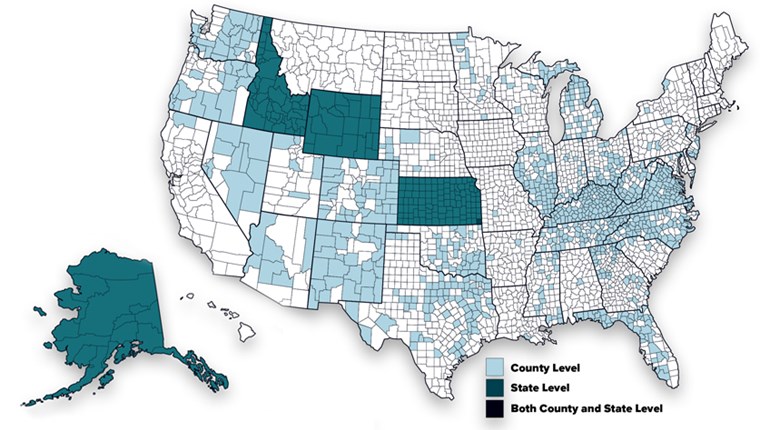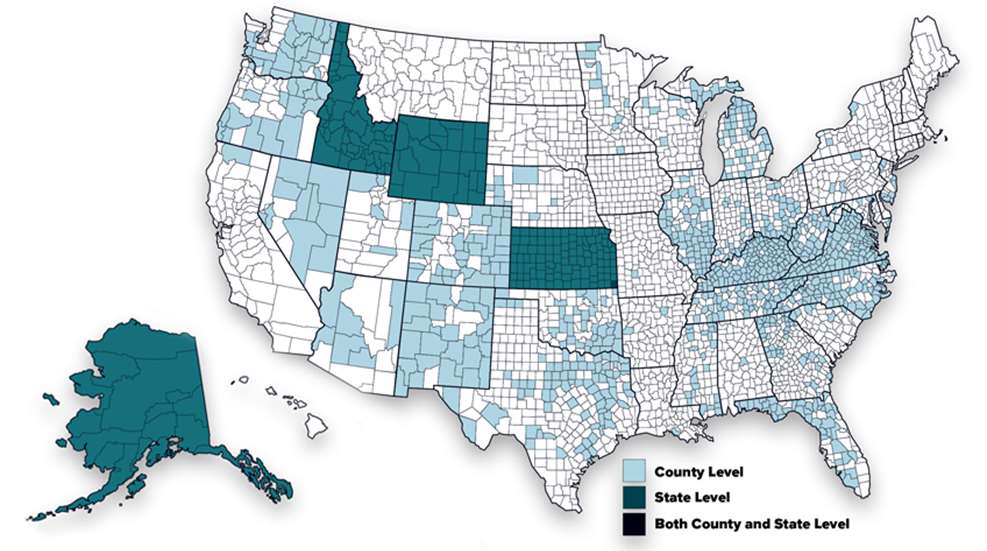
This map shows the states and counties that had passed some type of Second Amendment sanctuary law or resolution as of March 21, 2020. (Source: Wikipedia)
So, though these resolutions are mostly symbolic, they certainly show that the energy in this year’s presidential election is clearly behind our Second Amendment rights and therefore against the, at press time, Democrat’s presumptive nominee, Joe Biden.
This map only includes the counties and states that recently declared themselves to be Second Amendment “sanctuaries.” If we broadened the map to include other Second Amendment sanctuary-type declarations, such as those expressed in New York and Colorado over the last decade, it would fill in even more of America. Even as is, many areas of politically “blue” or “purple” states have declared that they won’t enforce laws that overly restrict or take away our right to keep and bear arms.
Basically, these localities officially stated they will support the constitutional rights of gun owners by not recognizing new gun-control laws they believe violate Second Amendment rights. Additionally, many locally elected law-enforcement officials have stated that they will not enforce new gun-control laws.
In Virginia, the sanctuary movement gained enormous momentum following the 2019 election, when Bloomberg-backed, anti-Second Amendment politicians took control of the state’s House of Delegates and Senate. (The governor’s office, lieutenant governor’s office and attorney general’s office were already held by officials who are not friendly to citizen’s Second Amendment rights.) With their power consolidated, these politicians immediately tried to roll out sweeping new gun-control laws, including an “assault weapons” ban (which also included a magazine-capacity limit and a ban on suppressors), “universal” background check laws, red-flag laws, drastically reduced reciprocity for concealed-carry permits and handgun purchases limited to one per month. In response, crowds began showing up at what are normally sleepy local legislative sessions to remind local lawmakers of their rights as law-abiding gun owners and to encourage county, town or city officials to declare their support for our constitutional rights.
It worked. As of press time, 91 of 95 Virginia counties, plus 56 towns and cities, had declared themselves to be Second Amendment sanctuaries (or made a similar declaration with slightly different terminology).
Rather than heeding the call for restraint, however, Virginia’s lawmakers threatened the funding of the Second Amendment sanctuary localities, and one federal lawmaker even suggested they might call in the National Guard for enforcement. In one particularly petty act of revenge, these politicians killed a bill that would have granted what was essentially a cost-of-living pay raise to sheriffs and deputies across the state. (Senate Majority Leader Dick Saslaw stated that this action was done because most of the sheriffs oppose new gun-control laws.) Eventually, though, they backed away from their most-restrictive gun-control legislation, the sweeping gun ban that sought to ban some of the most popular semi-automatic firearms in the Commonwealth, like the AR-15.
However, as you can see on this map, the Second Amendment sanctuary movement certainly wasn’t limited to Virginia—39 other states have seen sanctuary or similar declarations in at least one locality. (A few places had laws or resolutions in place before the sanctuary movement began.) And, as Democrats continue to make gun control a central part of their platform nationally, the movement may continue to grow.
Still, if Second Amendment sanctuary status is not legally binding, what’s the appeal? Simply put: It sends a strong message to lawmakers that the right to keep and bear arms still matters to most Americans.
“We want our citizens to know we read the law and we believe in the Constitution,” Sheriff Steve Reams of Weld County, Colo., told America’s 1st Freedom. “Sometimes you have to have your local officials push back against the state officials.”
Every time the far left pushes their anti-gun agenda, mainstream Americans push back; for example, the passage of the New York SAFE Act in 2013 resulted in a movement very much like the Second Amendment sanctuary one—83% of New York counties passed resolutions opposing the SAFE Act.
Meanwhile, every time anti-gun politicians are or seem likely to be elected, there is a huge spike in gun sales and concealed-carry-permit applications—this, of course, is Americans “voting” with their dollars.
We’ve also seen this impact elections, such as the flipping of Congress in 1994 after the passage of the national “assault weapons” ban. As for presidential races, after Al Gore lost his bid to be president, arguably because of his anti-gun platform in 2000, many politicians who oppose our right to keep and bear arms did keep quiet on the issue. But it didn’t last long. During Barack Obama’s presidency and Hillary Clinton’s subsequent run for office, Democrats kept pushing until, nationally, they completely abandoned the gun owners in their party.
This movement is clearly a sign that Joe Biden’s desire, according to his campaign website, to ban and confiscate Americans millions of semi-automatic rifles, to restrict “the number of firearms an individual may purchase per month to one,” to set up “gun-licensing programs” and much more will implore gun owners to vote against Biden.