Seventy-five years have passed since George Orwell observed that, when challenged by uncomfortable facts, political advocates often descend into “euphemism, question-begging and sheer cloudy vagueness.” This is still the best description of the rhetorical approach being taken by the American gun-control movement.
Over the last four decades, as support for increasing restrictions has steadily eroded, America’s gun-control activists have attempted to redefine or obfuscate almost every element within the debate. Disfavored guns have been rebranded “assault weapons”—not because such a designation means anything useful or concrete, but because, as the anti-gun activist Josh Sugarmann put it, the term takes advantage of “the public’s confusion over fully automatic machine guns versus semi-automatic assault weapons” and helps to “increase the chance of public support for restrictions on these weapons.”
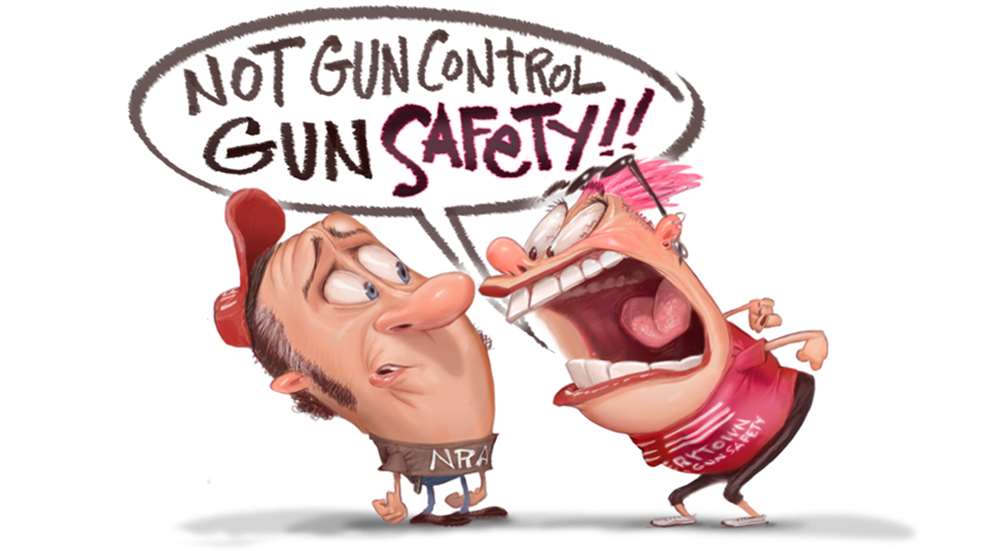
Over the same period, gun control has been relabeled “gun safety”; standard-issue magazines have been deemed “high-capacity” magazines; firearms owned by prohibited persons have become “illegal guns”; mass-murderers have been deemed “active shooters”; deliberately crafted laws have been transmuted into “loopholes”; weapons that happen to be black have been classified as “military style”; confiscation drives have been termed “mandatory buybacks”; and everything—yes, everything—that the opponents of the Second Amendment seek to do has been cast as mere “common sense.”
One can get a good idea of the game that is being played by comparing the changes in public-opinion polling to the evolving names of America’s largest gun-control groups. Back in 1974, when Gallup was finding that 41% of Americans favored a ban on handguns, the organization that is now called the Brady Campaign was called the National Council to Control Handguns. Also, the organization that is now called The Coalition to Stop Gun Violence was called the National Coalition to Ban Handguns. Over time, as polling changed, so did the names of the groups that were calling for it. In 1980, the National Council to Control Handguns was renamed Handgun Control Inc. By 2001, it had become the Brady Campaign to Prevent Gun Violence. Today, with support for a ban on handguns at 25%—about the same number as believe that we should “defund the police”—it is simply known as Brady: United Against Gun Violence.
Thanks to a relentless pressure campaign, these euphemisms have become standard in the media—and beyond. Back in 2013, as the Obama administration geared up for its big gun-control push, the Center for American Progress sent a memo to politicians and journalists alike explaining how they should talk about guns if they wanted to “help.” The big piece of advice in the memo: To describe everything Obama sought to do as mere “gun-violence prevention.” Since then, the Center for American Progress and similar anti-gun groups have so rigorously policed the language in this area that the vast majority of reporters have come to follow their advice without thinking about it.
The results of this shift have not only been farcical, but have also greatly diminished our understanding of reality. It is now common for media outlets, such as CNN, to describe any criminal event as a “mass shooting,” irrespective of the circumstances or the setting. There’s been a gang fight in Chicago? “Mass shooting.” We have news of a family tragedy inside an apartment building? “Mass shooting.” So imprecise has the media become, in fact, that by the end of 2019 almost every American outlet was repeating the claim made by the activist Gun Violence Archive that there had been 418 mass shootings in the United States that year. The real number, per the definition used by the FBI, was six.
Off by a factor of 70. Orwellian mission accomplished, I suppose.