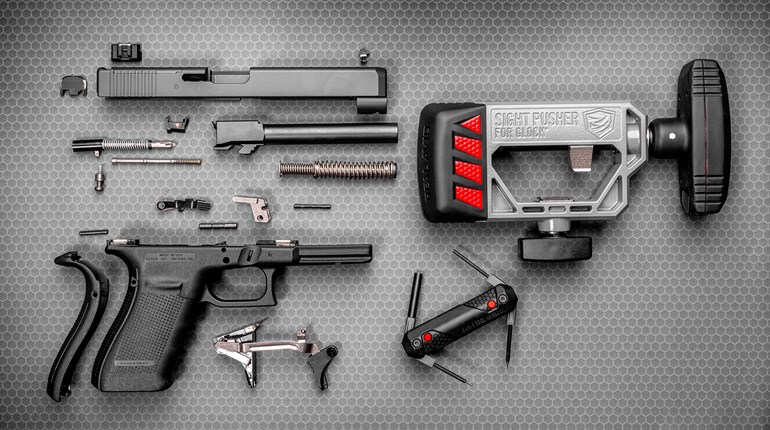
When California Gov. Gavin Newsom signed AB 1127 into law, making California the first state to outlaw the sale of Glock-style pistols and clones, it set off one of the clearest constitutional battles in recent memory.
The NRA and other groups quickly filed suit in Jaymes v. Bonta, challenging the ban as a categorical violation of constitutional rights. The lawsuit contends that the prohibition of Glock-style semi-automatic handguns contravenes U.S. Supreme Court precedent holding that the government may not ban “common” arms. Indeed, semi-automatic pistols are among America’s most-popular firearms, with tens of millions in private circulation. The plaintiffs argue that banning such a ubiquitous firearm is nothing less than an affront to the Second Amendment.
Under the doctrine emerging from District of Columbia v. Heller and Bruen, firearms restrictions must align with the historic tradition of regulation and cannot target arms that are in widely owned and used. The plaintiffs maintain the California ban fails both tests: It is overbroad; it singles out a class of guns without an historical analog; and it prohibits a popular class of arms used for lawful purposes.
Moreover, gun-rights groups point out that the law’s logic is internally contradictory. AB 1127 is officially justified as a response to devices that can convert semi-automatics to fully automatic fire, which is already illegal without proper permits. By sweeping the entire class of Glock-pattern guns into prohibition the state is declaring guilt by design. Effective enforcement in California is set to begin in July 2026; dealers who sell or offer those handguns (outside of law enforcement) will face fines of up to $5,000 and could have their licenses revoked.
This then is not just some new and onerous regulation; it is a full-frontal assault on the right to keep and bear arms.
California already has one of the most restrictive gun-regulation regimes in the nation, and many existing restrictions have been struck or weakened by recent court rulings thanks to Bruen.
This legal fight comes at a critical time. If the courts decline to strike the California ban, the decision could embolden anti-Second Amendment legislators in other states to push bans on highly popular firearms.
It is worth remembering that amidst the legal and political maelstrom over AB 1127, California Governor Gavin Newsom (D) actually attempted to recast himself as a moderate on gun rights. Last July, during an appearance on podcaster Shawn Ryan’s show, Newsom was ceremonially gifted a SIG Sauer P365 X-Macro. While he looked at the gift, Newsom declared he is “not anti-gun at all.” But it did not take long for the theatrics to unravel.
Newsom never really accepted the gun. He declined it off camera, citing California’s complex regulatory burdens. He left the gun behind in Tennessee, and his staff later conceded that he had to hire legal counsel to ensure compliance with state law.
Newsom’s attempt to frame the moment as evidence of secret Second Amendment sympathies quickly became absurd. His public claim of being “deeply mindful and respectful of the Second Amendment” is undercut by his legislative record: He has signed numerous gun-control bills, pushed for a constitutional amendment to gut the Second Amendment and defended strict state-level bans.
In short, Newsom attempted to shift the optics, but his actions exposed glaring contradictions. Meanwhile, his state has become a proving ground for how aggressively states can regulate arms in the post-Bruen era.
California’s new ban on Glock-style handguns comes as lower courts have disagreed on the limits of the Second Amendment. This California law, which targets one of the most common handguns in America, is widely seen as a deliberate bid to trigger a federal court showdown. Recent rulings have already struck down several of California’s firearm restrictions, including bans on high-capacity magazines and mandates for specific handgun safety features. Newsom’s push for a 28th Amendment to take away this individual right has gained no traction, but it underscores how this battle extends beyond Sacramento.
For gun rights advocates, Jaymes v. Bonta is more than a typical legal challenge; it’s a test case that could define the boundaries of permissible gun regulation for decades. A victory for the plaintiffs could restore access to Glock-style semi-automatics in California; a loss could embolden regulators nationwide to target other popular firearms. What began as a legislative fight in Sacramento is now poised to shape the future of American gun rights in the nation’s courts.