It’s gratifying to see how conscientious the huge majority of carry permit holders are, and how seriously they take the responsibilities that come with the Carry Life. Despite what the “mainstream” media would have you believe, these folks are not just numerous—now somewhere north of 14 million nationwide—but also astonishingly law-abiding. And by astonishing, we do mean astonishing—six to 10 times more so than law enforcement, who are in turn 30 times more law-abiding than the general public. Wow!
Every now and again, however, we happen upon a preventable sort of mishap that is actually a safety hazard, and this one disproportionately affects carry practitioners—holster “maintenance.”
Go ahead, say it: “Huh?! How can something with no moving parts need maintenance?”
As we hope to demonstrate, you might be surprised.
Right off the bat, materials matter greatly to our considerations. Especially for folks who carry as an adjunct to competitive shooting or vice versa, thermoplastic acrylic polyvinyl chloride is incredibly common as a base holster material these days. And yes, we looked that up—Kydex is what we’re talking about here. It’s a darn good choice, too: light, incredibly strong and—duh—highly formable. It also has very different care considerations than, say, leather. Again, duh, though it brings us neatly to the point: It requires different maintenance, but not none.Leather is easier to care for in one sense. Since most of us have other things made of the material, we’re inclined to know it needs some attention over time.
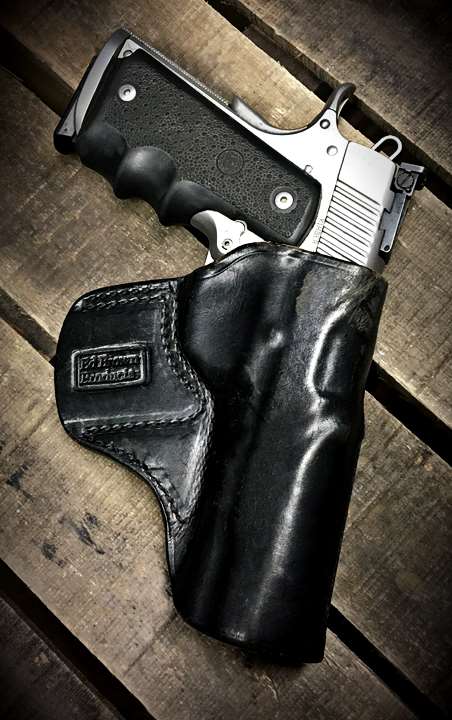
Leather is easier to care for in one sense. Since most of us have other things made of the material, we’re inclined to know it needs some attention over time. Good news, though, applies particularly to gun leather. Designed as it is for relatively hard use, the better examples employ superb base materials and finishes that are up to that rugged treatment. So that’s tip #1: Start with those “better examples.” They’ll cost more, but service life can be astonishing. We have Bianchis/Safariland and DeSantis examples approaching 25 years old, and they remain eminently useful.
We got them there with some simple expedients. Dust, for instance, is a killer on leather over the long haul (learned this on baseball kit as a youngster), so we wipe it down with a clean, dry cotton cloth after any exposure. The mechanics of the attack are straightforward, if subtle: The smaller the particulate, the more easily it gets into the “pores” of your leather. The net effect is one of drying to the point where the leather grows increasingly brittle and crack-prone. Replacing this naturally embedded moisture is harder than preserving it. Point?
Attempts to restore the natural suppleness with “product” has another high-consequence downside: Once this gunk is on the leather, just try and keep it off your clothes. If you carry in dry-clean-only items and use a leather holster, you’re toast. With luck, you’ll notice it before you ruin multiple articles, but that’s the best you can hope for.
Water is another hazard for leather, though a less likely one in the sense of being both more obvious when it does happen, and otherwise preventable. As it happens, a lot of help is built in here—tanning/finishing processes “fix” the leather to keep it from decomposing, but also lend substantial water-resistance.
A thorough soaking is another matter altogether, but our DeSantis survived a complete, relatively protracted one. The key if this happens is to let the leather dry slowly (no ovens or hair dryers!), and to support/restore the original shape as much as you can during the air-out process. We did this with a blue gun: No chance of rusting in the holster, yet supporting the shape to near-perfection. (Wadded tissue paper or newsprint can fill in here too.)
… be careful about leaving your firearm in a leather holster over a long period.The process took several days even in dry mountain air, and we removed the blue gun periodically to expose and dry the interior surfaces. But the net result was as near 100-percent as we could see—even 20 years later.
Depending on the color of your leather, the urge to wash it may be irresistible. Some of it is that beautiful. There are several ways to go about this, and we haven’t tried anywhere near all of them. But a couple of aspects in the formulas are consistent: No “saddle soap” (too likely alkali—use a glycerin soap instead), a soft brush, and limited wetting. Take a look here for very detailed steps.
Keep in mind that washing will almost certainly darken light-colored leather. If you do wash your holster, a conditioner is probably advisable. But again, be very sparing or your clothes will suffer, perhaps irreparably.
We’d be remiss not to get back to the firearm/holster interaction as we wind up. First is a point widely known at one time, but not so much now: Be careful about leaving your firearm in a leather holster over a long period. We’ve seen some go quite literally decades with no ill-effect, but others begin to rust in mere days. This is a function of many inter-related causes, but a simple expedient can seriously delay (if not altogether halt) such problems—a small amount of sprayed or sparingly wiped-on silicone. This has many benefits: It will slick up your draw for openers, but also substantially protect both the leather and firearm from water damage through its moisture-displacing properties. (Remember that the moisture displacement characteristic—the propensity to spread a thin film over the entire surface it touches—is bad news for cartridge priming). Key here is that “sparing” part.
While “holster wear” is inevitable on most finishes if you go long enough, the silicone trick will slow it down.There’s a tendency to think that leather is “so yesterday,” but we could hardly agree less.
A similar caution attends your own perspiration: Keep it off gun leather and guns whenever you can. For your leather, a physical barrier is sufficient (a tee-shirt, and trouser/pants waistband, for instance). For the firearm, we’ve had good luck with Tuf-Glide over the years in the cloth applicator form, and the Marine version is formulated with salt resistance in mind. Even relatively aggressive wiping to remove excess to protect your clothing seems to leave the dry film well intact.
There’s a tendency to think that leather is “so yesterday,” but we could hardly agree less. It still has many pluses, including an obvious favorite: People are essentially “leather” too, and when those unavoidable rubs, rotations and collisions occur in the Carry Life, nothing is as forgiving on you or your cover garments as a quality leather holster.
This is also where we close the loop on our posited safety concern: With leather, it’s simply less likely. A good one wears slowly, and occasional inspection will reveal anything to the point of weakening (loss of retention, or snagging the front sight for instance)—in the leather, stitching, or other fitments—quite readily. While the first is inevitable in the long run, it can be many years delayed with a little care. The manufacturer will likely attend to the last two under warranty.
As we’ll see next time, Kydex, despite considerable benefits, may not prove so, shall we say, “dignified” in its decline, and the necessary attentions are quite different.
Until then, Carry on.