Much of the mainstream media loves to report that what the FBI classifies as “active-shooter incidents” are seldom stopped by armed citizens. To do so, they quote the FBI’s numbers to argue that only about 4% of such attacks were stopped by armed citizens during the 2014 to 2023 time period.
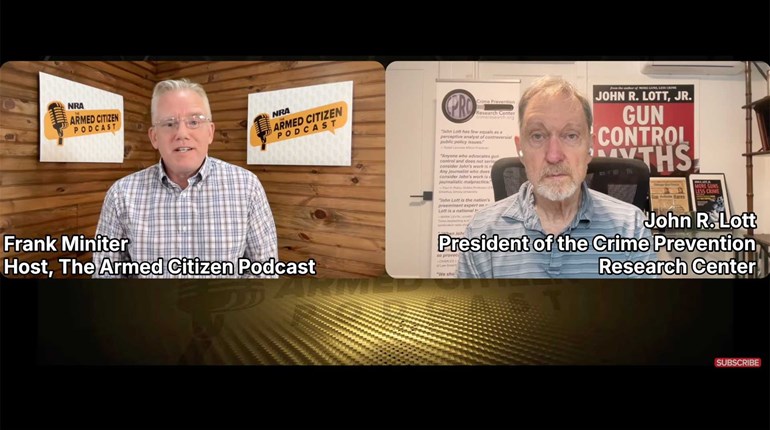
If that number were true, it would still be quite notable that 4% (14 incidents) were stopped by armed citizens; however, according to new research by John Lott, president of the Crime Prevention Research Center (CPRC), during that same time period the FBI undercounted the number of instances in which armed citizens thwarted such attacks by an order of more than 10.
For some background, the FBI defines active-shooter incidents as those in which an individual actively kills or attempts to kill people in a populated, public area. Unlike some other databases, it does not include those it deems related to other criminal activity, such as a robbery or fighting over drug turf.
The FBI reported that armed citizens stopped 14 of the 350 active shooter incidents it identified for the period 2014 to 2023. But the new analysis by CPRC identified a total of 515 active shooter incidents, with armed citizens stopping 180 of them.
Based on that data, instead of 4% of active-shooter incidents being stopped by armed citizens, the real figure is 35%. And, even more astounding, if you exclude active-shooter incidents occurring in gun-free zones from the analysis, more than half of active-shooter incidents (51.5%) were stopped by armed citizens, according to Lott.
Additionally, there were another 28 cases that CPRC didn’t include in its analysis in which armed civilians stopped armed attacks, but the suspect didn’t fire a gun. Those cases are excluded from the calculations, though it could be argued that a civilian also stopped what likely could have been an active-shooter event.
“Two factors explain this discrepancy—one, misclassified shootings; and two, overlooked incidents,” the CPRC report stated. “Regarding the former, the CPRC determined that the FBI reports had misclassified five shootings: In two incidents, the Bureau notes in its detailed write-up that citizens possessing valid firearms permits confronted the shooters and caused them to flee the scene. However, the FBI did not list these cases as being stopped by armed citizens because police later apprehended the attackers. In two other incidents, the FBI misidentified armed civilians as armed security personnel. Finally, the FBI failed to mention citizen engagement in one incident.”
While the media largely tend to overlook armed citizens stopping active-shooting incidents, CPRC relies on media reports to get the actual numbers, so the numbers are likely higher still. But, since most mainstream-media outlets have a decidedly anti-gun slant, they choose to use the underreported FBI numbers to pretend armed citizens aren’t effective.
In fact, as Lott pointed out in the report, when Elisjsha Dicken drew his concealed handgun and fatally shot an attacker at a mall in Greenwood, Ind., in 2022, it was impossible for media to ignore the heroic effort; nevertheless, many media outlets managed to report it in a negative way based on the FBI figures.
As the Associated Press put it at the time: “Rare in US for an active shooter to be stopped by a bystander.” The Washington Post also managed to make the story more about the FBI statistics than the actual incident by headlining its story: “Rampage in Indiana a rare instance of armed civilian ending mass shooting.”
In the end, it’s unlikely the media will take note of the CPRC study since the findings don’t fit their narrative that guns are bad and armed citizens seldom stop active murderers. But that shouldn’t stop gun owners from spreading the word far and wide to anyone who will listen.
“No one needs to take our word for these errors, as we provide each of the missing cases as well as links to underlying news stories so that people can check whether they meet the definition of active shootings,” Lott said.