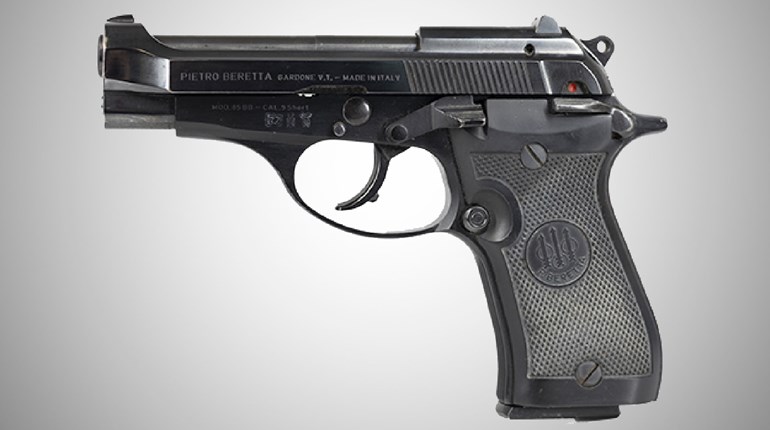
The problem with America, the gun-banners say, is that our civilian rates of firearm ownership are too high—in the much-quoted words of Liam Neeson, we have “too many f---ing guns.” If we could somehow confiscate them all, and make all continued supply dry up, then everything would be just fine. It’s a conclusion that resounds so unceasingly in the anti-gunner echo chamber that many in other nations have taken it as gospel truth. We’re guessing that not many Tunisians feel the same way.
Tunisia has restrictive gun laws, coupled with some of the lowest private firearm ownership rates in the world: 0.1 guns per 100 residents, as compared to 90 in the United States. But the scarcity of guns doesn’t seem to be counteracting their deadly use. In March, a group of men disguised as military officers entered the Bardo Museum in the capital city of Tunis, drawing firearms and killing 22 people. In June, a single attacker opened fire on beachgoers at a tourist resort outside the city of Sousse, killing 39.
Targeting tourist hotspots is a well-established strategy among radical Islamist militants: This practice was pioneered in Egypt, where notorious massacres occurred at spots such as Luxor and Sharm el-Sheikh. Neither of these attacks should have surprised security forces in terms of their methodology. The Sousse beach was even the site of a previous terror mission in October 2013, when a suicide bomber exploded his payload prematurely and guards stopped another, simultaneous attack. So the fundamental problem was not one of surprise, but of perpetual unpreparedness.No matter how few firearms we allow to legally circulate—no matter how much our culture wrongly shifts toward viewing gun ownership as taboo—evil people in the world will decide to prey on those around them.
Of course, Tunisia is currently steeped in unrest as part of the aftermath of the 2011 Arab Spring. At least there’s a single government in place, which is more than can be said for Libya at the moment. How does the situation differ if we turn our gaze to Europe, where this level of political chaos does not hold sway?
Austria has far higher rates of private gun ownership—closer to America than to Tunisia—and far less restrictive laws regulating them. But Alen Rizvanović evidently didn’t feel the need to acquire a gun. The Bosnian immigrant one day took it in his head to kill a large number of people: Some have argued that he was motivated by Islamist ideology, while police treated him as psychologically disturbed. On the same day as the Sousse massacre, Rizvanović drove his van at top speeds through the busy streets of Graz, mowing down pedestrians. At one point he even took a break to jump out of his car and stab an elderly couple before eventually turning himself in to police.
No matter how few firearms we allow to legally circulate—no matter how much our culture wrongly shifts toward viewing gun ownership as taboo—evil people in the world will decide to prey on those around them. These evildoers will use the tools on hand. The perpetrators of the 2014 terrorist attack in Kunming, China, carved a trail of death using only knives. There is nothing that we can do to eliminate the murderous impulse from human nature, as much as we may try to legislate it away.
It is also impossible to transport ourselves into a world where guns do not exist. They will find their way into the wrong hands at times. In these instances, it is in our best interest to make sure that evil does not dominate the playing field. The murder spree of Anders Breivik in Norway (77 killed) is so shocking, so incomprehensible, that it merits its own article. But suffice it to say here that this is the most destructive example we have seen—so far—of an armed madman having his way with an unarmed crowd.
When it comes to choosing an instrument of evil, be it guns, knives or automobiles, crazed murderers don’t tend to be picky—and they have channels of acquisition unavailable to law-abiding citizens. The push to stop mass killings by targeting the availability of guns doesn’t solve the underlying problem. All it does is remove that great equalizer that allows good people to fight back.