We’re loath to say “never.” A previous life had us deep in statistics of many kinds over a comparatively long period, and that alone made us skeptical of absolute prohibitions, to say nothing of the more general lesson life teaches: “It’ll never (leak, go flat, break down, misfire, etc.).” Such certainty often seems an uncommonly excellent way to invite precisely that calamity.
But when it comes to reholstering your firearm, we can’t find a single record or beneficial outcome tied to speed. Nothing in Guinness. No “special recognition” at any competition, indeed no acknowledgement anywhere that there is even a slight demonstrable benefit.
The other shoe drops, in fact, in quite another direction: Rapid reholstering is an invitation to trouble, up to and including folks getting shot. Yes, you read that right: shot—and we have certain, personal knowledge of two cases. Now that we have your attention …
A couple of common components go into both good and bad outcomes. It’ll be no mystery, we hope, why they need to be in your Exercise repertoire, or out of it.
And for many, there’s a lot more to it than just slowing down.
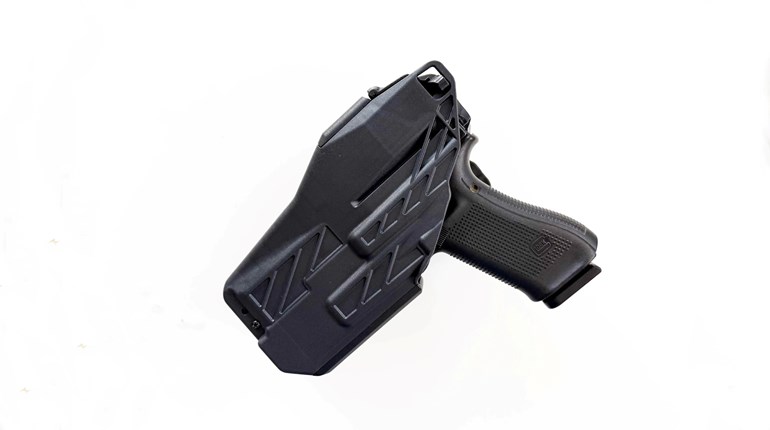
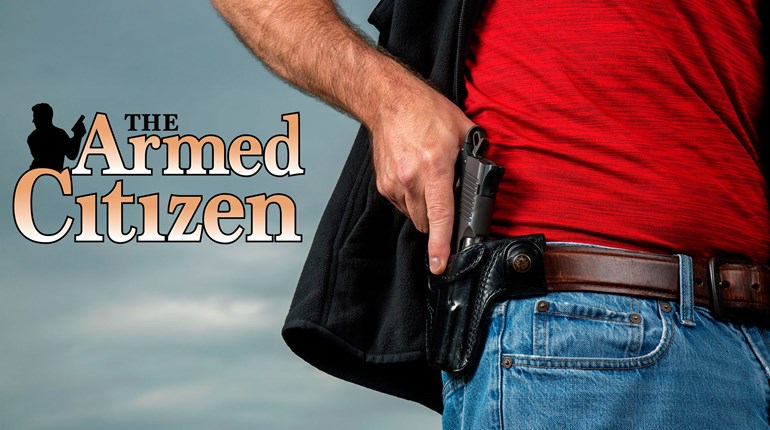
For openers, get your finger off the trigger (and outside the trigger guard) for all holster actions whether the firearm is moving in or out. This was part of the problem in both the cases of which we know: The reholstering motion was too fast for the trigger finger to be outside of the trigger guard completely when something else went wrong. A good/safe holster, by the way, covers the trigger and does not allow access to the trigger guard either prematurely or belatedly.
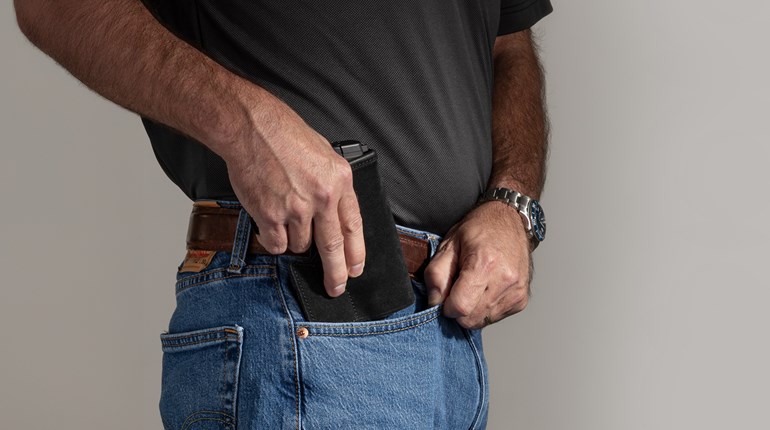
If you need two hands to reholster, this is unlikely to be a single-threaded problem. If you have to clear a garment to “reveal” the holster mouth, clear from the center of your body on an outside-the-waistband holster, or move the weak hand behind the gun for inside-the-waistband (IWB), don’t reach or hold so that you sweep your own weak hand.
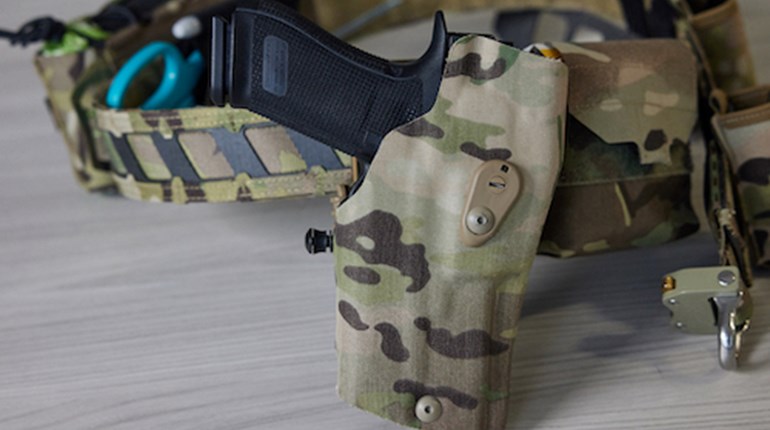
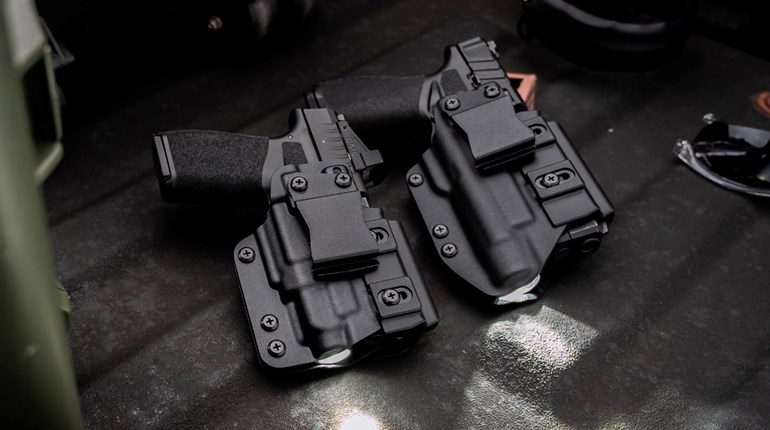
“Generic” style holsters can exaggerate both difficulties. Their attachments are usually compromises, and sometimes seriously so, and in the act of stabilizing the holster to receive the pistol, the weak hand routinely gets swept by a loaded gun. That’s a really bad idea if you’ve not yet mastered getting the trigger finger up alongside the frame when you come off the target, and especially so when the muzzle comes back toward the body. (Note, too, that extending the trigger finger along the frame outside the trigger guard gives explicit and implicit knowledge of muzzle direction, and the pointing instinct can be used as a reminder/cue/alert to improper direction. If you feel like you’re pointing at a body part, so is your muzzle.)
A really dangerous adjunct here is actually guiding the muzzle into the holster with the weak-hand fingers. The fix is in two parts. First, keep that muzzle parallel to the ground as you come off the trigger and start the gun back toward the holster. “Back” is crucial here, not up or down with the elbow (the rear of the firearm reaches the torso just below armpit level when done correctly, and the muzzle remains level). Following through is the key in this motion, that is, bringing your elbow as far back is it will go.
Then, look down at your holster, and rotate the forearm down from the elbow until the muzzle reaches the holster mouth. Only after the muzzle is inside the top of the holster is it time to rotate the gun forward and complete the vertical descent into the holster. (This keeps the muzzle down range until the last possible moment, but also advantageously directed if a need to re-engage appears.)
Our method enters the holster from the rear, where clearance is often quite a bit more generous.We often see the firearm rotated from horizontal/downrange to vertical/toward the ground somewhat prematurely in our opinion. It isn’t wrong per se, but with one important caveat—it requires a higher elbow lift. If this elbow lift is accompanied by lifting the shoulder—canting the torso slightly down on the weak side, up on the strong side—all is usually well. The muzzle stays downward and may even be directed slightly away from the body. But if the shoulder lift does not occur, the tendency to gain the last quarter- to half-inch of elevation needed to clear the side of the holster often results in angling the muzzle inward toward the body. A bad habit at best; a disaster, possibly.
Our method enters the holster from the rear, where clearance is often quite a bit more generous. Done properly, there is no sweep of any body part.
It’s a little unclear to us where, exactly, the urge to speed in reholstering comes from. We sense it ourselves on occasion, even catch ourselves doing it. The natural urge to complete the process, perhaps, combined with, “I’m done shooting, what could go wrong now?”
We have two pals who know: One who gave himself three wounds with a single errant discharge (in the back of the calf, out the shin, into the top of the foot), and the other who received wounds in high on the thigh and out well further down the leg, ravaging all the way, and from the shooter next to him. Happily, both recovered.
The next time you’re doing draw practice, give a thought to what the other end needs to look like, too. Your own safety and that of those around you may well depend on it. Learn how to use that speed on the front end of your draw, and remember it’s always wasted on the back.
Frank Winn has been studying arms and their relationship to tyranny, meaningful liberty and personal security all his adult life. He has been a firearms safety/shooting instructor for more than 20 years, and earned state, regional and national titles in several competitive disciplines.