Not much in the way of preamble on our recently acquired Columbia River Knife and Tool Daktyl™ folder: This Tom Hitchcock-designed, “skeletonized” locking pocket knife won’t be our last.
OK, here’s a little preamble—we couldn’t truthfully claim to be knife experts of any appreciable stripe. The myriad steels, blade-working techniques, shapes, sharpening, etc. that we do know are indirect and perhaps predictable as spill-over from our firearms work. That said, we will own up to—ahem—pointed tastes. We use knives beyond food prep a good deal more than most folks probably do, so we have some experience. We’ve dulled, broken and cursed our fair share.
The other side of that coin is that we couldn’t claim to be immune to the gimmick factor either. One look, and you could reasonably opine that’s what drew us to the Daktyl.
We grant that it’s an odd looking number, but it struck a distant and sympathetic cord—a functional similarity to the Sheffield-made John Watts “Easi-Fold,” our first-ever knife. While the metal had shortcomings, and the design only light duty, it was nevertheless a gem in other respects. Slim and light, the rounded contours were easy on pockets linings, and the blade was long enough for slightly more than letter opening. A series of them saw us to adulthood, and a better discreet gentleman’s knife, especially in the days of routine suit wearing, was hard to find. Long out of production, sadly, we used to buy them a half-dozen at a time for ad hoc gifts. Many recipients recollected them fondly even decades later, hoping to replace a lost or unserviceable sample. Alas, there were successors, but none with quite the same je ne sais quoi—nor the one-handed opening and closing that played absolutely no lefty/righty favorites.
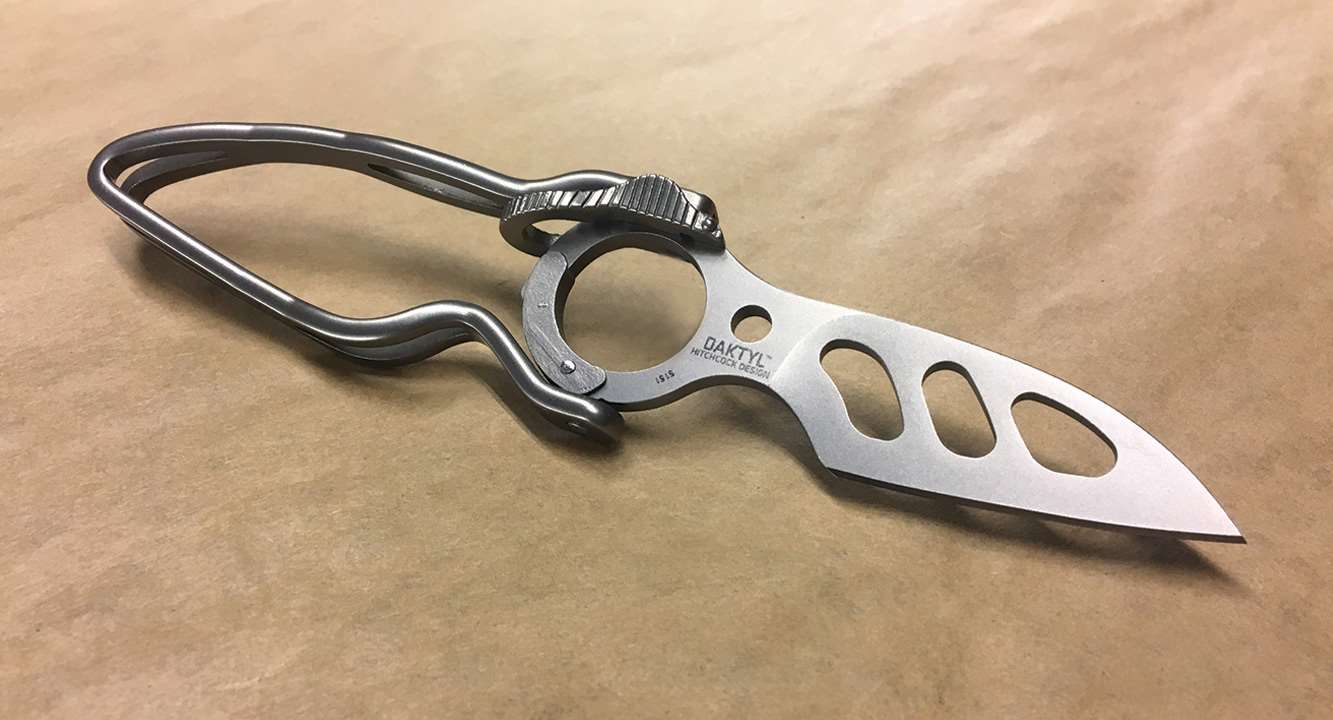
That’s just one way in which our new CRKT Daktyl beats up on many predecessors, including the Watts. In a couple of weeks of fiddling and carry, we’ve discovered multiple ways to smoothly, quickly get to the 2-inch Wharncliffe-shaped blade (3.05 inches total length). If 2 inches sounds shortish, check again—the choil has been contoured to accept a finger if this is how you like to grasp, but it also pushes the blade out where you need it, yet easily ducks length limits in some municipalities.
Another advance over other folders—we’d hesitate to call many “similar”—are the lock/unlock mechanics, of which there are actually two on the Daktyl’s one gimped lever. The first function is a traditional lock that won’t allow the blade to fold up when you have to bear down, but also prevents unsuspecting fingers from meeting unwelcome edges or points while still in your pocket. A further application of the same lever clears a discreet lug from its locking channel, and allows the blade to be opened for use or released for closure thereafter.
The second lever action does have an oddity that required a little noodle power to work out. As designed, CRKT suggests a thumb-opening method, and a little looseness in the hand makes this happen easily. But because of how the pivot works in relation to the geometry of the tang, there’s an index finger unlock method that is easier and faster, or so we think. Most folders, and especially those where one-handed deployment is either hastened or depends upon a wrist-flipping action, reward a solid if careful grip (position-wise), but this is not quite the case with the Hitchcock design.
This is so because what passes for the haft or handle of the Daktyl is also a spring. It applies pressure at the pivot point (and to the lug), and locks either open or closed. As a result, you won’t want to bear down in a clasping fashion with the middle finger and thumb as the index finger works the latch in our method. If you do, this essentially adds to the spring tension that opening or closing tries to overcome.
Instead, use the middle and ring fingers to press the skeleton into the base of the hand rather than to grip over the edge, and just keep the thumb out of the way. Once the blade starts to swing, the thumb can sneak underneath to finish pushing the blade open and locked. The index finger will slide naturally off the latch and into a full-tension grasp around the blade, or slip into the finger hole. The tendency not to overgrip is better with our off/weak hand, so we’re arguably faster/surer there. (That finger hole, by the way, is an almost-too-cleverly disguised lanyard loop and bottle opener.)
Two observations then emerge: Ambidextrous handling is 100 percent with the Daktyl in both opening and closing, and, if you’re struggling a little, suggests you may want to try switching sides. You may find the weaker hand setting a good example for the strong to follow. The second is an admitted subtlety, but one we like very much: Most of our one-handed-opening knives still need a telltale flipping motion to get either gravity, inertia or both to help. The Daktyl doesn’t; particularly if already in hand, small amplitude motions that don’t betray much will have it ready to go in fractions of a second.
A last observation—or gripe, really—that deserves to be headed off is the absence of a clip. We like clipped knives too, and their ready access at the top of the pocket can be a big deal in military, police and first-responder roles. But there are times when a clip is at least an advertisement, and others, just maybe, a provocation. Here the Daktyl harkens back to the Easi-Fold: Its smooth contours are discreet, yet its heft and shape are unmistakable to the reaching hand.
While “gimmick” may have gotten us here, the Daktyl shakes off that accusation in a hurry, and somewhere between your toothpick and kukri, everybody ought to have one.
Visit Columbia River Knife and Tool here. MSRP for the Daktyl is $59.95.
Frank Winn has been studying arms and their relationship to tyranny, meaningful liberty and personal security all his adult life. He has been a firearms safety/shooting instructor for more than 20 years, and earned state, regional and national titles in several competitive disciplines.