LaserMax Guide Rod Laser
There’s no question laser aiming technologies are a big deal in modern shooting. For both handguns and long arms, the technology shows where a projectile will strike, and who wouldn’t want such intelligence to supplement not only aiming, but perhaps a crucial shoot/no-shoot decision as well?
<<Cue clickety-clackety adding machine sound effect>>
Er, nobody. At least no one we know.
But there is a natural sequel to such a conclusion in the form of a question: Why don’t we see more of them? Killer “b’s” is our answer, and no, not the ones from South America, or Africa, but rather “batteries” and “bulk.”
Several centuries of smart shooters set the stage for such skepticism. Grumpy questions like, “Can I get those batteries in the aforementioned Africa or South America?” “Will they last more than 20 seconds?” “Will that gizmo work wet?” “Given the other uncertainties, why would I add even an ounce to my kit, or change my _______ (usually “holster” fills this blank, but there are other possibilities)?”
In order, “Yes, but just buy spares from LaserMax or dozens of other sources (they keep for years). Yes, we’ve shot ours a bunch with no issues, though LaserMax recommends need-it-or-not yearly replacement. Apparently, protractedly emphatically yes—see this.” The last question, we get to below.
Out of the box, it works because of accurate, concise instructions. Check that your pistol—in our case, a Glock 43—is unloaded. Remove the slide/barrel assembly and set it aside. Remove the disassembly lever and spring (nifty tool thoughtfully provided). Install LaserMax’s version of same—not just disassembly now, but also the ambidextrous switch for the laser. Go back to your slide/barrel, and insert the LaserMax combined laser, recoil spring and guide rod assembly. Reassemble your pistol.
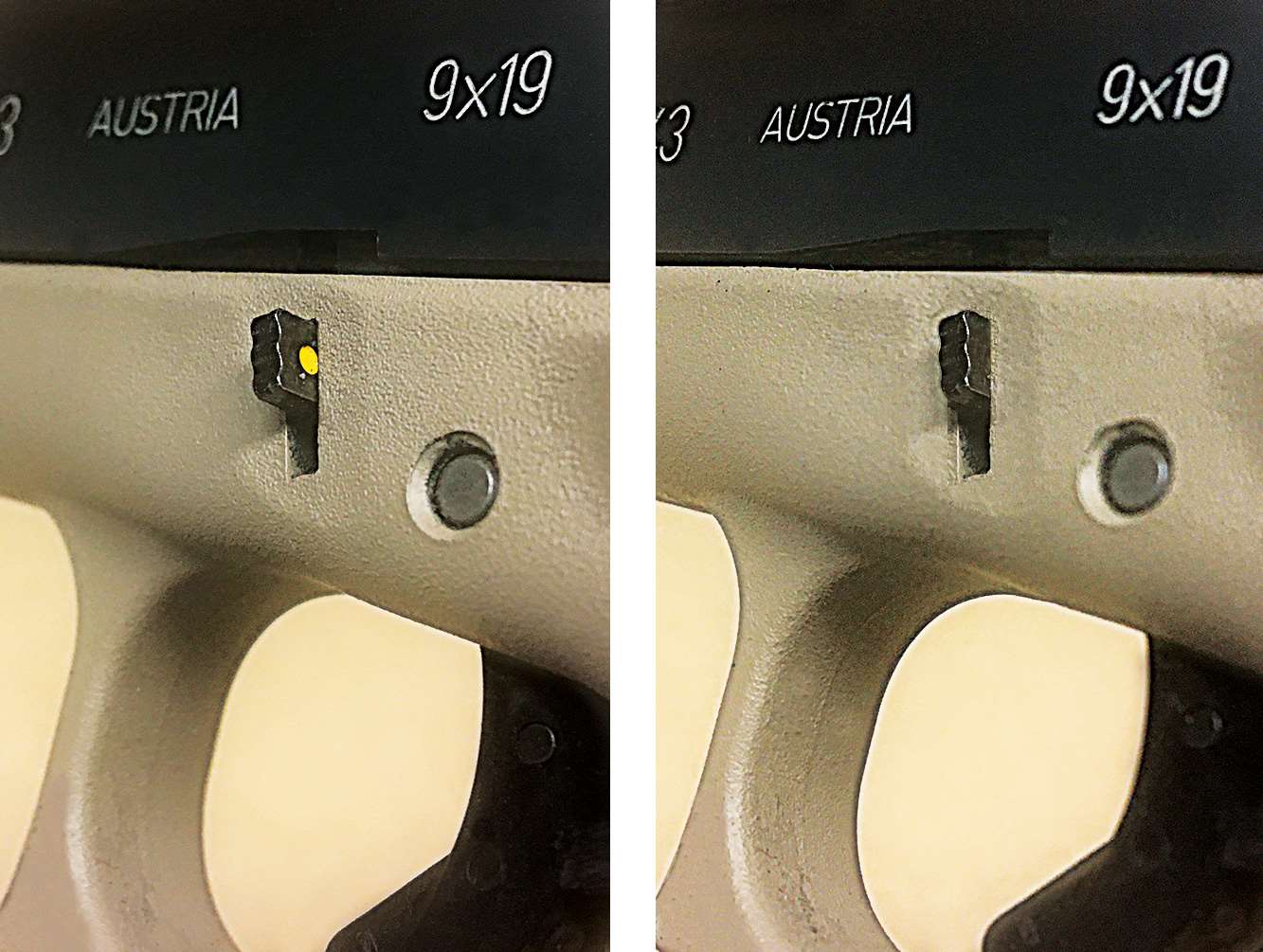
You’re lasered up. If that sounds like about 10 careful minutes, you’re overestimating by 40 or 50 percent, unless you really don’t know your pistol that well. If that’s the case, you will know it well by the time you’re done, and it still seems impossible that more than 10 minutes will be required. If you’ve experience with other lasers, you’ll notice we make no mention of “sighting in.” We aren’t sure we understand how it’s done, but the alignment of ours was essentially perfect with no adjustments, nor even provisions to make any—so good in fact, we think our standard sights need a tweak. Clever business, that, and more time saved.
Next you’ll want to try out the emitting modes—flashing or steady. Switching between the two is highly complex. NOT. Just switch on/off quickly three times, and you’ve toggled. We can’t find any reference that suggests a positive or negative effect on battery life with either option. Steady is the best for early practice it seems to us, but flashing is superior for picking up the dot once the eye and brain know what to look for on real-world textures/colors.
All that’s left is shooting tests, and we’d argue that this is really where laser use gets tricky—there are lots of what-ifs and conditions to consider. Probably the most critical is a Hollywood-inspired misconception: That the dancing red (or green) dot will make you shoot like Jason Bourne or Bob Lee Swagger.
No such luck: Bad mechanics are bad mechanics, and a laser may actually make these worse. Virtually no one holds a pistol (or rifle) utterly still. The resulting movement of the red/green designation on the target can be a huge distraction, and exaggerate aiming problems particularly as distances grow.
Next is a little more technical—shooting-wise—but still serious: The dot gets you looking at the target, not the sights. This isn’t wrong per se, it’s what the dot is there for, after all. But if it makes you abandon conventional sighting technique and rely exclusively on the projected cue, that’s a formula for difficulty down the line. While every indication is that the LaserMax is and will continue to be superbly reliable, there are other firearms that won’t have them, and situations where they can’t work (intensely lit targets, for instance, or on clothing of similar color to the laser).
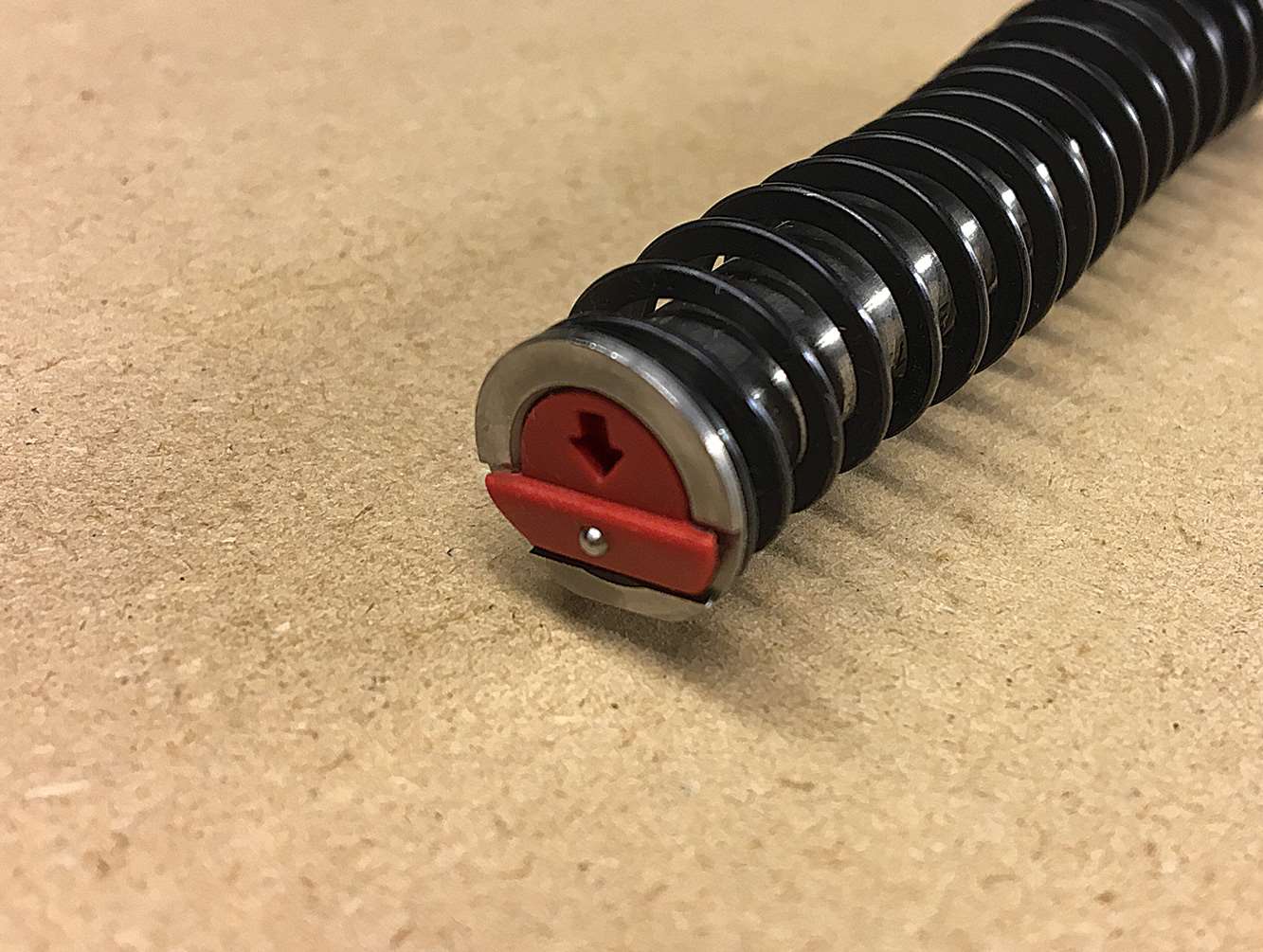
Our point is that laser use and aiming technique are not necessarily interchangeable. Keep developing those conventional skills; there is no downside. In fact, they’ll likely improve your laser-aided shooting; it’s the reverse side of the “bad mechanics” coin.
Instead, also develop what a top-quality laser gives you that conventional sights cannot—off-visual-axis precision. The best sights in the world only work when they can be aligned with one or both eyes. Particularly in rapid onset, defensive scenarios, this alignment may not be possible or desirable: Trying to align those ojos and the sights can have the effect of handing your wherewithal to a closer-than-expected aggressor. A LaserMax will let you aim and shoot with precision from a strong “retention” position—gun hand close to the body, and comparatively safe from fouling or the other unpredictable aspects of a grapple.
Keep in mind, this sort of shooting takes explicit practice, especially in terms of keeping energy “in the gun” so an autoloader will function/cycle. In other words, drawing to a stiff elbow, stiff wrist posture, and with the weak side hand out of the line of fire. Experiment with on/off switch technique too: We push to the right with the weak side thumb, but there is merit in other methods too. Note the LaserMax is 100 percent single-hand friendly, a decided benefit in “hand down” situations.
The LaserMax Guide Rod solution has another tandem benefit, which we alluded to above: Every holster we own works just fine, even our minimalist Zacchaeus. And we don’t have a scale sensitive enough to measure the difference in weight. Bravo.
We hammered Hollywood for a silly idea earlier, but in ending give credit where some may be due, especially since we’ve heard it echoed in the LE community. Laser-equipped defensive arms may keep you from having to shoot at all under some circumstances because they have acquired intimidation value, courtesy of films and TV. While some new owners are disappointed not to see an actual beam streaming from the newly fitted LaserMax, the closer you get to the emission axis, the more apparent the light becomes. But DON’T TEST THIS DIRECTLY; you can damage your vision. Downrange, however, it’s as obvious as can be.
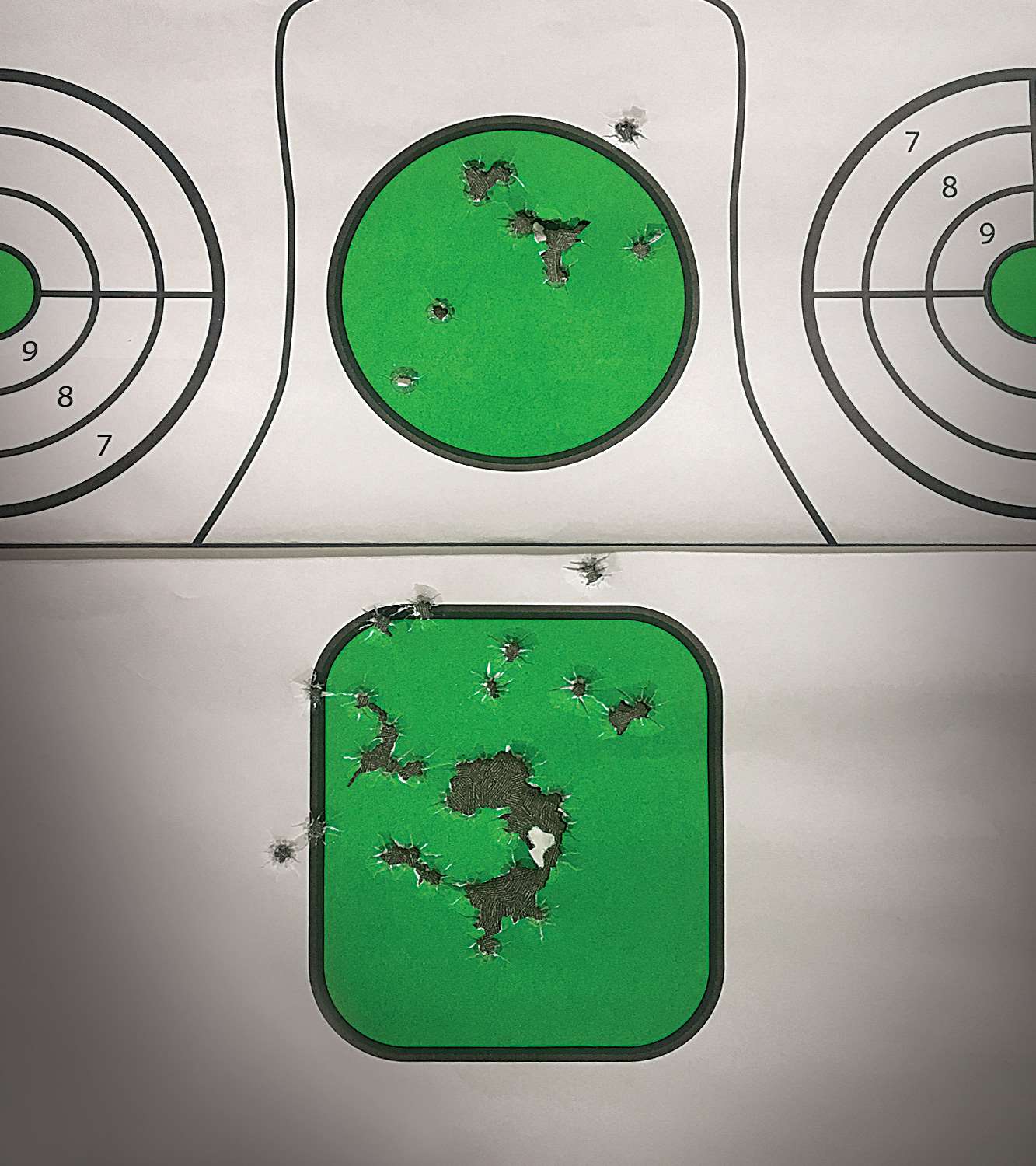
Between that ominous glow and an actual dot on themselves, it appears that the less mannerly among us sense that they transgress, and withdraw or submit with agreeable haste.
That alone may be reason enough to get a LaserMax, and learn to use it well.
Contact LaserMax at www.lasermax.com. MSRP of handgun guide rod lasers is $289-459.
Frank Winn has been studying arms and their relationship to tyranny, meaningful liberty and personal security all his adult life. He has also been a competitive shooter and firearms safety/shooting instructor for more than 20 years, though he won’t admit how many more than 20.