I would like to introduce you to the Rost Martin RM1C—and yes, anyone familiar with the Glock 19 will immediately see its lineage. I nevertheless became intrigued by this gun, as I believe you might, thanks to some of its special features—and thanks to its price tag.
Rost Martin may be a relatively new company, but its founders, Chris and Stefany Toomer, bring significant expertise. to the business. He was an officer in the U.S. Marine Corps, and she is the daughter of Springfield Armory CEO Dennis Reese—so having their own handgun line seems nearly fated. They have headquartered Rost Martin in Dallas, Texas, and proudly offer their American-made firearms with the motto, “The next generation of freedom.”
Many semi-automatics on the market are based on the Glock pattern, and for good reasons: It’s a reliable, accurate 9 mm that is large enough to shoot well yet small enough for many people to easily carry it concealed.
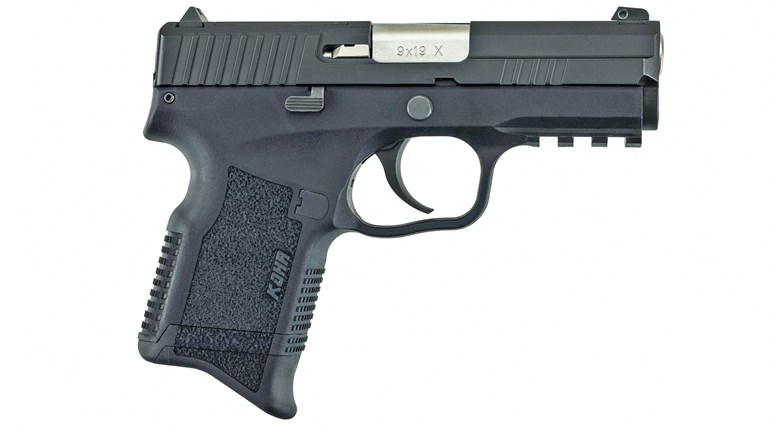
The RM1C features a hammer- forged 4-inch barrel, aggressive front and rear slide serrations and an ambidextrous magazine release (and slide lock) that is sure to please lefty shooters. The gun’s low bore axis, which was very comfortable for me, is a plus for controlling muzzle flip. A three-slot Picatinny rail on the lower front of the frame allows for easy light or laser mounting.
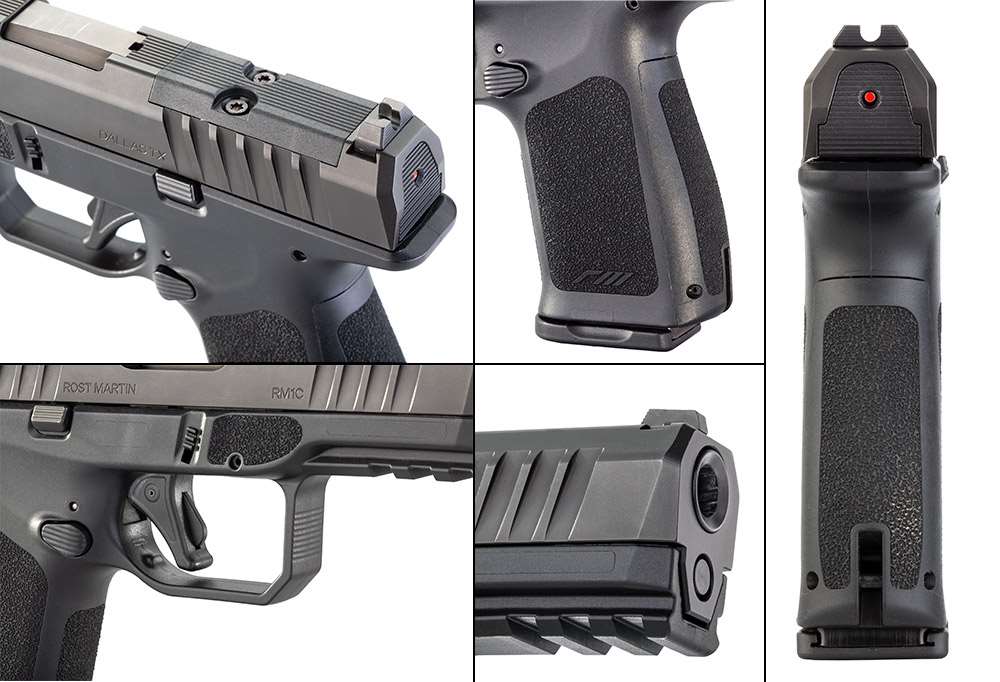
The tri-top slide is Tenifer-treated for durability and corrosion resistance, and the top of the slide has nonglare serrations to assist with getting a fast sight picture no matter the light. A red-circle cocking indicator adorns the slide’s rear.
The slide is also cut for an optic and comes with a metal RMR plate. The RM1C accepts all other popular optic footprints, too, and additional metal plates for the most popular red-dot sights are available; however, adding an optic takes out the option of the standard iron sights—they are not tall enough to co-witness.
The grip on the RM1C boasts what the company calls the signature “Rost Martin Responsive Grip Texturing,” or RGT. This proprietary graduated laser stippling is designed to respond to the amount of grip pressure exerted by the shooter to give a secure but comfortable grip on the gun when shooting. The texturing design includes “gas pedals,” or indexing points. The RM1C also has two additional backstraps for customization of its grip size.
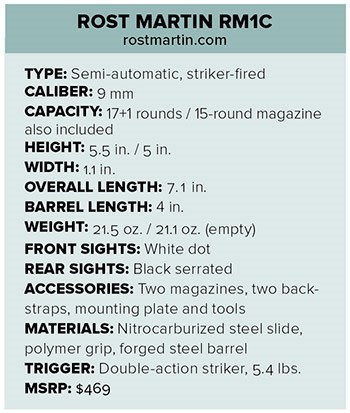 The Rost Martin comes with two magazines—a flush-fit 15-rounder and an extended magazine that holds 17 rounds. Each has witness holes to easily see how much ammo is left in them, and each has finger grooves to aid in stripping them out if needed.
The trigger is a flat-faced steel shoe with a drop-safety tab in the middle.
Spec-wise, the RM1C has an overall length of 7.1 inches and an overall weight of 21 ounces with the empty flush-fit magazine inserted. The frame is available in four different colors—black, flat dark earth, stone gray and green. All options retain the black, Tenifer-treated slide and all are very attractive.
Eastern Oklahoma offered me a clear range day with a temperature of 69 and a cool north breeze—perfect!
After shooting a few magazines of ammo through the gun offhand at a bullseye target and running the requisite rounds through the chronograph, I started to get a feel for the RM1C. The first thing I noticed was how much I liked the proprietary grip texturing. The second was how good the trigger was for a striker- fired gun. The company said it was a five-pound trigger, and my sample measured a breaking weight of just a few ounces higher. The break also was quite crisp, and the audible reset really struck my fancy. I chose to use the pistol’s iron sights for the test and was very happy with them.
I shot for accuracy testing by resting my hands on a sandbag rest for steadiness. The target was set at 15 yards, which is the protocol for 4-inch-barreled semi-autos. To get a feel for accuracy with a number of different ammunition types, namely 115-grain Winchester White Box FMJ, 124-grain Federal Syntech training match, and, since the gun will likely be used as a defensive pistol by many who buy it, 124-grain Federal HST with a jacketed hollow-point bullet.
I shot five, five-shot groups with each of the ammunition types. Before we get into accuracy results, I’m pleased to report that the pistol didn’t have a single failure to feed or any other kind of failure. It cycled every type of ammo I fed it right out of the shipping case.
As accuracy went, I was pleasantly surprised as I felt like the groups weren’t looking good. The truth always becomes known, however, when you pull out the calipers back home. The Federal HST and Winchester White Box tied for the best group of the day, and both had very good averages—2.7 inches for the Federal and 2.9 inches for the Winchester. The Federal Syntech round had a best group of 2.0 inches and averaged 2.8 inches.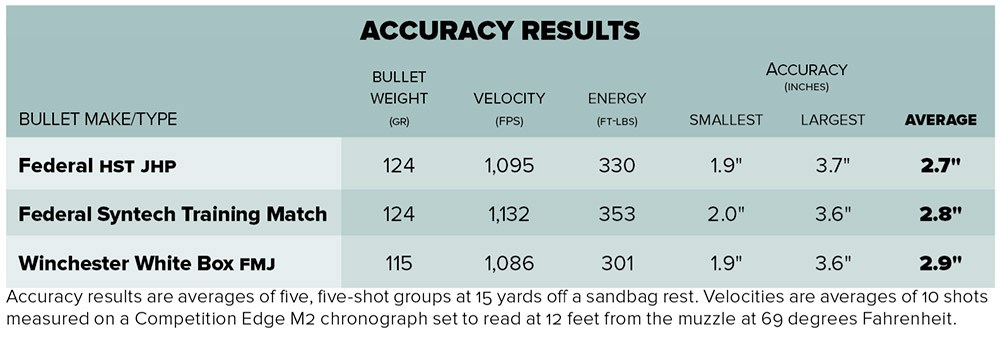
Any discussion of a particular gun eventually leads to the question: What’s it good for? From the time I spent at the range with the RM1C, I know it makes a great little range companion or home-defense gun, as well as a fine carry gun. It could even be an acceptable basic competition gun, given its accuracy and reliability.
About the “affordability” we mentioned earlier, the RM1C has a suggested MSRP of $469, which is substantially less than you might usually pay for the Glock 19. Even if you’re a skeptic, you can find out how much you like this little pistol, just as I did, without breaking the bank.