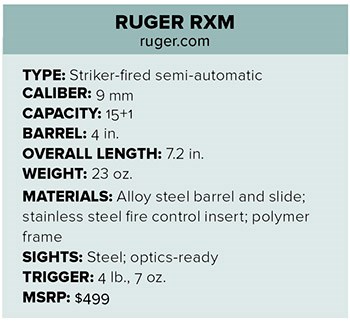
Almost from the day the first Glock showed up, other designers started using it as a pattern. Its enormous popularity has thus resulted in many clones and in many innovations claiming to improve on the original. The Ruger RXM, a collaboration between Ruger and Magpul, is a notable entry.
Together, these two companies have given us what is essentially a Glock Gen 3-adaptable 9 mm pistol, but with changes I would call improvements.
Ruger brings to the RXM a through-hardened slide, with a sculpted line that is visually interesting and handy for re-holstering. The slide features steel sights, not polymer, with the front blade containing a tritium cell for low-light use. Between the steel sights, the slide is cut for direct-mounting RMR, Delta Point Pro and Shield RMSc red-dot optics. (Adapter plates are available if you prefer another format.) The slide receives a black nitride finish, as does the optics plate just in case you are an iron-sights shooter. If you do mount an optic, the iron sights are tall enough to co-witness through the view of the optics.
The barrel is alloy steel and has been given a ferritic nitrocarburizing finish to give it a hard surface. The hood of the barrel has a small notch in it to be used as a loaded-chamber indicator. The barrel is bored and rifled with a standard Enfield-type lands-and-groove bore. This bore is just like that of all the other Ruger 9 mm pistols that have been made, so it will be just fine with most bullet types. So, if you’re a reloader who is stretching your practice budget with lead, coated or plated bullets, you don’t have to worry about the polygonal bore problems Glocks can exhibit. Oh, you can lead the bore—that’s possible with any firearm if you aren’t prudent—but the Ruger is not as bad as the Glock in that regard.
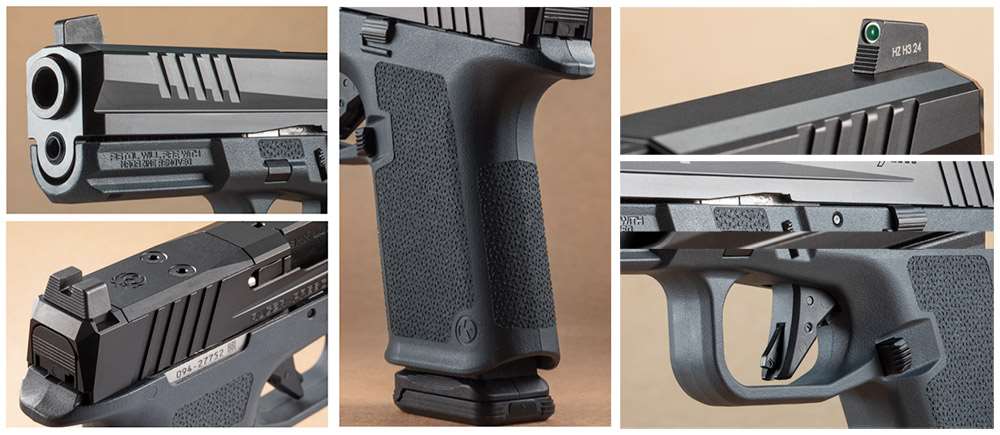
Another Ruger contribution, and a big step forward from the Gen 3 Glock, is its fire-control insert (FCI). The Ruger RXM is a chassis pistol, and that means the FCI is the firearm. The FCI has the trigger, the transfer bar and the ejector all in one assembly. The FCI comes out of the grip as a unit, and that’s that; even for a thorough cleaning, you do not need to take the FCI apart, nor should you. One aspect of making the RXM as a chassis pistol is that the FCI is a rigid unit. Since it is made of stainless steel, the FCI cannot flex, as a polymer-framed pistol does. That flex might not be much, but it is enough to require the parts in a polymer-framed pistol to be dimensioned with flex in mind. Since the FCI is rigid, the parts can be designed with, and take advantage of, the greater precision offered. That leads to a much-improved trigger pull. The Ruger RXM does not have a tuned 1911-level trigger, but it is much better than that of the standard out-of-the-box Glock.
The trigger face is almost straight, and it comes to the wall (the release point) at a 90-degree angle to the bore. So, you have a straight-back pull at the time of striker release. The safety tab in the middle moves so cleanly you won’t notice it during take-up. Take-up is clean, and the press to release is not mushy, which are both problems shooters notice with the Glock. There is a tactile, audible reset, so those who work at refining the reset will appreciate that.
 The Magpul contribution is also significant. The first thing you might notice is the grip angle. The Magpul- designed grip is much closer to that of the 1911 than it is to the Glock, and the texturing is the Magpul ¾-scale trapezoidal surface projection, which means it will provide a non-slip grip without your hands feeling like they’d been attacked by a hyperactive kitten at the end of your practice time.
The frame/grip has an accessory rail on the dust cover, and the magazine release has the grip relieved near it, so you will find it easy to press the magazine release button. The magazine release is not reversible—so that’s one detail that is not an improvement over the Glock originals or later updates. The backstrap is flat, and it is integral, so there are no replacement options. The frontstrap has been lifted to the trigger guard, and the tang has been slightly lengthened. This makes the RXM feel a bit smaller in the hand than a regular G19, and, combined with the changed angle, makes it index more like the 1911. The initial production of the RXM comes with either a gray or black grip; however, once production is underway, additional color options will be available—olive drab and flat dark earth are currently planned.
Grips will come with the parts needed for easy interchangeability. That is, they will come with the magazine release and takedown tab. All you will have to do to change grips is unload, disassemble and remove the upper assembly, then remove the FCI and install it in the new grip. The RXM ships with a G19-sized grip, but the larger G17 and smaller G26 grips are planned. Obviously, magazines sized to fit the shorter grips will not work in the longer grips, but they will work the opposite way. So, if you have a stash of G17 magazines, they will work in the RXM.
The bottom of the grip has a small flare in it, which acts as a magazine- well funnel. The rear of the grip on the interior is beveled to add to that funnel effect. Reloading the RXM thus will not be a fussy or clumsy affair. The RXM comes with a pair of Magpul PMAG 15 GL9 magazines, which drop free of their own weight when you press the release button.
With the RXM being based on the Gen 3 Glock G19, nearly the entire raft of Gen 3 accessories, parts, upgrades and improvements will work in it—but not all. For holsters in particular, you need to note the differences. If you order an RXM holster through Ruger, of course, you’re set; however, despite being a Gen 3-based pistol, the RXM differs slightly. The trigger guard on the Ruger is curved, unlike the square-ish one on the Glock. If the holster you’ve selected uses the square trigger guard of the Glock frame as its retention point, the curved guard of the RXM might not lock in place.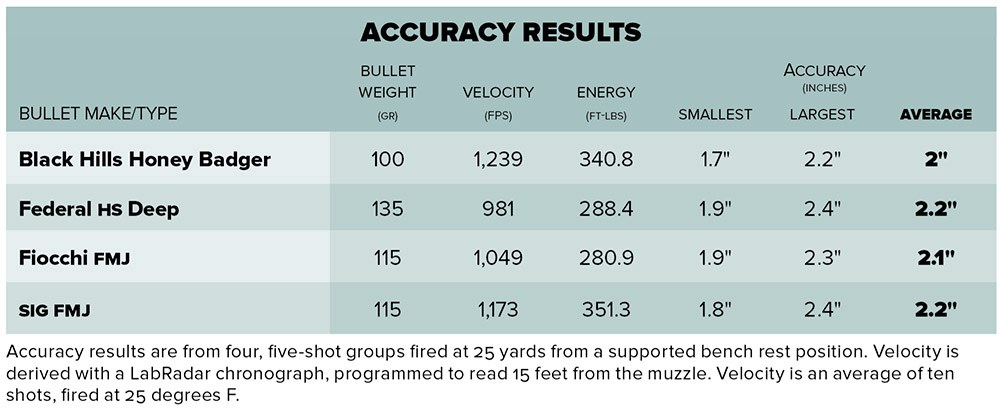
I talked with the Ruger people about this, and I understand their position. They are making their pistol. While they are following the G19 pattern closely, they cannot guarantee that every aftermarket G19 accessory will fit. You might have to do some fitting yourself if you opt to “improve” the RXM.
But … improve what? The trigger is already better than that of the Glock, and, while we all appreciate the best-possible trigger, how much better does this have to be for a defensive pistol? The barrel is better-suited for non-jacketed bullets than the Glocks, and accuracy is already very good.