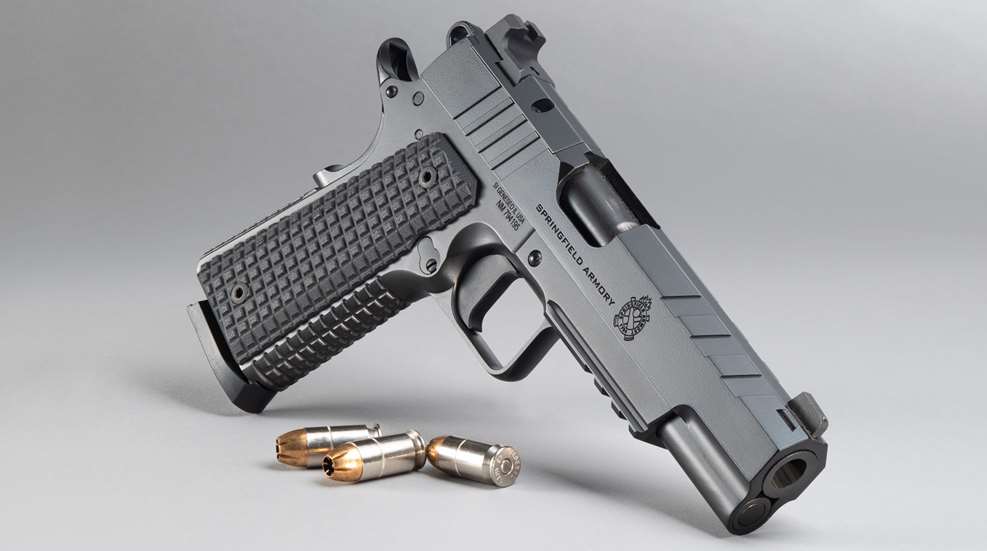
The Springfield Armory Emissary AOS, a 1911 single-stack pistol in .45 ACP, offers power, precision, elegant looks, smart ergonomics and adaptability, along with the reliability derived from a century- plus of manufacturing knowledge—a superb pedigree, indeed.
The Emissary’s forged carbon-steel slide sports a tri-top contour with a serrated centerline that helps knock down glare and guide your eye to the luminescent tritium front sight. The slide has a generous ejection port and the classic 1911 internal extractor.
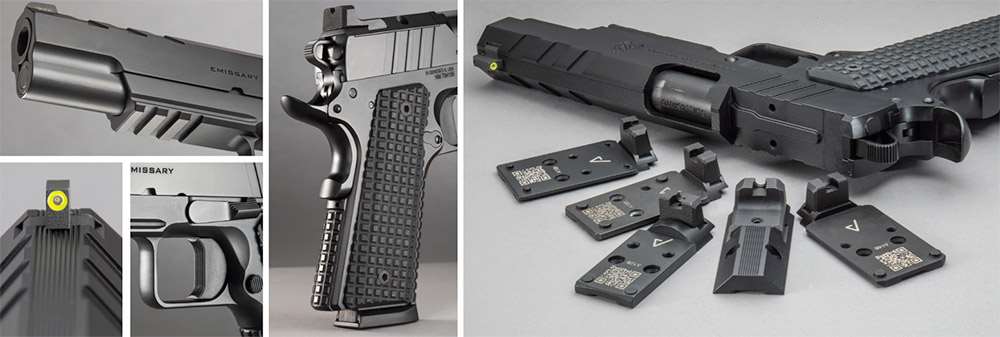
Whatever method you use to manipulate the slide, the location you’ll be gripping has traction grooves. All of the cocking serrations are slanted, square-bottomed slots that provide generous gripping surfaces for slide manipulation. The forward serrations are not on the sides of the slide, but are instead on the angled flat of the tri-top. The front sight is a steel blade with a tritium insert, and the rear is a serrated steel upright blade that is also suitable for use in one-handed manipulation. (This requires practice with an unloaded pistol, but if you need to cycle the slide one-handed, you can catch the rear blade on an edge and push.)
A cover plate that incorporates the rear sight sits behind the ejection port on the base pistol package. If you prefer the traditional 1911 experience and thus intend to use the Emissary with only with its iron sights, then you need not ever do anything with the plate. But the modern world is much more optics-oriented than in the old days, so it makes sense that Springfield Armory teamed up with Agency Arms to develop the AOS (Agency Optics System). The AOS makes it simple to install nearly any reflex sight. Simply unbolt the cover plate, install the appropriate adapter plate and then bolt on your chosen red-dot. The included adapter plates encompass the most-popular platforms of the RMR, Shield, Delta Point Pro and Docter—and these footprints are, of course, also frequently used on the lesser-known brands.
Underneath the slide, the Emissary uses a solid recoil-spring guide rod, with a reversed spring-retention cup. The slide is fitted to the frame for a smooth back-and-forth travel without wobble. The barrel is fitted to the slide likewise, with no perceptible movement when closed. The slide and barrel are then subjected to a black nitride finish to reduce corrosion and increase durability.
The stainless-steel barrel is not like the one in your grandpa’s 1911. Instead of a bushing, the Emissary barrel is machined with a bull-barrel profile, so the front end locks up to the slide interior itself. This does several things for you. First, by eliminating the bushing, Springfield has also eliminated the handful of dimensions and fittings that a bushing requires, allowing them to situate the barrel more precisely. Second, removing the bushing shifts the way the mass affects the action, so the increased mass of the slide/barrel combo (before the barrel unlocks) soaks up a small amount of force at the very beginning of recoil and the reduced mass of the slide itself (after unlocking) allows it to cycle at the best speed for reliable function.
 The forged stainless-steel frame is everything you’d expect in a 1911A1 frame and more. The Emissary has an accessory rail on the dustcover, so if you feel the need for a light or laser, you have a convenient place for them. If not, the rail is unobtrusive, but you will have to mention it to any holster maker when ordering a holster. The trigger is a square-face design, with small angled upper and lower portions there to guide your trigger finger to the center of the bow. The slide stop lever is grooved. The thumb safety is large enough to be used at speed or under stress, but not so large it becomes bulky or uncomfortable riding in a holster. The grip safety has a large upswept beavertail at the top and a speed bump at the bottom. The mainspring housing is flat and checkered. The frame is given a black Cerakote finish.
The grip and the frontstrap of the frame are machined with a non-slip pattern reminiscent of the block pattern of grenades from the 20th century. The blocks, or squares, provide deep grooves for your fingers and hand to mesh into so that the Emissary doesn’t slip during recoil. The grips are made by VZ Grips out of G10, which is a synthetic material so hard and abrasive it must be machined to shape, and thus it is practically impervious to sweat, solvents and oils. The thickness of the grip produces an effect that makes the Emissary a bit flatter in your hands than other pistols, even some other 1911s. This improves its indexing—on the draw or presentation, this pistol comes up with the front sight centered on your line of sight more naturally. A properly indexing pistol also brings the rear sight up on the centerline.
In testing, the Emissary made shooting small groups easy. My test Emissary AOS came with a Defender-ST reflex sight installed, though that is not included in the standard purchase. Having worked with a number of other AOS-equipped Springfield Armory pistols, I didn’t feel the need to spend an afternoon swapping plates and red-dot optics back and forth, just to prove it can be done, so I left that one in place. The trigger might be deemed a bit “too heavy” by the standards of some of today’s pistol mavens, but I found it clean and crisp, and I never found it to be a hindrance. At speed on falling plates or poppers, it was “dot-on-target, press-for-a-hit” easy. Reliability was, as expected, 100% for about 400 rounds.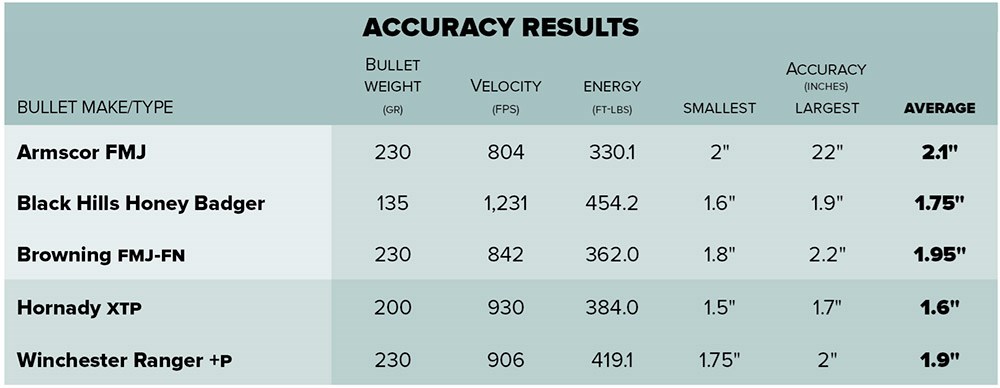
The Emissary in .45 ACP has power to spare. The FBI may say that 9 mm is the equal of the .45, but Newtonian physics tells us otherwise. Even with +P ammunition and some testing with power-level loads, the recoil from .45 ACP in the Emissary was never oppressive.
What does the Emissary lack? Capacity. It is a single-stack 1911 that ships with a pair of eight-round magazines. If you want more, there are a number of ultra-reliable and durable 10-round magazines made for the 1911. When the USMC Recon units were still issued 1911s, they used 10-shot magazines—a solid if unofficial endorsement. But if you want more capacity than that, you could choose a 9 mm, giving up the extra power to keep a reasonably compact frame size, or you’d have to accept a wider-body .45.
If you were in a curmudgeonly mood, you could also give the Emissary strikes for being big and heavy for daily carry. Well, heavy helps tame .45 recoil, and, as for size, a proper holster makes daily carry something that can be managed. I carried a government-sized all-steel 1911 in my early years of carry and pistol smithing—and today’s holsters are much better.