I have long been a proponent of using the .22 LR cartridge for limited self-defense work. By no means should it be your primary consideration, but it still fits where larger cartridges simply can’t—literally and figuratively. Staging or carrying a .22 LR pistol is an effective means of having a backup on hand. Taurus’ 22 TUC pistol can easily fill this role and comes with a side of “easy to handle.”
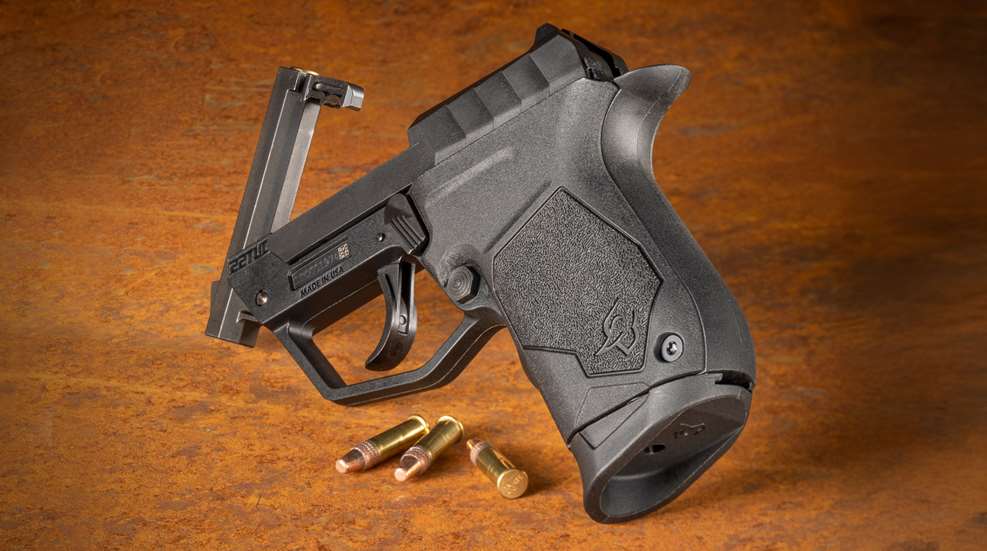
An acronym designed to nod to its affinity for concealed carry, TUC stands for “Tip-Up Compact,” as this semi-automatic features a hinged barrel. Armed defenders who struggle to rack a slide will rejoice, as that is not required to prepare the gun to fire. Instead, a lever on the left side of the gun releases the barrel, and the first round can be placed into the chamber. From here, the user will insert the nine-round detachable magazine, and the gun will function like most any other semi-auto pistol. Unloading can be conducted by reversing these steps, or in the conventional manner of cycling the slide after removing the magazine.
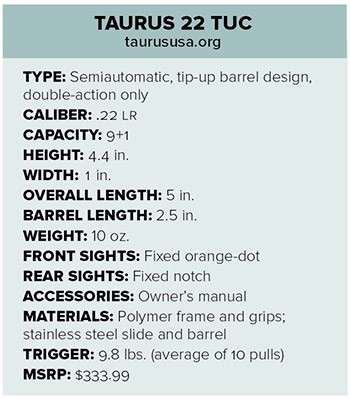
Although the 22 TUC shares a similar footprint with larger-caliber pistols, at a scant 10 ounces, it’s plain to see the benefit of this sub-caliber. Typically, pocket pistols make concessions in grip length to maximize concealability—not so with the TUC. Taurus’ intention was to make the pistol fill the hand, which aids those with dexterity issues and makes the gun easier to control. Combined with the .22 LR's very low recoil, the TUC is one of the most comfortable micro-pistols on the market to fire.
To keep the gun light, the 22 TUC employs a polymer frame finished with a set of relatively smooth polymer grip panels. Two small areas of grit are on each, which create more than enough purchase to handle its diminutive recoil.
To ensure years of reliable service, the frame and barrel are made of stainless steel and treated with an anti-reflective matte-black finish. Aside from the barrel catch, the only other control on the 22 TUC is the push-button magazine release. This is configured for right-handed operation and cannot be reversed. As a lefty myself, I confirmed that it was indeed easy to reach with a left-handed trigger finger, so that shouldn’t be a disqualifier for southpaws.
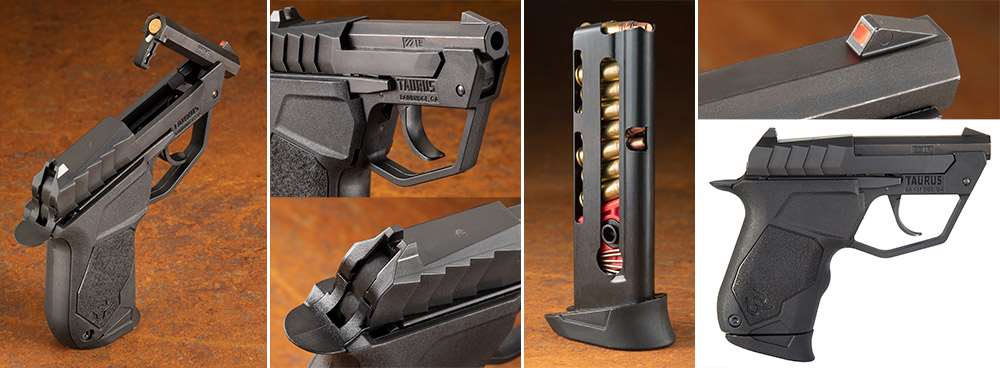
This leaves the question of a mechanical safety—there isn’t one. Instead, the gun's double-action-only trigger allows it to safely be carried like a revolver, which concurrently eliminates any mechanism between you and putting rounds on a threat in an emergency.
 One of the biggest criticisms of using the .22 LR for personal protection was the lack of adequate self-defense fodder, with “was” being the operative word. Today, several manufacturers are designing rounds in this chambering for this very purpose. For my testing, I was able to procure some of Winchester’s new Silvertip load. This cartridge is built with a faster-burning powder to ensure it reaches enough velocity for the bullet to perform when constricted to a shorter barrel. The projectile in question is a segmented hollow-point designed to fracture when it contacts a liquid medium. This expands the wound area, allowing it to act like a larger-diameter bullet. I paired it with CCI’s subsonic version of its Clean-22 product to test it in its quietest configuration. This is something that isn’t often discussed, but shooting a .22 in a confined space is going to have far less impact on your hearing than just about anything else. Arguably, this cartridge is even quieter than some suppressed centerfires out there.
I rounded out my ammunition supply with a brick of Federal’s Automatch, which does a great job of balancing consistency with a fair price. This would ensure enough rounds to conduct a thorough reliability test and give the pistol a chance to prove how accurate it could be.
I carried the 22 TUC to the range in a Tuff Products Jr. Roo holster in the front pocket of 5.11 Defender- Flex jeans. Needing to make next-to-no considerations to carry a pistol is a major selling point for me, as it leaves few excuses to depart from my house unarmed. I began my day by confirming the sights were true, as they were milled directly into the slide and barrel. Some might balk at the lack of adjustability, but those are folks who've never had a removable sight move. Truth be told, I’ve experienced more iron-sight failures during my career than even red-dot catastrophes, so I’m starting to see the utility of simplicity. Depending on ammo, my seven-yard impacts were between two and four inches high. I believe this is perfect, as it allows enough play for shots fired from an extended distance to drop into place.
The trigger pull was characteristically long, but surprisingly smooth, particularly for a gun in this price range. As predicted, recoil was nearly nonexistent, especially when loaded with the subsonic fodder. Overall accuracy was acceptable for a tiny defensive pistol and outstanding when filled with the match-grade Federal ammo. Above all, it ate everything I loaded into it, which is the most-important factor for anything I might be staking my life on. My only con was that the slide was tough to rack, though the validity of this critique is ambiguous, as the whole point of this gun is that you shouldn’t have to rack it. Still, I feel that some work could have been done there for those of us who are hardwired to reach for it when loading—and, after all, you still might need to clear a misfired cartridge.
My final synopsis is that this is an excellent backup self-defense tool, particularly for those who have a hard time handling anything chambered for a more energetic cartridge. The 22 TUC offers enough meat to grab during manipulations, while its open, straightforward design makes it easy to visualize where the ammunition is when loading or unloading. If nothing else, it offers a great way to introduce somebody to a self-defense pistol, so there’s no reason not to tuck one of these away for a rainy day.