At the inception of centerfire cartridges, a pure lead bullet was the chosen projectile for a few reasons: It was simple to construct, the material was plentiful and, with no more than a mold and a heat source, the owner could make their own projectiles on the frontier. But, while the lead bullet and variations on it still have a place in the market, our defensive projectiles have certainly developed over the last 150 years.
Lead is malleable—one of the reasons it was chosen early on—but it makes a mess in a barrel. It also tends to bend or deform and, though expansion is desirable, it may expand prematurely in the terminal phase. Adding antimony to the lead can harden it considerably, and the “hard-cast” formula gives a better performance than does pure lead, especially when penetration is needed to stop a threat. Still, the barrel fouling associated with lead projectiles is a chore to clean.
Adding a copper (or copper alloy) jacket to lead projectile started in the 1880s, and the jacketed bullet might be the most-popular handgun bullet design to this day. The jacket is harder than the lead core, so the fouling is greatly reduced, yet the material is soft enough to let the rifling engrave into the jacket and put the proper spin on the projectile. The harder jacket serves to slow the bullet’s expansion, thereby increasing penetration. Many efforts have been made to balance the thickness and hardness of the jacket—including scoring the jacket to initiate expansion—to find the best combination of expansion and penetration.
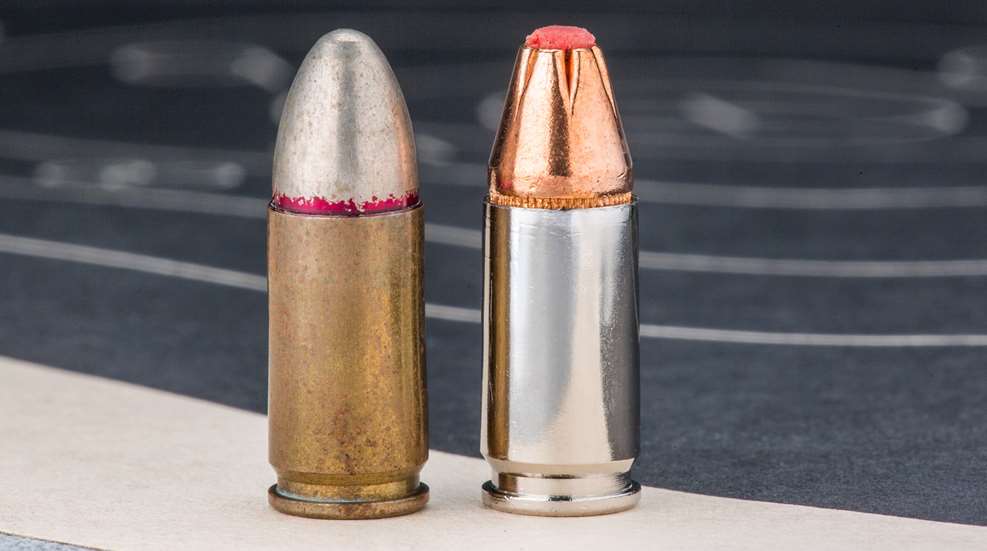
Completely encasing the lead core in a copper jacket results in the full-metal-jacket design, often associated with the military since they must adhere to the Hague Convention of 1899, which prohibits the use of expanding bullets in war. These FMJs are known for their penetrative qualities, but, since they usually do not expand well enough, the risk of over-penetration is a reality.
Conversely, the hollowpoint projectile uses an open dish at the nose (or meplat) to initiate expansion, resulting in the desired larger wound channel. Highly popular for their immediate energy transfer, the hollowpoint remains a smart choice for all-around defensive work, as they are among the best means to neutralize a threat, yet still give reliable penetration, including penetrating heavy clothing.
Because of the need to penetrate thick clothing, common drywall or even automobile glass, projectile companies have expanded on the hollowpoint formula. Federal’s Hydra-Shok and HST and Speer’s Gold Dot are fine examples of modified hollowpoint designs, which use a center post to prevent a hollowpoint from plugging up (Hydra-Shok), a crimp to lock the jacket into the core (HST) or a bonded core (Speer Gold Dot). Chemically bonding the copper jacket to the lead core not only slows the expansion of the bullet during the terminal phase, but increases the retained weight of the projectile, as the copper jacket will not separate from the lead core. In all three instances, the engineers have worked hard to balance expansion and penetration.
Stroll down the ammunition aisle of your favorite shop and you’ll see that choosing one design over another isn’t easy. The more complex a bullet’s construction, the more expensive it tends to be. The simplest designs—pure lead and FMJ—are the most affordable and are often used for practice, but don’t offer optimum performance for defensive applications; in fact, the FMJ can give too much penetration in a home-defense situation, posing a greater threat to others.
I prefer the performance of the Federal HST and Speer Gold Dot after testing them in a variety of mediums, including bare ballistic gel, clothing and gypsum, as they tend to give 12 to 14 inches of penetration into bare ballistic gelatin with an expansion of roughly 1.5 times the original caliber, which will stop a threat quickly; those in law enforcement often choose these designs for the same reasons. A jacketed hollowpoint, which has long offered a balance of affordability and performance, is still a viable choice, but in a defensive situation, I would take the bonded-core designs (like the Federal Punch or Speer Gold Dot) since bonding the core and jacket prevents jacket/core separation that can lead to a lack of penetration. As new designs are offered, I would look for the same level or better for penetration, expansion and reliability these offer before I traded them out.