Despite the irrefutable fact that many of the most popular movies of all time, from Dirty Harry to The Avengers, rely heavily on the theme of good people fighting bad people—often using guns to even the odds—Hollywood’s producers and actors love to sneer at our Second Amendment rights and the ordinary citizens who embrace them. So, it takes a brave cinema insider to make a movie that is unapologetically pro-gun.
Luckily, Hollywood doesn’t quite have a monopoly on the industry anymore, and great movies that actually reflect American values are being made without Tinseltown. Such is the case with JCFilms’ upcoming drama Heels to Holster, which recounts one woman’s story of surviving domestic violence.
Shirley Watral is that woman, and she has an important message about standing up for yourself—and about the need for an equalizer against stronger assailants.
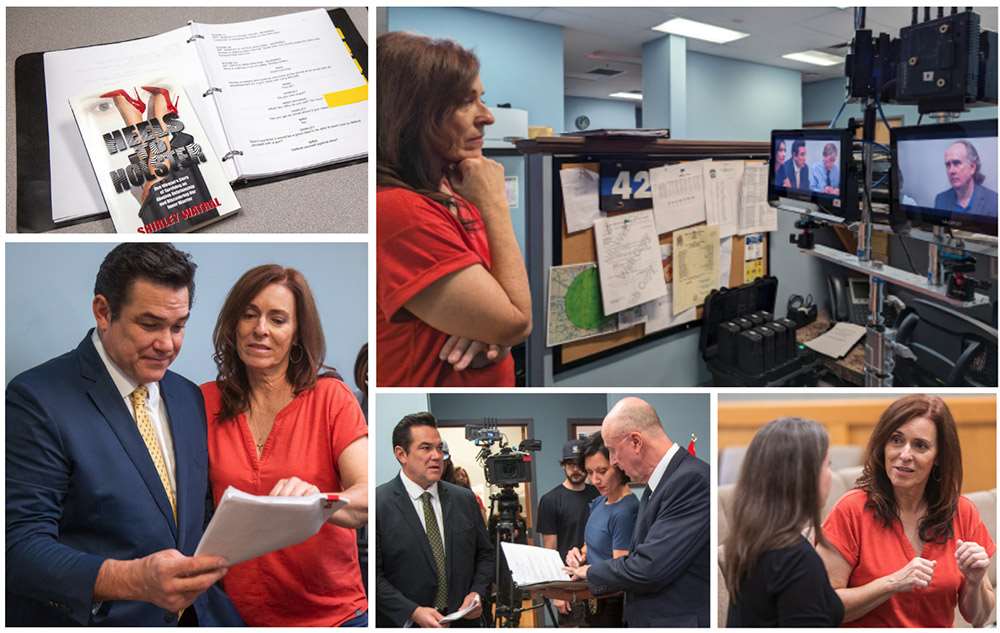
Three of us from NRA Media traveled to Bridgeport, W. Va., to meet her on set at the town’s police station. Shirley’s smile was lighting up the dingy blue-and-gray surroundings that seems to be found in every municipal building.
With all that light emanating from her, you’d never know the darkness Shirley has come through. But, like so many people, she’s learned the hard way that you are often the only one who can defend yourself if you’re attacked. (It’s a sadly common story, with one in four women experiencing physical violence from a partner in their lives, according to CDC statistics. So, it’s easy to see why so many women are choosing to embrace their Second Amendment rights—20% or more of U.S. women have reported being gun owners to Pew Research and other sources—and why those numbers keep rising.)
Shirley took the lesson to heart. She learned to shoot and later became an instructor, competitor and Second Amendment advocate. She has since written a book about her ordeal and her subsequent path to what can only be called empowerment, though that term is overused.
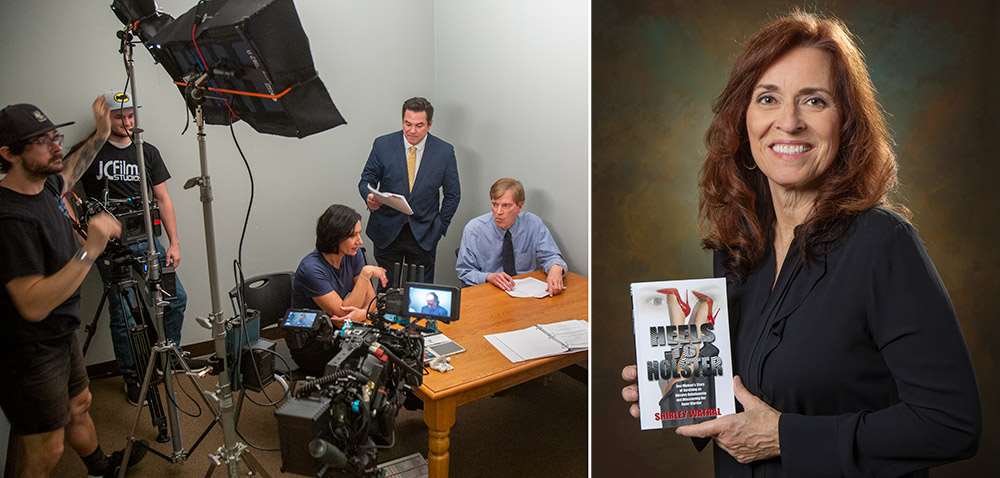
And the book, titled Heels to Holster, is now being made into a movie starring Jana Lee Hamblin, known for roles in shows like The West Wing and The Terminal List, as Shirley. Dean Cain co-stars as Detective Justin Stone—a fake name for the real detective who helped guide Shirley through documenting evidence of her abuse and obtaining a restraining order. Cain should already be known to our audience as a strong Second Amendment supporter (and NRA Board member). As an actor, he is probably most famous for his role as Superman in the series Lois & Clark: The New Adventures of Superman.
So, we stepped into the police station to find a confusing array of tall, crowded cubicles filled with both real police officers and actors. Extras milled around in the background of various scenes, and the production team of videographers and sound technicians and all their equipment further complicated the milieu. But everyone made room for us, mostly good-naturedly, so we could watch a series of monitors as scenes were being filmed.
Dean Cain wasn’t there initially, but when he walked in, fresh from meeting with representatives in Washington, D.C., the team launched right into filming his scenes. He seemed to have brought his own detective wardrobe and personally ensured he was wearing a different suit and tie for the parts that were supposed to be happening on different days. I watched as he filmed and re-filmed a scene of his chief grilling him about whether he was in a relationship with Shirley and then informing him that “someone” called in a threat against the two of them. Dean did what he does, pretending over and over again to be shocked by this news, and it was fun for us to see it all behind the scenes.
Shirley watched it all play out on the monitors, too. The crew consulted with her when they wanted to change or cut a scene, ensuring they were still capturing the spirit of her story.
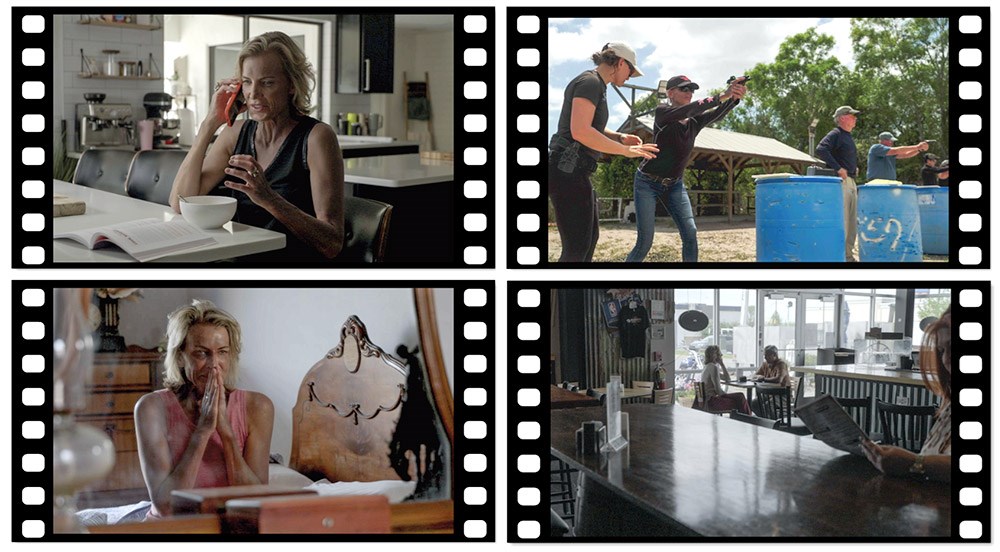
That story is common, but not easy. Shirley got invested in what initially seemed a normal relationship, but she gradually started to feel hemmed in and controlled. The man began showing up in unexpected places. Shirley found things in her apartment had been moved around, even though she hadn’t given him a key. (He’d managed to talk the apartment management into giving him one.) One day, he persuaded her to come to his house to check on a cat. She stood outside talking with him and didn’t want to go in, but she ultimately overrode that instinct out of concern for the animal.
As soon as she was inside, Shirley started to see what her instincts had been warning about. All the windows and doors had been locked and shuttered. The man had also made a prison room of sorts for her in a closet, which he soon forced her into. The next several hours became a nightmare of threats and physical violence.
When the man took out a gun, Shirley knew she was about to die. She fought back and even managed to briefly get the gun in her hands, but a lack of knowledge with how to use it meant she was soon overpowered.
Miraculously, Shirley was somehow able to turn the situation around by convincing the man that she would comply with everything he wanted, including marrying him. He then began to act as if nothing had happened and suggested they watch TV and order pizza—presumably the beginning of the typical abuse cycle’s “honeymoon phase,” where things become calm again (until they aren’t again).
So, she talked her way out of the house, explaining that she’d lost a contact lens and couldn’t see without it. Returning to her own apartment in shock, she knew she wasn’t safe, so she had to overcome her mental and physical reactions enough to reach out to a friend. That friend took her in, though she still had a long road ahead to fully extract herself from the situation.
When we finally had the chance to talk, I asked Shirley what it was like to see all of this play out on screen.
“It started out just weird,” she said, “because there’s this woman [Hamblin] that everyone’s calling Shirley Watral, but she doesn’t look like me! But eventually it did dawn on me—this is your story; this is what happened to you.
“The most-intense part was when they did the scene of me trying to escape from the prison he had made for me in his house. That was probably the hardest. At one point, as they were filming this, I was showing them what it was like, and I was like, wrestling—that’s the point where he brought the gun out—and I was wrestling him, halfway on the bed, and it kind of got to me. Fighting brought back something—I was actually fighting him—I had to chill because you don’t want to hurt the actor, but I was really fighting him. I wanted to bash him on the head! The emotions just rushed in, but they [the film crew] were all very patient.”
The trauma is still apparent in Shirley’s answer, but she has since taken all that horror and channeled it into helping herself and others.
One of her first steps was learning to handle firearms. I had to know what that first class was like for Shirley, too, as I’ve witnessed some women experience a very strong post-traumatic reaction the first time they shoot a gun. But Shirley had made the decision to learn to shoot and she was firm in that decision. In her first course, the instructors, not realizing she’d never taken any firearms class previously, soon had her moving and shooting, and Shirley just did her best to keep up.
After this, Shirley said she felt changed. “My self-esteem grew after being battered down for so long,” she wrote. “I successfully completed that class … and it helped me look at myself differently.”
So, Shirley kept taking classes, and discovered at each step how welcoming the firearms community was. She got a job at a range and moved into instructing and competition. She took a course, and then a private course, with pro-shooter Lena Miculek (who is also slated to appear in the movie). She realized her need to advocate for her gun rights and met Dianna Muller of Women for Gun Rights (formerly DC Project), and became a state director for the group.
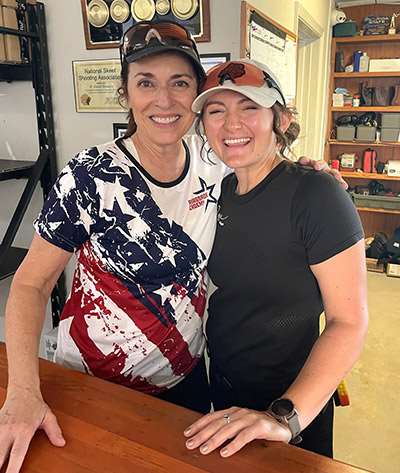
Along the way, people kept telling Shirley how sharing her journey from abuse to empowerment was helping them. They shared their own stories with her and used her example as a model.
“It doesn’t have to define us,” she said. “You can use it to become the person you want. It doesn’t happen overnight, but you become a warrior. You must fight through. You must find something that builds your self-esteem—like shooting—and gets you prepared. Find your purpose and have faith.”
With so many people asking her to share her story, she finally decided to write it all down into book form. Heels to Holster was born, which she self-published and promoted. But people kept telling her that the story needed to be shared more widely. Shirley heard it often enough that she finally bought a few books on scriptwriting and spent two hours a day at a coffee shop for the next four years turning the book into a script.
She didn’t know what to do once it was written, so she attended a workshop she’d seen advertised. The workshop topic was about writing a script, but of course she’d already passed that phase, so she decided to ask the organizers what to do next. She walked up to them—accidentally interrupting a meeting—to ask.
The group members were interested but noncommittal at first, but the story really stuck with Jason Campbell, who started JCFilms in 2013 “as a way to change culture through film.” Jason frequently works with Dean Cain and knew of his appreciation for the Second Amendment, and he began to think the film really should be made.
“Today’s generation of women is more empowered than ever before—confident, self-assured and fiercely independent,” Campbell told me. “Yet despite this progress, violence against women continues to rise. Heels to Holster aims to confront this crisis and inspire women to find strength, healing and hope.”
No doubt Heels to Holster, scheduled to debut in January 2026, will be an important movie to inspire survivors of domestic violence specifically, but it will do much more than that; after all, the story serves as a stark reminder—maybe even one that could get through to the Hollywood types—of the realities of why we need our Second Amendment rights.
“One of many important lessons I learned is that safety and security are things I need to provide for myself,” Shirley wrote in Heels to Holster. “If you think gates and papers will keep you safe, I implore you to think again. They are illusions.”