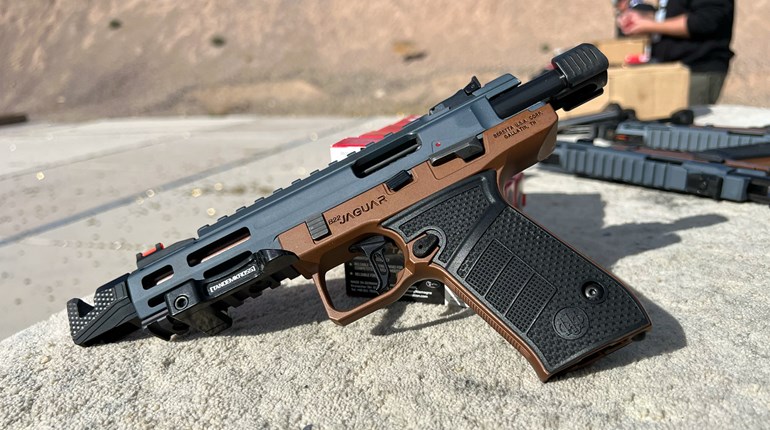
Imagine Hillary Clinton touring the Savage Arms factory in Westfield, Mass. It’s not a completely wild idea, as this factory is smack in the middle of a “blue state.” It’s located in a part of America that used to be called “gun alley,” right where American manufacturing sparked the American Industrial Revolution.
She would be off balance from the start. All around the factory’s lobby is a timeline of glass cases filled with photos of guns and of those making guns, of gun catalogs and, yes, of lots of guns from Savage’s founding in 1894 to today. It might help Clinton that some of the magazines and catalogs in the cases have women on their covers holding Savage’s classic rifles and pistols, but then maybe not, as they are smiling. I joked, “Wouldn’t it be great if Hillary were here with us right now to meet the people she says should be sued for the actions of criminals?”
If she got dizzy from all the reality around her, perhaps Alan Beaulieu, a silver-haired gentleman who started at the factory in 1965 and did just about every job there was to do at the plant for half a century, could take her elbow to steady her. He could lead her to the factory floor where blue-collar, unionized workers are making about 2,400 guns a day for free people. He could show her, as he did me, an iconic American company that still makes things out of steel and wood for Americans. He could introduce her to these real, mostly blue-collar workers, to the very people she has been demonizing and mischaracterizing on the campaign trail.
Can you see that in your mind’s eye?
The image struck me as I stood in the lobby. I joked, “Wouldn’t it be great if Hillary were here with us right now to meet the people she says should be sued for the actions of criminals?”
Beaulieu scratched his head as if such an image was unfathomable. He then led me out of the lobby to the factory floor where so many of the guns that a lot of us grew up shooting are still made. I hadn’t been to this factory in nearly 10 years. Since then they’ve been expanding and currently have areas walled off with big blue tarps as contractors expand the factory.
This expansion is a good example of a trend. The gun industry published a report recently saying it’s not only doing just fine, but has actually grown by 158 percent since President Barack Obama first won the presidency in 2008. The National Shooting Sports Foundation (NSSF), the trade association for the firearms industry, reported that the total economic impact of the firearms and ammunition industry in the U.S. increased from $19.1 billion in 2008 to $49.3 billion in 2015. The NSSF also reported that, in that same time period, the total number of full-time jobs related to gun making in the U.S. rose from about 166,000 to nearly 288,000.
Beaulieu showed me long steel poles being cut into gun-barrel sized pieces that were then drilled and milled in CNC machines. We saw the steel being rifled and threaded. Finally, at the end of this long line of machines, is a man using an antiquated mechanical device to straighten barrels. He locks the barrels in, looks through them, and then adds a little pressure here and maybe there to straighten them by hand.
I see more men and women putting together Accutriggers and rifle bolts. In one section there was a guy with a file smoothing off burrs on gun parts left behind by precise CNC machines.
All through the line I saw a mix of state-of-the-art manufacturing and old-fashioned artisan skill. I later met four men in a closed off room who were busy test firing semi-automatic and bolt-action rifles to make certain they were flawless.
As we toured, Beaulieu talked about how guns used to be made and how they are made now. Savage Arms used to have just one design engineer, but now there are rooms loaded with them. They used to use draft boards, but now they use SolidWorks and other software to design new features and to completely design new firearms before using 3D printers and other technology to create prototypes. So much has changed, but so much is the same.Maybe it wouldn’t change what she says, but at least these real people who make freedom’s tools would be there, somewhere deep in the back of her mind.
In one room we find a woman who began in 1973, working with the men on the factory floor. She said, “I was wearing heels and a dress when they took me out onto the factory floor to see if I thought I could work there. Men’s heads turned and machines stopped. But I was back the next day. I drove forklifts and ran machines and did it all.” She is now the special sales coordinator. She answers the phone when someone wants to special order a gun. When they want a particular barrel or stock or even a caliber Savage doesn’t commercially produce, she figures out if they can do it or not. If it’s possible, she’ll put together a work order and the gun will be made.
Later I met another lady who began working on the shop floor with all of the men in the 1970s. While she was covered in grease she met an engineer at Savage and thought, I can do that. She went back to school and got an engineering degree. She is now an engineer for the company. No, these aren’t the people Clinton thinks they are.
After the tour, Beaulieu turned back to the factory floor, shrugged, and gestured with his right thumb as he said, “That’s America.”
I thought, Yeah, it is a critical part of America.
And sure it’s just a wild idea, but wouldn’t it be great if Hillary Clinton really met these people? Maybe it wouldn’t change what she says, but at least these real people who make freedom’s tools would be there, somewhere deep in the back of her mind.