Have you ever watched a movie about journalism? You know the genre: Clacking typewriters, babbling newsrooms, hard-bitten editors, intrepid reporters who refuse to take anything at face value. Such flicks are full of aphorisms: “If your mother says she loves you, get a second source,” “get it first, but first get it right” and so on. That’s the Hollywood version.
The real version in so much of the media is now very different—especially, perhaps even uniquely, when the topic has anything to do with guns. So, what do we have then? We have the vast majority of the media serving as little more than a greased pipeline for the output of America’s many well-funded anti-Second Amendment activist groups. We have the mainstream media not so much writing stories as they are laundering press releases—what it is fed, it eats whole, and, as our mothers told us, eventually you are what you eat.
Understanding this, an archipelago of activists has emerged to satisfy the demand for attacks on the private ownership of guns. Some, such as the Giffords Center and Everytown for Gun Safety, are open about their desires. Others, such The Trace and the Gun Violence Archive, hide their radicalism behind a pretense of independence. All of these institutions end up playing the same role, and all have the same ultimate aim: To erode, and eventually abolish, the right to keep and bear arms.
The Sorry State of the Press
As a rule, most media outlets are primed to believe, indulge and promulgate anti-gun content. When other constitutional rights are at stake, the press can be suspicious of anyone who demands their abridgement. When gun rights are at stake, by contrast, those who are opposed to our freedom are simply presumed to be correct.
That is not an overstatement. In almost every case, the default assumption of the press is that the United States has too little gun control, that more gun restrictions would inherently be a good thing and that any law that does not move the country toward more gun control is intrinsically useless.
This is why, after a notable crime has been committed, the media talks incessantly about rules that were not in play at the time, legislation that did not intersect with the details, types of firearms or ammunition that were not used and American citizens who were not involved. The starting position is that the right to keep and bear arms is bad—and from this, everything else flows to its illogical conclusion. As such, the key question is never what works, but whether one is in a vague sense “for” or “against” stricter regulations. In this worldview, the good guys are those who are for more laws, and the bad guys are those who oppose them—facts, analysis and basic research do not enter into it.
Enter the Activists
Fortunately for the press, there exists a host of self-appointed “experts” who are only too happy to flatter their preconceptions. Chief among these is The Trace—a supposedly “independent, nonpartisan, nonprofit newsroom” that, in practice, is a front for Michael Bloomberg’s gun-control outfit, Everytown for Gun Safety.
I say The Trace is a “front” because its president is John Feinblatt, who is also the president of Everytown for Gun Safety. I say that because its former editorial news director has admitted that “we do bring a point of view to the issue of gun violence.” I say that because, despite insisting in its mission statement that it’s interested simply in using “the power of journalism to improve public understanding,” all of its output militates in a single direction. At one level, The Trace’s model is rather clever: It partners with “more than 300 national and local media organizations,” and, in return, those organizations pretend that it is a legitimate source. Via this arrangement, The Trace gets a series of venues in which to exhibit its advocacy, and those venues get to pretend that they are exhibiting a credible source. Were it not so potentially destructive to a key part of the U.S. Bill of Rights, one might almost be impressed by the ingenuity of the setup.

But, alas, it is potentially destructive. The most media-savvy of The Trace’s writers is a man named Mike Spies, who—surprise!—holds every single position on the Second Amendment that one would expect from Everytown for Gun Safety. On TV, on the radio and in print, Spies goes through his progressions like a quarterback. First, he offers up the most modest of his opinions: That the guns available to the public in the United States are “too powerful.” Next, he moves to the claim that, irrespective of their potency, there are “too many” guns in America. And, finally, he arrives at his actual belief, which is that the Second Amendment does not protect an individual right to keep and bear arms, and that the federal government should engage in the same sort of Draconian confiscation program that has been executed in Australia. Like his colleagues, Spies is keen to present his proposals as the unalloyed fruit of careful, impartial, independent research. But, of course, they are no such thing. His worldview begins with a conspiracy theory—that the obvious and permanent meaning of Second Amendment was invented in the modern age—and the rest follows suit.
In and of itself, this would not be an enormous problem. There are, after all, all manner of silly media outlets in these United States. But, because The Trace is treated by hundreds of other institutions as a credible and unaligned voice, Americans who watch the news are routinely treated to fringe political advocacy masquerading as agnostic analysis. Imagine, if you will, that every segment on a high-profile criminal trial featured a figure who argued that the U.S. Constitution did not actually mention juries. Or if each report on police investigations starred an “expert” who insisted that the need for a warrant was a contemporary myth, and that the best way to fix crime was to allow the government to barge into the homes of the law-abiding. This would be absurd.
Add Some Fake Statistics
The Trace is by no means alone in this role. For nearly a decade now, it has been all but impossible to read any major piece of journalism that mentions firearms without coming across a rote recitation of the preposterously inflated statistics that are regularly put out by the Gun Violence Archive. Open any gun-related story in a major newspaper, or glance at the chyron during any segment on guns on CNN or MSNBC, and you will invariably be informed that there is a mass shooting in the United States “every day.” For those who don’t pay attention, this sounds extremely scary—the implication being that, somehow, the worst crimes in American history are a daily occurrence, but that only a few of them make the news.
Naturally, this isn’t true. Indeed, not only is it untrue, but it is astonishingly untrue. In 2015, for example, the Gun Violence Archive claimed that there were 335 mass shootings. The actual number, per the FBI, was six. Defending himself from this criticism, the executive director of the Gun Violence Archive insisted that his organization merely compiles numbers and then lets “the user make interpretive decisions.” But this is nonsense. The entire purpose of the Gun Violence Archive’s methodology is to persuade the American public that there is a Columbine each and every day. The GVA knows full well that their data will be shared uncritically—and without explanation—by the mainstream media, and that this is useful to the cause of gun control in the United States. The project is not scientific; it is propagandistic.
As for that methodology? It’s a disgrace. It relies heavily on early reports—and is rarely corrected to account for mistakes; it does not clean up its data when that data has been proven to be suspect; and, by design, it produces a ridiculously maximalist account of “mass shootings” that is used literally nowhere else in the world. It conflates gang shootings and robberies with mass-murder events; it treats wounds as deaths; it classifies nighttime drug deals gone bad near schools as “school shootings;” it lumps in domestic disputes with randomized violence; and, as we learned after the attack in San Bernardino, it even includes terrorist attacks in its numbers.
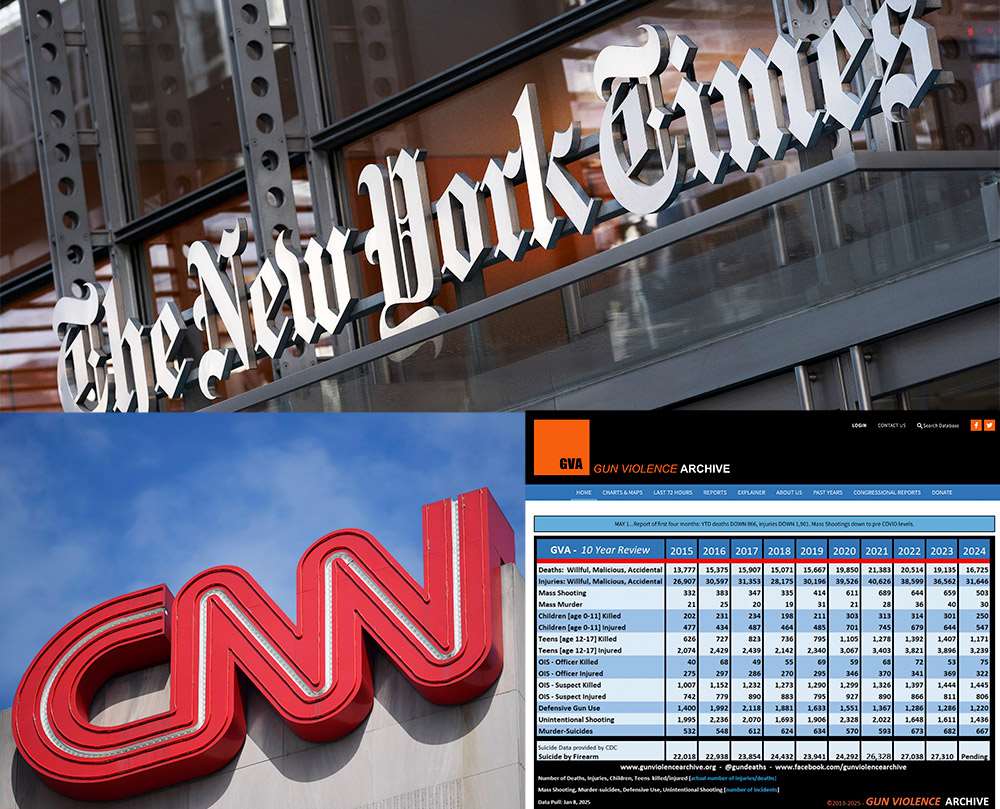
In consequence, the Gun Violence Archive’s data is so off that its “mass shooting” statistics for a single year tend to be four or five times higher than the total number of mass shootings that have taken place in the entire history of the United States. To understand the scale of the intentional mistakes, imagine if the Weather Channel claimed that it were counting “major hurricanes that have made landfall in the U.S.,” but it was actually counting every day that it rained anywhere in the country. This, quite deliberately, is what the GVA is doing. To reach a predetermined end, it collates information from a common category and presents it as if it were a catastrophic category.
Garnish with Deliberate Ignorance
Ultimately, responsibility for this problem lies with the media outlets themselves, which tend to suffer from a toxic combination of political radicalism and deliberate ignorance. I write “deliberate ignorance” because, at this point, it is impossible to escape the conclusion that most American journalists consider the possession of even elementary knowledge about firearms and the people who own them to be icky and déclassé. The average member of the media does not know what a semi-automatic firearm is, or how it works; they do not know what a magazine is, or how it works; they do not know what a suppressor is, or how it works; and they do not know the legal processes via which Americans purchase and carry guns. Certainly, they do not know which gun laws are already on the books nor the voluminous regulations that already govern firearm manufacturing, importation and sales in the U.S.
Not only does this make the press highly susceptible to the output of organizations such as The Trace and the Gun Violence Archive, it makes most reporting on Second Amendment questions utterly incomprehensible. Add in the media’s bizarre expectation that criminals will obey laws but that law-abiding people will break them, and we arrive in our current predicament—somewhere east of Wonderland.
The right to keep and bear arms is one of the most-fundamental parts of the American social compact. Crime, by contrast, is a universal scourge. By focusing its outrage on the former rather than the latter, our press does the people of this country a profound disservice. Imagine if, in the aftermath of the sinking of the Titanic, the main topic of discussion in the newspapers had been whether its passengers had really needed to travel—or even whether we really needed ships after all. Next, imagine that the most frequently cited sources were the Anti-Ship League, and an activist counting house that insisted that there was a Titanic-scale disaster every day. Imagine also that every journalist who wrote on the matter knew nothing about the ocean, icebergs or the properties of steel, disliked everyone who made transatlantic journeys, and had never been on a boat. That, I’m afraid, is what we’re dealing with here: The blind being led around by the pathological.
The good news is that the American public has remained solidly behind the Second Amendment. They understand that the provision protects an individual right; they comprehend that criminals, not inanimate objects, are responsible for crime; and, unlike the press corps, they know a good number of gun owners in their own lives and are thus inoculated against the character assassinations.
Still, it could be so much better. When you stop to think about it, it is absurd that so many of the key institutions in American life are thriving in defiance of the best efforts of our fourth estate, rather than with its enthusiastic support. It would be a good thing if the press aligned more closely with their Hollywood depictions. For now, though, I won’t hold my breath.