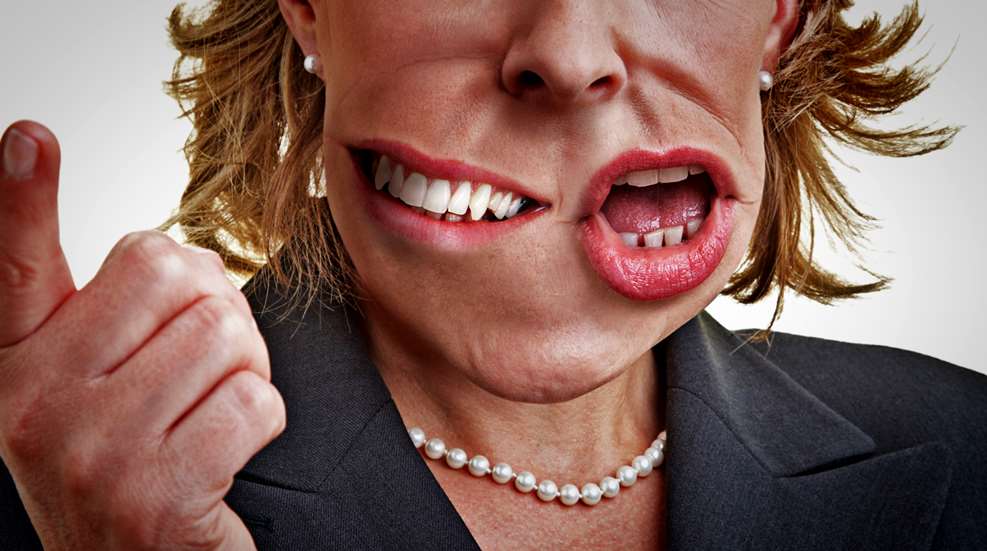
The use of semantics to avoid accountability became “Clintonian” after Bill Clinton denied he lied straight-faced about his affair with Monica Lewinsky. Bill had said under oath, “There’s nothing going on between us,” and then found he had to explain this away. To do so, Bill avoided accountability in a ridiculous way. He actually disputed the definition of the word “is” to a grand jury. Here’s what he told them: “It depends on what the meaning of the word ‘is’ is. If the—if he—if ‘is’ means is and never has been, that is not—that is one thing. If it means there is none, that was a completely true statement ...”
Democratic presidential nominee Hillary Clinton has been playing an even less sophisticated semantic game. She said “there was nothing marked classified” in the emails she sent or received on a private email account and has since been trying to explain this away by defining “marked” and so much more that even her supporters must be mouthing Sir Walter Scott’s line: “Oh, what a very tangled web we weave … when first we practice to deceive.”
But we enter even murkier waters in this election season when some in the media give “Pinocchios” to those who call Clinton out on her own words.
Such is where we are now with the gun issue. The Washington Post, PolitiFact and more are claiming to be honest referees in the throes of a presidential election, even as they call Donald Trump a liar for saying that Clinton would “abolish the Second Amendment.” They claim Trump is “cherry-picking the facts,” as PolitiFact put it, even though Hillary said the Supreme Court “got it wrong” with the Heller decision, the case in which the court determined the Second Amendment is an individual right. If the Heller decision is reversed, as Hillary said she wanted, the Second Amendment would become nothing more than fading words on an old parchment as seen in the U.S. Archives.
Nevertheless, The Washington Post says gun owners’ “fear” that Clinton’s Supreme Court nominees, if she wins the presidency, would reverse Heller is nonsense because “predicting the rulings of Supreme Court justices not yet selected is a fool’s errand. Moreover, Clinton’s public positions on gun control are far less extreme than suggested by the [NRA].”
If it’s a “fool’s errand” to worry over how a future justice might vote, then why did Franklin D. Roosevelt’s attempt to pack the court rile so many that it’s still talked about today? Actually, dismissing this issue as a “fool’s errand” is so loaded with duplicity and political expediency, especially for a journalist, that it’s hardly even necessary to spell out why.
But enough about the so-called “mainstream” media’s grandstanding on their false claims of impartiality. Let’s instead decipher Hillary’s doublespeak on guns.
First, we need a quick definition of “doublespeak.” Edward S. Herman, in his book Beyond Hypocrisy, defined doublespeak this way: “What is really important in the world of doublespeak is the ability to lie, whether knowingly or unconsciously, and to get away with it; and the ability to use lies and choose and shape facts selectively, blocking out those that don’t fit an agenda or program.”
So, here we go.
Clinton: “I believe weapons of war have no place on our streets.”
Deciphered: By “weapons of war” she isn’t talking about bazookas, machine guns or hand-grenades; she is talking about an arbitrary and expansive class of popular semi-automatic firearms that she or some other politician might classify as “assault weapons.” She has repeatedly said she wants another “assault weapons” ban. Her husband signed one in 1994, and President George W. Bush let it expire in 2004. She can’t mean “weapons of war” literally, because, as any gun owner knows, “weapons of war” include bolt-action rifles, pump-action shotguns, semi-automatic pistols and just about everything else available today.
Clinton: “You shouldn’t be able to exploit loopholes and evade criminal background checks by buying online or at a gun show.”
Deciphered: The American freedom to buy, loan or trade firearms among citizens has been part of our freedom from long before 1776. But according to Clinton, this freedom is a “loophole.”
Clinton: “If you’re too dangerous to get on a plane, you are too dangerous to buy a gun in America.”
Deciphered: According to Clinton, it is okay for the government to use secret black lists to take away a constitutionally protected civil right from someone not even suspected of a crime. This makes any reasonable and thoughtful person wonder why she is afraid of finding a speedy and practical way—with insights from law-enforcement agencies, gun owners and more—for the courts to work in such a way that doesn’t strip away our “life, liberty or property, without due process of law,” as protected by the Fifth Amendment.
Clinton: “Something is wrong when so many Americans have reason to believe that our country doesn’t consider their children as precious and worthy of protection as other children because of the color of their skins.”
Deciphered: Clinton wants to use the disastrous results of her party’s current gun-control laws as an excuse to cry racism and take away even more rights of law-abiding Americans.
Clinton: “I stand in support of this common-sense legislation to license everyone who wishes to purchase a gun. I also believe that every new handgun sale or transfer should be registered in a national registry, such as Chuck is proposing.”
Deciphered: Clinton said this in June 2000, while endorsing a bill introduced by Sen. Chuck Schumer, D-N.Y., that would require licensing and registration for handguns. She has since acted like she has backed away from calling for national gun registration, as this direct assault on a constitutional right hasn’t proven to be politically wise.
Clinton: “I would also work to reinstate the assault weapons ban. We now have, once again, police deaths going up around the country, and in large measure because bad guys now have assault weapons again.”
Deciphered: “Assault weapon” is a political term, as the only way to define the ambiguous and ever-expanding list of what constitutes a so-called “assault weapon” is by reading a law that bans guns of certain models and with specific features. As to her claim, FBI data shows that less than 3 percent of murders are committed annually with any type of rifle (the FBI data doesn’t differentiate between rifle types).
Clinton: “I think again we’re way out of balance. We’ve got to rein in what has become almost an article of faith that almost anybody can have a gun anywhere at any time. And I don’t believe that is in the best interest of the vast majority of people.”
Deciphered: The government, according to Hillary, has the right to ban our right to bear arms wherever and whenever it sees fit. This includes bans on the right to bear arms that covers entire cities and states and bans that cover expansive and arbitrary lists of firearms.
Clinton: “I believe that we need a more thoughtful conversation. We cannot let a minority of people—and that’s what it is, it is a minority of people—hold a viewpoint that terrorizes the majority of people.”
Deciphered: She equates the average law-abiding American gun owner with armed gang members, brutal terrorists and other violent criminals.
Clinton: “No. We just can't trust the American people to make those types of choices ... Government has to make those choices for people.”
Deciphered: Hillary Clinton said this in the early 1990s while arguing the government can’t trust the people to make wise medical decisions. Given everything she has said about the Second Amendment, it is hardly a leap to believe she applies this point of view to America’s law-abiding gun owners as well.