In the pre-Clinton era, when the .40 was new, it was going to be the do-all cartridge that changed everything. It was going to be the near-9-mm-capacity pistol that delivered near-45 ballistics, but without .45 recoil. In modern parlance, it was going to be epic. Alas, it over promised and under delivered, kind of like my previous auto mechanic. Instead, it was derp-ic. Why?
- It wasn’t easy for manufacturers to convert 9 mm to .40. The idea was, with a new barrel, recoil spring and tweaked magazine, standard 9-mm pistols could become .40s. What it actually took was a complete redesign of the basic package for each 9-mm maker to come up with a model in .40.
- It was going to be easy to shoot, being the in-between cartridge. No matter how good your lawyer is, you can’t escape the laws of physics. If you loaded the .40 to near-.45 power, it kicked like a .45. If you put it into a compact 9 mm, it kicked even worse. Load it down to manageable recoil, and it was just a fat 9 mm. Which leads us to:
- The capacity wasn’t there. In a standard 9-mm magazine, the 40 was a claustrophobic fit. A regular 15-round, 9-mm magazine suddenly became an 11-round .40, at best. Maybe only 10 shots. Nobody was going to get excited about that, nor should they have. Except for Glocks, it took new magazine-tube dimensions to get .40 capacity back up.
- If you made the .40 pistol you were shooting big enough and heavy enough to handle a full-power .40 easily—it wasn’t any different in size and weight than a .45. Given a choice, most would opt for .45 over .40. USPSA/IPSC shooters flocked to the .40 because in a .45-sized magazine it held morerounds. But the pistols were as big as .45s were.
All that changes with the pistol-caliber carbine (PCC).If you want a PCC chambered in .40 SW, then the CMMG Banshee in this photo is a really good selection.
- Conversion is easy, you simply need a bolt with a suitable-sized breechface, new barrel and existing .40 magazines. Unlike the pistol, a .40 PCC has plenty of room for a heavier bolt, if you need it, and magazines? Since the .40 has been around for almost 30 years, there are plenty of them.
- The stock, or arm brace, on a PCC, means recoil is now distributed over more area, and will be handled with more body mass. The recoil of a .40 PCC is no big deal over that of a 9-mm PCC. Even near-.45 loads are not a problem, unlike the same loads in a CPL pistol.
- The capacity is the same for .40, compared to 9mm, or close enough. For example, a Glock 9mm big-stick magazine holds 33 rounds. A .40 holds 31. Two rounds difference? I won’t be sweating it.
- Thus, the .40 PCC is no larger or heavier than a 9-mm PCC, so you don’t really pay a carrying or handling price for the added power. And unlike the jump up to the .45, which is markedly more in weight or recoil than the change from 9 mm to 40 in a pistol—changing calibers doesn’t change the handling dynamics of the PCC enough to be noticed.
And just for fun, there are a few bonuses:
The PCC in .40 finally delivers on the “hits like a .45” promise. The extra bit of barrel—even just going from a four-inch (a common pistol length) to an eight-inch PCC barrel—nets you at least 100 fps more velocity. Some loads do more. All of a sudden you can be talking a 180 JHP at 1,200 fps, which is what a .45 ACP+P can do from a handgun.
One thing we’ve found in competition is that a PCC is wicked fast, and your performance with a PCC is as good as if you had suddenly moved up a couple of classes in competition. When we started, way back when, we had B-class shooters with PCCs matching Master-class pistol scores.
A lot of jurisdictions are negative on “assault rifles/weapons/pistols” (whatever those are). Something like the Ruger PC, newly made in .40, is not one that makes such lists. In the takedown version it is compact and easy to transport, and readily assembled and loaded. As a travel firearm that passes muster in almost all locales, the PCC can be great. In .40 instead of 9 mm, it is even better.
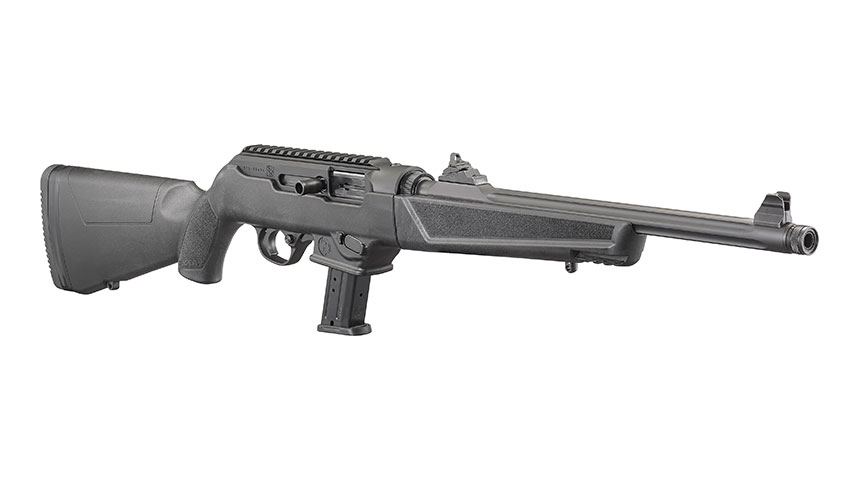
The Ruger PC in .40 offers a lot. It can be used with a slew of magazines. It is now chambered in .40 SW. It passes muster in most states, and the un-threaded version in even more. Compact, powerful, fast in use, what's not to like?
The FBI has kicked the .40 to the curb. Pistol makers find their .40 pistol lines are getting the cold shoulder. United States Practical Shooting Associationcompetition shooters still shoot .40, but that’s not much consolation for the ammo makers. However, the PCC might just be the avenue by which the .40 S&W finally gets the respect it was supposed to garner. Heaven knows the PCC is hot in competition right now.