Legends | The Perfect Gun For A Sharp-Dressed Man

posted on September 12, 2017
** When you buy products through the links on our site, we may earn a commission that supports NRA's mission to protect, preserve and defend the Second Amendment. **
17-nrz-010_legends-in-arms_main_9-12.jpg
Michael Ives

In the 1800s, canes were seen as an indispensable fashion accessory, and it was assumed that any man of good social standing wouldn’t leave home without one. There were canes for every occasion, and women carried them as well.
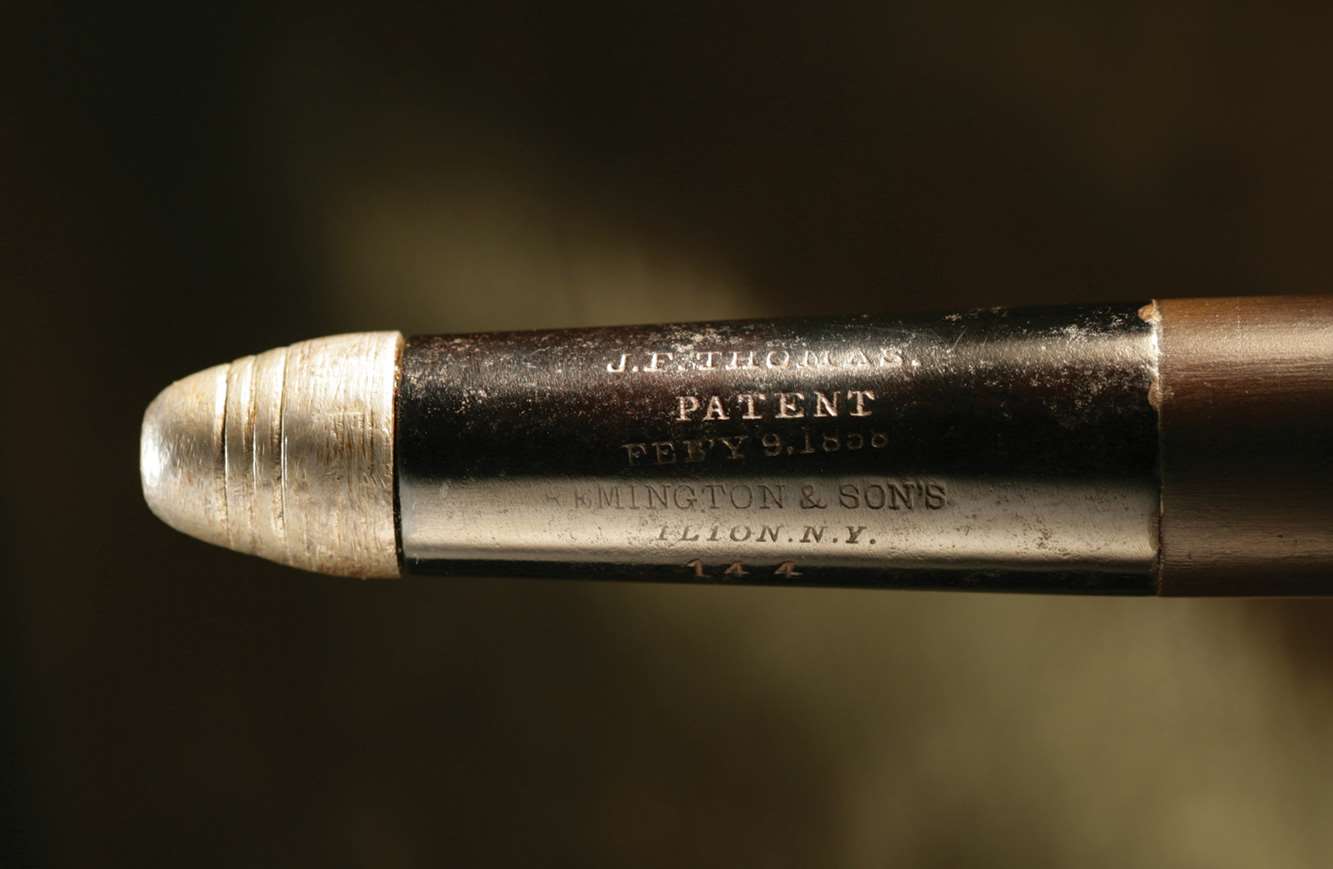
The cane guns were designed by Remington’s master mechanic, J.F. Thomas. Photo by Michael Ives

By the late 1850s, Remington Arms was looking to capitalize on this trend and began to manufacture cane guns that enabled dapper gentlemen to combine a de rigueur fashion accessory with a personal defense firearm. The single-shot arms were based on a patent, first issued in 1858 and extended in 1872, from Remington’s master mechanic, J.F. Thomas.

As originally designed, Thomas' invention consisted of two parts—a lower, or barrel section, complete with percussion cone; and an upper, or case section with attached cane head, which fitted over the cone and contained the gun's action. The internal hammer and inconspicuous button trigger aided in the disguise of this walking-stick-turned-personal-defense-arm.
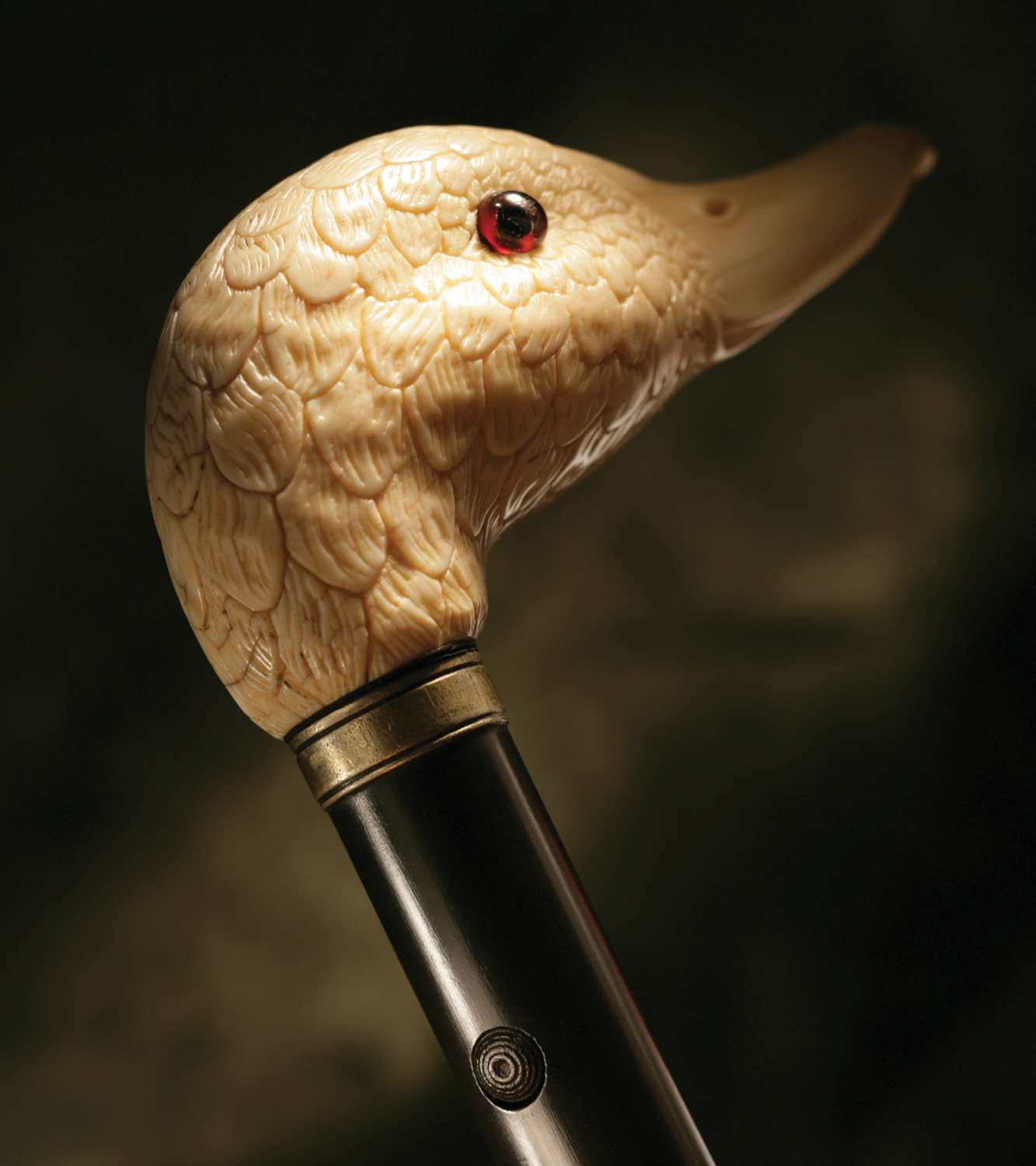
The cane with a deluxe carved ivory handle in the shape of a duck head with realistic glass eyes set a dapper gentleman back $15. Photo by Michael Ives

A black powder charge and a solid ball or shot were loaded through the muzzle. Cocking the gun was accomplished by pulling back on the handle—this exposed the percussion cone for capping, while also extending a catch spring that served to keep the action from being closed inadvertently. If desired, the case could be closed without firing by depressing the catch spring and pushing the handle forward. The gun could not be fired with the handle closed, which acted as a safety feature for its gentlemen user.

Approximately 2,300 of these guns were manufactured, 1,800 of which were of the .22 or .32 rimfire caliber metallic cartridge design. Percussion cane guns were offered in .31 and .44 calibers. The cane guns weighed between 20 and 24 ounces.

By 1877, any gentleman could acquire one of Remington’s cane guns with a gutta-percha grip for the sum of $10. A deluxe carved ivory handle in the shape of a duck or dog head with realistic glass eyes would add another $5 to the cost.

You can see this Remington single-shot cane gun at the NRA National Firearms Museum in Fairfax, Va. The museum is located on the first floor of NRA Headquarters.

Latest

William A. Bachenberg

President’s Column | What a Year It Has Been!

Wow! How fast a year has gone by since being elected president at the end of April last year! My first column was titled “It’s A New Day At The NRA,” and included the following:

Standing Guard | We Are the Good Citizens

I am a big believer in transparency. Each individual needs privacy from unconstitutional government intrusion—this especially includes what guns a law-abiding American citizen might own—but an association of freedom-loving citizens must be transparent.

U.S. v. Hemani Arguments

On March 2, the U.S. Supreme Court heard oral arguments in U.S. v. Hemani. The case involves a defendant who is fighting a federal indictment for possessing a firearm while being a marijuana user.

President’s Column | Getting You Up to Speed

A lot of things have occurred over the past month or so that not all members are completely aware of. I’ll use my column this month to update you on some important issues—transparency.

Standing Guard | The NRA Gathers to Celebrate Our Freedom

The momentum we’re seeing across the country is both encouraging and energizing. January opened with tremendous activity at the NRA booth during SHOT Show, where members, industry partners and supporters stopped by to connect, share ideas and reaffirm their commitment to freedom and the Second Amendment.

Port Authority Doubles Down on Constitution-Free Zone with High-Profile Arrest

As anyone who has passed a basic civics class knows, the U.S. Constitution is the supreme law of the land. All legislation and official government actions are subject to its limits.

Interests


Get the best of America's 1st Freedom delivered to your inbox.