Everyone has heard that odd thump in the dark. Many grab a flashlight and go looking. Others grab a firearm along with the light. Illumination can help you conquer the darkness—and discover the source of that thump. Is it a threat?
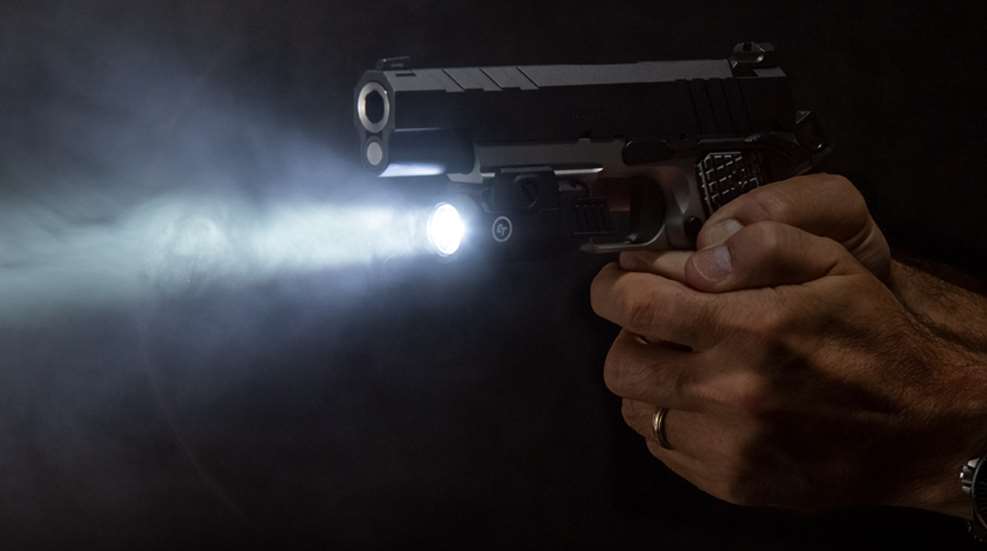
Most law-enforcement and military training teaches holding a handheld flashlight up over the weak-side shoulder with your weak hand—out away from your head in case someone starts shooting at the light. But there are inherent problems with this tactic; for example, if you use a handheld flashlight, you’d need three hands to reload or grasp another object. To mitigate this problem, consider securely attaching the light to your firearm.
You should choose the best option for your situation. This means you must train to understand the true feel of each possibility and its pros and cons. You must become proficient at working through situations, identifying targets (friend or foe) and making accurate shots in the dark.
Light the Night Exercises
Practicing in darkness means learning to aim, shoot, reload and manage other tasks, like taking cover, with limited visibility.
To become acquainted with the operation of the light and firearm, always first practice during daylight and include drawing, turning the light on and off and reloading. Once you can safely activate your light and shoot the firearm without looking at the safety and power buttons, then you can begin shooting in darkness. Dropped magazines or handheld lights on the ground are signs of failure in this type of practice—slow down and start again.
Caution: Shooting at night changes depth perception. As always, follow all NRA safety rules when using a firearm—especially in the dark.
Set several 8.5x11-inch paper targets secured on contrasting backgrounds ahead of your location at distances from 5 to 20 yards.
Starting with dry-practice, practice drawing or shouldering your firearm and aiming, as you activate your light, at the closest threat (target) and then the farthest.
Load the firearm with five rounds and have two extra rounds in a pocket or in a second magazine.
Draw or shoulder your gun and aim as you activate your light. Shoot two rounds at the closest target, then three rounds at the farther targets. Incorporate a reload time in this practice and use of barricades.
Back-Lighting
Next try using vehicle headlamps or a flood light as a light source from behind you, shining over your shoulder.
Set up with 8.5x11-inch white sheets of paper on contrasting backgrounds at various distances from 5 to 20 yards with vehicle headlamps or flood lights behind you.
Starting with dry-practice, practice drawing or shouldering your firearm and aiming at the closest threat (target) and then the farthest.
Load the firearm, and prepare at least two extra rounds in a pocket or magazine.
Draw or shoulder the firearm and engage the targets from nearest to farthest (or simply vary the target you choose). Shoot at least two shots into each target, then reload and shoot two additional shots.
Further Practice
You can also be better prepared for the unknown if you have a range partner place numerous targets down range—on a cold and safe range—while you stand and face away from the target area. Have them differentiate hostile and non-hostile targets into the layout (this can be as simple as Os and Xs). When the range is ready and safe, turn around and find, identify and hit only the threat targets. Just be certain to keep all practice safe and have someone standing behind you and watching carefully to ensure everything remains so.
You can also add additional stress by incorporating a timer or by adding a stress noise in the background, such as someone blasting a car horn or hollering into a bullhorn. Again, you want to identify friend and foe targets, and improve your time and accuracy with each drill.
Consider and Remember
Darkness presents unique challenges. Vehicle headlamps, street lights, home security lights and other sources might help you see the threats, but they can also give away your location.
Also consider that powdered debris from the muzzle may eventually cover the lens of any light near it, and that bright muzzle flashes can be disorienting. Remember that light distorts depth perception. Additionally, using lights can lead to tunnel vision, so practice safely sweeping the light around your target area to look for unforeseen threats.