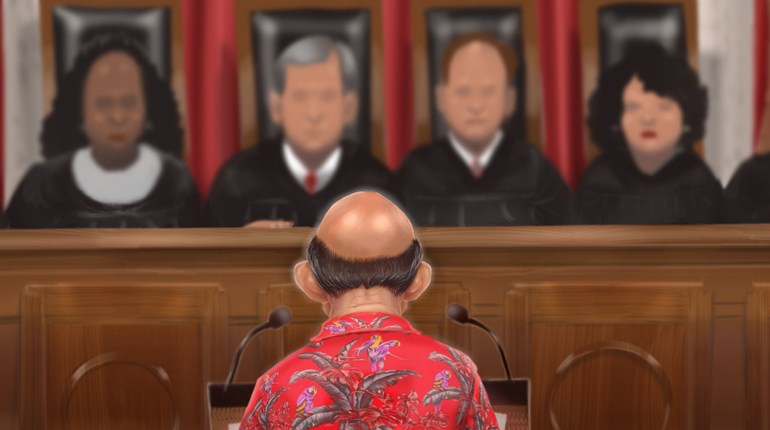
Once again, the state of Hawaii is attempting to nullify the Second Amendment within its borders. But, on Jan. 20, in Wolford v. Lopez, the Supreme Court will hear arguments on the constitutionality of a law that makes it a crime to carry a handgun on private property without the property owner’s explicit permission
I use the term “state” to describe Hawaii because, according to my history books, Hawaii joined the Union in 1959, and, in so doing, agreed to be bound by the U.S. Constitution. Sometimes, though, I’m left unsure as to whether Hawaii’s current government knows that.
In 2023, Hawaii passed a law, “Act 52,” that made it a crime for its residents to carry a gun on publicly accessible private property unless the owner explicitly permitted them to do so. Act 52 thus reversed the longstanding presumption that law-abiding gun owners are allowed to carry their firearms—with a few “sensitive-place” exceptions—pretty much everywhere, except in such cases as the owner of a private business that is open to the public has opted out. Overnight, concealed carriers in Hawaii were rendered unable to exercise their rights without risking committing a crime. Even carrying a gun while in the drive-thru lane became presumptively illegal. Carrying in the supermarket also became presumptively illegal. Carrying while pumping gas was suddenly presumptively illegal. Walking through a church parking lot even became presumptively illegal.
Hawaii’s legislature insisted that it was merely protecting “the right of private individuals and entities to choose for themselves whether to allow or restrict the carrying of firearms on their property.” But this is an absurd and dishonest claim. That right already existed, and it was already being exercised. What Hawaii’s legislature actually did was put its finger on the scale, and, in the process, turn almost all of the state into a so-called “gun-free zone.”
This, obviously, is illegal. Under the plain terms of the Bruen decision, the Second Amendment guarantees that an “ordinary, law-abiding citizen” has a “general right to publicly carry arms for self-defense.” Under Hawaii’s new laws, that right is obviated—not, as it claims, in a handful of “sensitive places,” but everywhere that a normal American citizen might go. As the Trump administration pointed out in a brief objecting to Hawaii’s law, “because most property owners do not post signs either allowing or forbidding guns, Hawaii’s default rule functions as a near-complete ban on public carry.” Add into the mix that Hawaii has not applied its new property-rights standard to literally any other item—tellingly, it’s only guns—and the intent of this government infringement becomes painfully clear.
It is shocking that Hawaii is even bothering to pretend otherwise. Indeed, it was only last year that the state’s supreme court made it clear that it does not accept the validity of the Second Amendment at all. In a bizarre case, Wilson v. Hawaii, a unanimous court not only ruled that the state’s right to keep and bear arms does not protect an individual right but also indulged in disrespectful and unprofessional diatribe against the U.S. Supreme Court’s landmark decisions in Heller, McDonald and Bruen. The court insisted that politicians in Hawaii were obliged, in construing the state’s right to arms provision (with identical wording to the Second Amendment) to “give consideration to the ‘Aloha Spirit,’” which “clashes with a federally mandated lifestyle that lets citizens walk around with deadly weapons during day-to-day activities.”
Until now, Hawaii has been largely successful in pretending the Second Amendment does not apply to its residents. And its politicians have only grown more confident in their abridgment of the right to keep and bear arms. Having determined that there is no right under the state’s own constitution to carry a firearm in public, they ensured that there is virtually nowhere in which a firearm can be carried under the auspices of the Second Amendment, either. When the U.S. Supreme Court decides what to do in this case, it ought to make clear once and for all that, Aloha or no Aloha, the Second Amendment is not an optional protection from government infringement in any part of these United States.