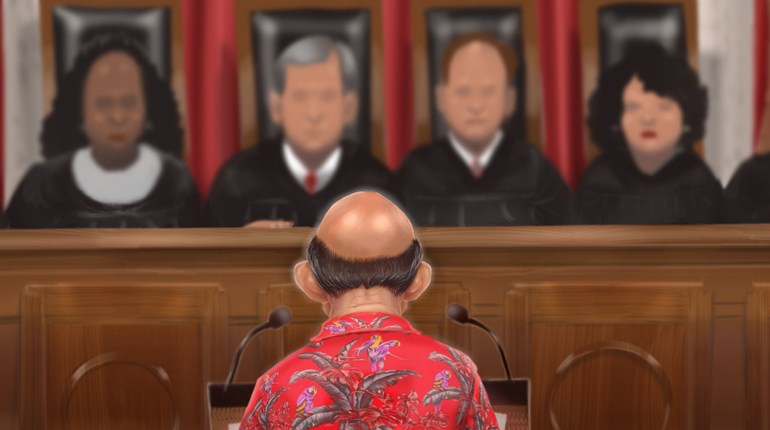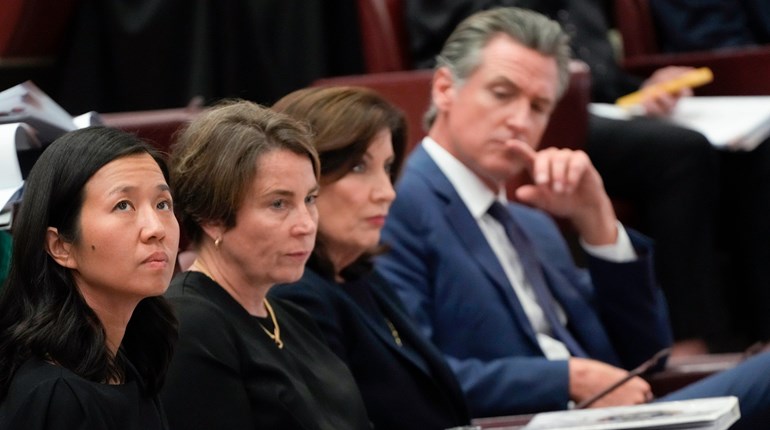
During oral arguments in the case of New York State Rifle & Pistol Association v. Bruen, U.S. Supreme Court Justice Brett Kavanaugh explained to the lawyer representing New York state that core individual rights cannot survive if they are to be subjected to the personal judgments of their opponents. “If it’s the discretion of an individual officer” that determines whether a person gets a carry permit, Kavanaugh suggested, “that seems inconsistent with an objective constitutional right.”
Kavanaugh was correct: If rights are to mean anything, they must be inoculated against subjectivity. We do not restrict speech because some people are offended by it; we do not deny the accused a fair trial because some people are nervous that there will be an acquittal; we do not inflict cruel and unusual punishments because some people think it is deserved; and we must not limit the Second Amendment because some people are scared of guns. There is a reason that we Americans chose to write down our liberties on paper.
It is, of course, true that firearms can be used to inflict harm. Indeed, it is precisely because they can be used to inflict harm that they are sought after by the tens of millions of Americans who wish to protect themselves from harm. But the important question in a republic such as ours is less whether guns can be used to inflict harm, and more who gets them? Underpinning the gun-control movement’s worldview is the belief that the answer to this question should be “only the government,” as if human beings who happen to work for the state are not people, too. But, in a free country, this approach will not do—in part because self-defense is a human right that applies to all citizens irrespective of their place within the firmament, and in part because to limit access to firearms to the elite class is to turn guns into mystical tools that can be wielded by the powerful alone.
In the 1940s, George Orwell wrote that the “rifle on the wall of the labourer’s cottage or working-class flat is the symbol of democracy. It is our job to see that it stays there.” In this asseveration he was channeling James Madison, who observed in Federalist No. 46 that, in most countries, “governments are afraid to trust the people with arms,” but that the new government of the United States was not. And how could it be, when that government had itself been created by an armed people? As Madison implied, it would make no sense at all for a government that claims to be representative to turn around after its election and disarm the citizenry for which it works.
Happily, more and more Americans are choosing to avail themselves of Madison’s unalienable right—and, in so doing, they are learning that the irrational fear of firearms that is so often on display in the media, in popular culture and in certain quarters of Washington, D.C., is both unnecessary and counterproductive. As a former Englishman who did not grow up with guns—and who was once against the private ownership of arms—I myself was somewhat nervous the first time I went shooting. Afterward, though, I found that I had changed. Having used a gun myself, I had acquired a great deal of respect for the power and responsibility with which I’d been entrusted, but I no longer had any fear.
In essence, it was a liberation. A liberation from fear, a liberation from ignorance and, ultimately, a liberation from mistrust—of myself, of my fellow countrymen and of the principle that all men are created equal, and that they deserve to be treated as such.
This appeared in the February 2022 issue of America's 1st Freedom.