While our 32nd president, Franklin Roosevelt, was known for the frequency with which he addressed the public, for many Americans one statement stands above all others made during his four terms in office: his characterization of Japan’s December 7, 1941 attack on the U.S. Pacific Fleet as “… a date which will live in infamy.” Certainly, the dramatic nature of the surprise attack at Oahu, Hawaii’s Pearl Harbor was not overstated by FDR: Only a day elapsed before an irate Congress gave him a Declaration of War against the Axis Powers, and America’s mobilization as “the arsenal of democracy” began to unfold. World War II became truly worldwide on December 8, with all the predictable, unpredictable and devastating consequences history now makes plain.

Japan had long chosen to be isolated from the rest of the world. For more than two centuries, the island nation had particularly eschewed involvement with the West. The U.S. Navy’s Commodore Matthew Perry changed all that when he sailed into Tokyo Bay in 1853-54, “asking,” over a 73-gun naval salute, for the opening of Japanese ports to U.S. vessels. Japan’s culture, politics and religion may have seemed both alien and secretive to him and other Westerners, but there was nothing wrong with the Empire’s collective intellect: Her leaders knew power when they saw it, and they raced–comparatively–to adopt some Western ways. Determined to avoid becoming a colonial vassal, they undertook an intense study of European and American methods of war-fighting early on as preventive measures against such an ignominious fate.For more than two centuries, the island nation had particularly eschewed involvement with the West.
Japan’s Boshin War—a civil war that ousted the Tokugawa Shogunate and reinstated the Imperial Court—dominated the late 1860s, but more importantly set the tone for the next 70 years. While Imperial forces were smaller, they were modernized in the Western sense, and thus the Shogunate fell. By the ‘70s, Japan’s mostly coastal defense fleet was using European-built, metal-skinned vessels (the Scotland-built ironclad Jo Sho Maru, renamed the Ryujo, beginning in 1870, and the fleet flagship Fuso starting in 1878). Even a French-built, ex-Confederate States ironclad (CSS Stonewall) found her way to Japanese waters as the Kotetsu.
In addition to vessels, know-how was also imported from Great Britain. British officers brought their considerable skills and long tradition to the Land of the Rising Sun, teaching everything from basic gunnery on up. At least three naval missions visited the islands between 1870 and 1879, with at least two Imperial Navy officers also studying in the United States..
By the end of the 19th century, most Japanese warships were still produced in British yards, but her Navy was of unassailable fighting quality. The Chinese learned this at the mouth of the Yalu River in September 1894, losing eight of 12 vessels in a key engagement of the Sino-Japanese War.
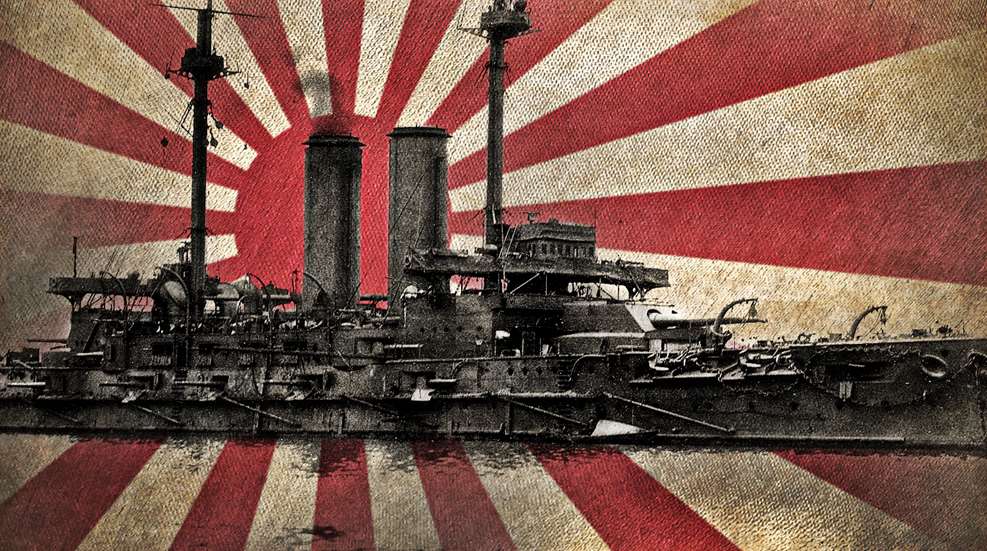
As the 20th century opened, Japan understood that her future would be determined by access to resources. British experience again provided important impetus, with colonial aspirations—and the need for a pre-eminent Navy—becoming a mainstay in Japanese foreign policy and relations. One hundred and nine ships were commissioned for the Japanese Navy in the late 1890s, including six battleships, 17 armored cruisers and cruisers, 24 destroyers and 63 smaller ships. When Vickers-built Mikasa reached Yokohama in 1902, she was equal or superior to most of the world’s battleships.The Chinese learned this at the mouth of the Yalu River in September 1894, losing eight of 12 vessels.
The Russo-Japanese War (1904-05) would dispel any lingering doubts about Japanese capabilities on the high seas. In a series of engagements beginning with a surprise attack on Port Arthur, the Imperial Japanese Navy would battle a modern European navy—first to a draw, and soon after to a humiliating, devastating defeat—at Tsushima in May 1905. Forty-five Russian vessels entered the battle; only 10 emerged. Czar Nicholas II’s fleet lost all 11 battleships, four of eight cruisers, and six of nine destroyers.
Japanese dominance in the western Pacific was thus assured for the foreseeable future. As an Allied—or, more correctly “Triple Entente” —power in World War I, the Japanese Navy helped secure some colonial expansion, mostly at the expense of Germany. The Empire cemented this hegemony with another crucial piece in the long-range puzzle during the teens and ‘20s: It could now build its own warships on any scale.
Naval planners were in no way standing still in terms of development in the interwar period. The emergence of naval airpower was probably less debated in Japan than in any other nation (a first carrier was operational in 1921, roughly a year ahead of the U.S. Navy), and Japan re-tasked both a battleship and cruiser hull to fleet aircraft-carrier design and duties. The Kaga and Akagi (respectively) were in service well before 1930, and the best and largest carrier fleet in the world—consisting of 10 ships—by the start of European hostilities in World War II (September 1939).
In retrospect, there is no question that the Japanese military had long expected a fight with the United States. By the late ‘30s, the antagonisms were clear: Japan’s thirst for raw materials was gigantic (the country had been exporting warships for 20 years), but its expansionism brought it into conflict with the U.S. and long-standing allies, mainly France, China and Great Britain. A September 1940 alliance with Hitler’s Nazi Germany boded further ill. In retrospect, there is no question that the Japanese military had long expected a fight with the United States.
FDR froze Japanese assets in July 1941 in retaliation for the occupation of French Indochina, with the Dutch and British following suit. Oil-poor Japan had reserves for three years at best, and far less at war tempo consumption. With a host of other imports and revenue streams cut off, war in the Pacific became an increasing certainty.
Seventy years of increasing Japanese militarism and advancing naval technology would reach a crescendo a mere five months later. Seventy five years ago this week, six of Japan’s 10 carriers were approaching the Hawaiian Islands for another surprise attack. More than 350 aircraft would vault toward the home of the U.S. Pacific fleet on a quiet Sunday morning, and find their American rival deeply unready. At a cost of only 29 aircraft, five midget submarines, and 64 sailors and airman, the Imperial Japanese Navy put the service of Bainbridge, Decatur, Farragut, Hull, Jones and Perry on its heels.
Though not for long.