Crime is a complicated topic, but there is an extremely simple rule that must be observed before one can begin to fight it effectively: One must genuinely wish to deal with the problem. Without such an elementary ambition, no amount of legislation, activity, taxpayer money or speechmaking will make the slightest bit of difference.
Violent crime, meanwhile, should never be used as an excuse to take away the rights of law-abiding Americans. Doing that isn’t just lying; it also creates perverse incentives. The far Left has behaved as if criminal mayhem—violent crimes with real victims—is useful for their anti-gun propaganda.
Law-enforcement officials are supposed to have one goal: to catch and prosecute criminals. This can be a tough job, but, as we have learned in places such as New York City during the 1990s, and more recently in Washington, D.C., it all begins with the desire to make a tangible difference, rather than to grandstand or to distract or to score partisan or ideological points on TV.
To many people in America—perhaps, indeed, to most people in America—this is all rather obvious. Unfortunately, those people tend not to be the ones who are running our major cities. The average American understands instinctively that violent criminals ought to be removed swiftly from the streets, that there is a clear link between policing and order, and that nothing useful is achieved by disarming the law-abiding. Too many of our mayors and prosecutors seem blind to these simple facts.
For example, as this was going to print, the current frontrunner for the mayorship of New York, Zohran Mamdani, had questioned the purpose of jails, described the NYPD as “wicked and corrupt” and insisted that “we need to ban all guns.”
The mayor of Charlotte, N.C., Vi Lyles, recently responded to a heinous murder on the city’s transportation system by saying that “we will never arrest our way” out of such problems; she instead suggested that the appropriate response was to “address root causes” and not to “villainize” the killer.
Last September, the governor of Illinois, JB Pritzker, dismissed complaints about Chicago’s high murder rate by saying, simply, that “big cities have crime.”
There are a whole host of specific problems with these figures’ political agendas, but, above all else, their sin is indifference. To them, crime is an abstraction, a debating topic, a segue to a different conversation. Each has his worldview, and each rejects anything that challenges it.
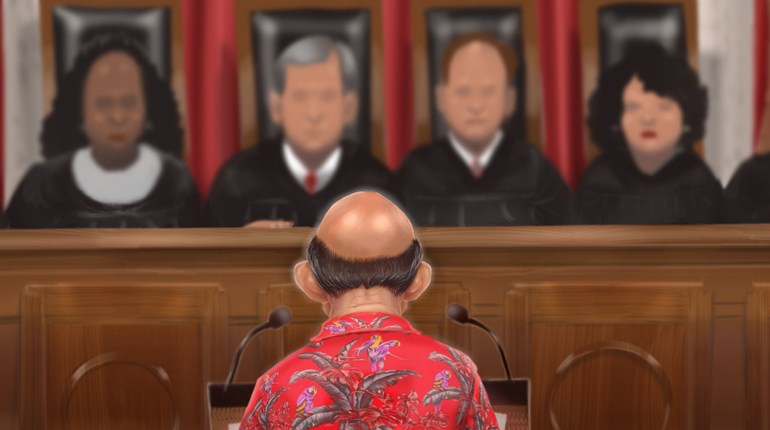
Consider the case of Washington, D.C. Under bad mayor after bad mayor the District has acquired a well-deserved reputation for violence, lawlessness and a general sense of personal insecurity, and, under bad mayor after bad mayor, the city’s government has responded to these problems by pointing its finger at everything—and everyone—other than itself. In particular, D.C.’s government has blamed the mere existence of the Second Amendment for crime. When, in 2008, D.C.’s total ban on handguns was challenged at the U.S. Supreme Court, the city’s lawyers insisted that they must be allowed to prohibit an entire class of commonly owned arms, lest the city would become unacceptably dangerous. Not only did the city’s brief propose that handguns “have no legitimate use in the purely urban environment of the District of Columbia,” but it vowed confidently that the maintenance of “a handgun ban would mitigate the very serious problem of handgun violence” there. After D.C. lost that case (in D.C. v. Heller), it continued to provoke other legal challenges by instituting a system of mandatory ballistic identification; by establishing a requirement that all firearms registrations must be renewed after three years; and by banning concealed carry completely within the city limits. (Once the city’s total carry ban was struck down, it replaced it with a “good-reason” requirement that was also nixed in the courts.) At every stage of this process, the city’s argument was exactly the same: That the ills it faced were the product of law-abiding citizens being able to exercise their Second Amendment rights, not of shortcomings in the way the place was being run.
This was always nonsense on its face. D.C.’s handgun ban was struck down in 2008, and, since that time, murders committed with firearms have decreased. In the 1980s, D.C. had an average of 180 murders committed with firearms. In the 1990s, that number was 300. And, in the 2000s, it was 160. Likewise, in the three years prior to the Heller decision, the number of estimated murders committed with firearms was 140, whereas, in the three years after Heller, that number was about 100. Again, crime is complicated. But if D.C.’s habitual claims were correct, one would not expect to see these trends—or, indeed, to see anything close to them. For a quarter of a century, the central contention that D.C. presented to the world was that the “deaths and serious injuries that handguns would cause would more than offset any benefits” associated with allowing law-abiding citizens to own or carry them. This, obviously, was incorrect.
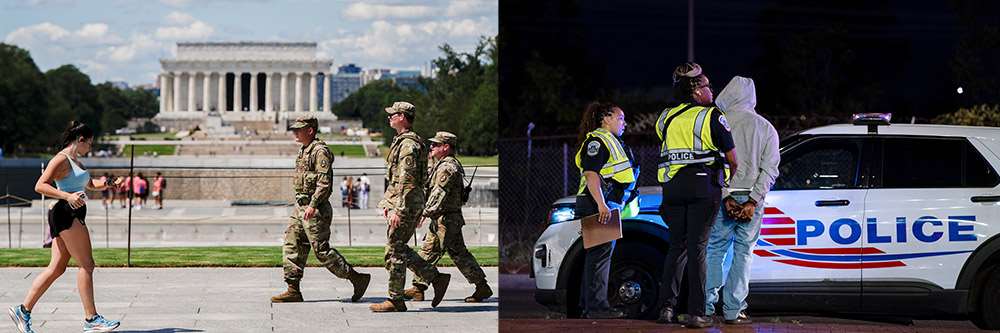
Also incorrect was the associated contention that D.C.’s afflictions could not be solved by good, old-fashioned policing. This summer, President Donald Trump (R) made the decision to deploy the National Guard to Washington, D.C., to deal with the city’s out-of-control crime. In the press, and within the city’s hapless government, Trump’s move was described variously as “controversial,” “unnecessary,” “manufactured,” “unwarranted” and “a brazen use of power.” In truth, a more accurate term would be “embarrassing”—for Trump’s critics.
Constitutionally, D.C. sits directly under the control of the federal government. It is true, of course, that the federal government may allow D.C. a role in that control if it wishes. But it is not obliged to do so, and if, in its judgment, the mayor or council to which its authority has been loaned is abusing its trust, the federal government may nullify their actions and substitute its own judgment. In complaining that the city had been “overtaken by violent gangs and bloodthirsty criminals,” and dispatching the National Guard to clean it up, this is exactly what President Trump did.
Good, old-fashioned policing—not a war on American freedom—made D.C. safer.
The results were so positive that D.C.’s mayor, Muriel Bowser, went from cautiously suggesting that “the fact that we have more law enforcement and presence in neighborhoods ... may be positive,” to confirming that “the federal surge has helped in fewer gun crimes, fewer homicides and led to an extreme reduction in carjackings,” to signing an executive order that permitted “indefinite coordination” between the city and federal law enforcement “to the maximum extent allowable by law.”
It is difficult to overstate the importance of the lesson on display. An inordinate amount of the coverage of the National Guard’s deployment has focused on the fact that the troops in question are federal. But, in the grand scheme of things, this is neither here nor there—especially in a federal city such as Washington, D.C. What mattered is that those troops were there, and that they had been instructed to keep the peace, rather than to indulge far-fetched social theories or to advance fringe political goals.
President Trump’s stated aim was to restore order. But, in achieving that, he also demonstrated the folly of more than 50 years of misplaced priorities in D.C. Shockingly, it turns out that obsessing over the types of guns that the good guys have—as well as how they are stored, how many rounds they may contain, why they want them, where they can be carried and how many they can buy in a month—is a ridiculous red herring that helps nobody. Replace that focus with another one—say, leaving the good guys alone, and using the government to create an environment in which there are “fewer homicides and ... an extreme reduction in carjackings”—and salutary things result.
Not every part of the United States is like Washington, D.C., nor should it be. Elsewhere, crime is mostly the responsibility of the states, counties, cities and towns that make up the country. But there is nothing whatsoever that prevents those jurisdictions from emulating what has been done in D.C., nor that prevents the citizenry in those places from insisting that their leaders do not abdicate their responsibilities.
It is bad enough for a mayor or a governor who has taken an oath to uphold the U.S. Constitution to spend his or her time attacking or undermining the protections they swore to protect. It is even worse for that figure to blame those protections for the poor conditions of his state or city, or to use them as an excuse for his failures in the job. In America, our governments exist to protect our unalienable rights, to keep evil from terrorizing good. If they don’t do that, they are useless—or worse. Evidently, the worst of all possible worlds is one in which the state does little to superintend the lawbreakers, while preventing everyone else from providing for their own defense.

It is one of the more peculiar aspects of our current political moment that, in so many places, we know exactly how to deal with crime, but are steadfastly refusing to do so. New York City fixed the issues that plagued it in the 1970s and 1980s, but then, having received praise from all around the world during the 1990s and early 2000s, promptly stopped trying. Similar backsliding has occurred in Philadelphia, New Orleans, Los Angeles, Seattle, Portland and Chicago—all of which made solid progress in reducing their murder rates, only to abandon many of the systems that were responsible for the improvement—while cities such as St. Louis and Chicago never adopted a useful approach in the first instance.
Why? They were consumed by ideology, politics, superstition and a desire to control. Every study ever conducted shows that there is a clear link between more police and reduced violent crime. Elementary logic determines that a violent criminal who has been separated from society will be unable to offend again.
As has been the case since before the American republic was a glint in George Washington’s eye, the right to keep and bear arms should not be a part of this debate.
In the late 18th century, Thomas Jefferson copied a couple of lines from the Italian philosopher, Cesare Beccaria, into his commonplace book. The first: That “laws that forbid the carrying of arms … disarm those only who are neither inclined nor determined to commit crimes.” The second: That such laws therefore “make things worse for the assaulted and better for the assailants; they serve rather to encourage than to prevent homicides, for an unarmed man may be attacked with greater confidence than an armed man.” Nothing that has happened in the intervening years since the founding of this nation has altered that fundamental truth.
Time and time again, we have been shown how to address crime, and how not to address crime. The question, as ever, is whether enough of we the people understand this.