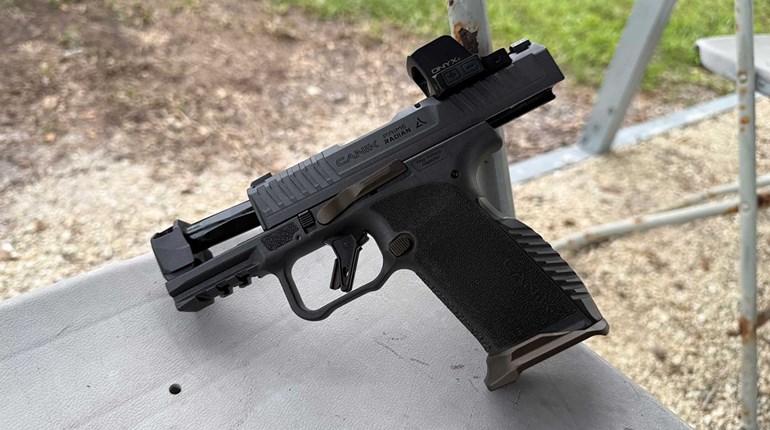
Ever see a pistol stop working because of a dust bunny? I have. Every-day carry (EDC) can be hard on handguns, but not for the reasons you might think. A sidearm in a duty holster gets rained on, gets bumped into door frames (car and building) and can even end up underneath the pile of struggling people in an arrest.
But for those who EDC concealed, the environment is different. It is both wetter and drier. Wetter in that we sweat. Sweating is the physical mechanism for cooling, called heat exchange, and we sweat—some of us a lot. That puts salty water on our handguns, in our clothes, onto and into our holsters. Then when we aren’t sweating, our body heat dries off the handgun, the holster, the clothing, and the cloth sheds bits of thread. The heat also causes the lubricant to flow, evaporate, and oxidize.
When I was gunsmithing, I saw more than one rifle or shotgun each year, with petrified oil in the trigger mechanism. Not to pick on WD-40, but that was what they had used. They’d get back form hunting season, lube the firearm, and then they’d leave it in the closet for the next 11 months. The heat and low humidity over the winter would dry out the oil, and lock up the trigger.
No mechanism is perfect. Nothing made by the hand of man is, with the possible exception of Rogier van der Weyden’s “The Descent from the Cross.”
A revolver will withstand the rigors of hiding under a jacket to a much greater degree than a pistol will. If you are going to sweat onto it, then one made from stainless steel—or stainless steel and aluminum—will stand up to your sweat better then blued steel. I had a customer once whose sweat was so acidic he sweated through blued steel in a day. We ended up doing a double hard-chrome plate job on his 1911, to keep it oxidation-free.
The revolver, since it depends on your trigger finger to cycle between shots, is much less bothered by lint, dust, and other clothing debris. If you opt for a model with an enclosed hammer (might I suggest a S&W M442, or a Taurus 650?) then there isn’t even that area of entry for possible dust bunnies.
Now, revolvers can break. I broke mine at the World Shoot in Rhodes, in 2011. I had to finish the match with a borrowed wheelgun. But, in all fairness, it had had a ton of bullets go down the bore, and had been dry-fired a bazillion times.
I was at a TV shoot when one of the guys decided it was time to finally clean the gunk out of his striker-fired pistol. I swear, there were dust bunnies in there that had applied for voter registration, they were so established. Did it work? He wouldn’t let us test-fire it before he cleaned it, so we won’t know in that instance, but the fact that he wouldn’t leads me to believe firing was doubtful.
Now, you do get a reduced ammunition capacity with a revolver. Or do you? A J-frame gives you five shots, a K gives you six. An ultra-compact 9mm single-stack pistol gives you six shots.
This is America, you get to choose. And the marketplace is full compact carry guns, just waiting for you to try and buy.
Just don’t be swayed by the gun counter experts, and the tacti-cool wannabes, who tell you that revolvers are old and obsolete. A six-shot snubbie, loaded with the latest high-tech ammunition, might be old. But obsolete? Never.
And there’s one big advantage wheelguns have over the ultra-compact pistols; accuracy. Useable accuracy. During a demonstration, I once used a 2-inch S&W M-15 on a steel plate at 100 yards. Six shots, six hits.
Try that with a deep-concealment 9 mm.