You’re working on a sprawling cattle ranch in New Mexico when you are forced off the road by armed men in trucks. They toss your tools into the ditch and pack hundreds of pounds of marijuana into your truck. Bound and blindfolded, they pack you off into the night toward an unknown destination. As the sun rises behind you in the east, you wonder: Will you ever see your family again? Will they ever know what happened to you?
However, you are lucky. At noon the next day, they dump you in Willcox, Ariz., tired and hungry, with a warning: Do not call the police, because we will be watching.
Ironically, you were kidnapped on Dec. 7, 2015—Pearl Harbor Day, created to honor the victims of a sneak attack by foreign forces on American soil. Border Patrol agents are being redirected from high-traffic areas to low-traffic areas. This keeps apprehension numbers artificially low, which DHS uses to claim success for its interdiction efforts.
The Vulnerability Index (VX) assigns values to the risks associated with our circumstances and choices, the goal being to get you thinking about your personal security. Ex-Secretary of the Department of Homeland Security (DHS) Janet Napolitano believed in such an index in 2010, when she promised that DHS would develop a “border condition index,” a complex matrix of crime stats and interdiction efforts that would create a more accurate yardstick for success.
Three years later, DHS official Mark Borkowski stunned lawmakers when he told Congress that he had no progress to report on the index. Despite abandoning the effort, Napolitano assured reporters at a D.C. breakfast, “We are confident that the border is as secure as it has ever been.”
But … are we? Is it? Is there really no way to answer the question: What is your VX on the border?
“We’ve seen a big increase in drug activity since September,” a shaken Tricia Elbrock told us. It was one of her Elbrock Water Systems’ employees who was performing maintenance on a water well south of Animas, N.M., when his truck was hijacked by drug runners. “One of theirs was stuck, and they needed our service truck. It could have been a school bus, or a UPS truck,” Elbrock said. “He was in the wrong place at the wrong time.”
Elbrock was on her way to a meeting between New Mexico and Arizona cattlemen and public officials that she hoped would raise awareness of their plight. “This county is poor anyway; what is this going to do to our insurance, workmen’s comp, propery values? This could be devastating.”
“We’ve seen a 25-percent increase in traffic in illegal crossings since Oct. 1,” said Paul Babeu, sheriff of Pinal County, Ariz. Babeu was speaking at a press conference on Tuesday with Brandon Judd, the president of the National Border Patrol Labor Council. They revealed some disturbing facts; among them:
- In 2013, Immigration and Customs Enforcement (ICE) released 67,800 illegal immigrants with criminal convictions. These were not unescorted children or families seeking a better life, nor did they have traffic violations; they were felons.
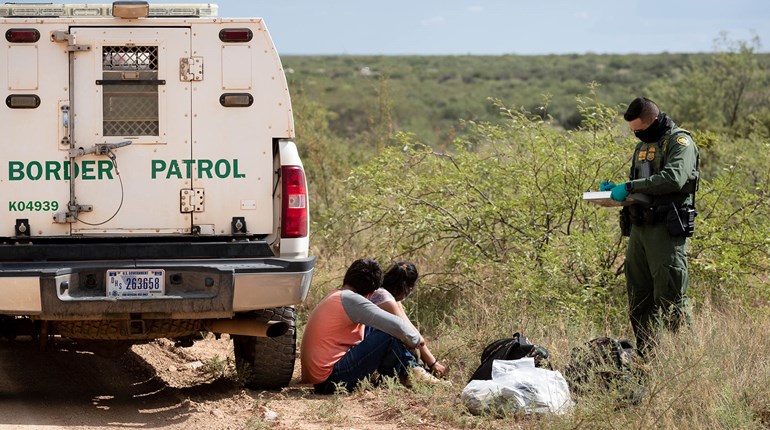
- Border Patrol (BP) agents are being redirected from high-traffic areas to low-traffic areas. This keeps apprehension numbers artificially low, which DHS uses to claim success for its interdiction efforts.
- BP agents have been directed to stop issuing Notices to Appear, which direct an individual to appear in court. About 40 pecent never show up, so an embarrassed DHS dropped the requirement—as well as any means to track those that did.
- Drug cartels funnel vast numbers of unaccompanied minors across the border illegally in order to tie up BP manpower, creating huge holes in the border that make smuggling easier.
- BP is not hiring agents fast enough to fill the 1,500 vacant positions created by retiring and exiting agents. On March 1, Customs and Border Protection Commissioner Gil Kerlikowske told Congress, “We are not able to hire as fast as attrition.” The 2016 federal budget cuts another 300 agents.
Kerlikowske probably didn’t help this personnel problem when he suggested that any agents who didn’t like the aforementioned amnesty policies should “look for another job.”
How are the locals going to address this escalating risk?
Sheriff Babeu says avoidance has been policy for some time: “There are signs posted on federal land in my county that say, ‘Danger, Warning, Travel Not Recommended, Drug and Human Smuggling Area.’”
Similarly, Elbrock says they have tried to avoid traffickers for years. When her employees encounter illegals, they turn and leave: “We leave them alone, and hopefully they leave us alone.”
However, the kidnapping has changed all that.
“We have safety meetings to talk about buried power lines,” Elbrock said, “but never in my wildest dreams did I think we’d have to talk about what to do if you’re kidnapped. We’re going to have to do things differently: No employee is going by themselves anywhere, and ranchers are just going to have to pay for it.” Kerlikowske probably didn’t help this personnel problem when he suggested that any agents who didn’t like the aforementioned amnesty policies should “look for another job.”
We asked Babeu: Would building a wall help? “What’s going to help us here is enforcing the current law,” he said. “When we have consequences, we have deterrent. Right now, there is no consequence for breaking immigration law.”
Babeu continued, “Always be aware of your surroundings. If there are people there who shouldn’t be there, be more vigilant. Call law enforcement, confront them, identify who they are, command them to leave if they’re on your property. And be armed. Arizona is a constitutional carry state, and I encourage people to be armed.”
Considering all this, just what does a New Mexico rancher’s VX look like? (Note: Criticism that the following math is subjective will be taken as encouragement.)
For starters, add 50 points to your VX just for being a cattle rancher in one of the two busiest corridors for trafficking drugs and illegals. Add 1 point for every mile of distance under 50 to the border. Add 10 points if your truck is newer than 2000, and another point for every year since 2005. If you sometimes work alone, add another 100.
You mitigate risk by maintaining good relations with the local sheriff, police and Border Patrol. You know the land and your neighbors, their families and vehicles. You do regular maintenance on your truck, and keep the batteries charged in your cell phone and radio. You maintain a high level of awareness. You own both a rifle and a handgun, and you train regularly. All this reduces your vulnerability by 75 points—give or take 25.
How close is help? At a distance of 20 miles from the border, the Border Patrol’s Forward Operating Base is not that forward; others are as far away as 60 miles (+25). BP agents are committed and respond quickly (-50), but high rates of turnover and attrition mean they are often new in town (+25) and stations are understaffed (+25). Even worse, they’re being reassigned (+50) and cartels are driving minors across the border to distract agency resources (+50).
Individual results will vary, but southwest ranchers can be comforted that Napolitano, who once promised that the border is as secure as ever, is on their side (0).