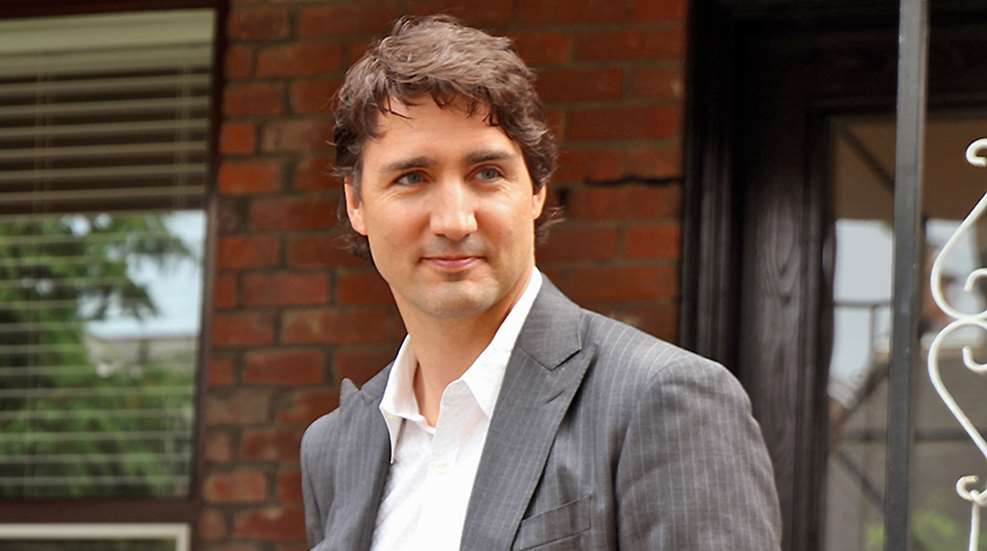
As he promised when he first announced a ban on over 1,500 firearms last year, Canadian Prime Minister Justin Trudeau recently announced new legislative proposals to restrict Canadian gun owners, including legislation that would allow individual cities to ban handguns.
As reported by The Hill, “The proposals include the Canadian government supporting municipalities that restrict storage and transportation of handguns within their boundaries. Breaching these bylaws would carry a maximum penalty of two years in prison and a possible revocation. Another proposal would create ‘red flag’ and ‘yellow flag’ laws that would make it easier for concerned friends and relatives to petition courts for the immediate removal of a firearm or to ask a chief firearms officer to suspend and review a person’s license for firearms.”
Trudeau’s ban and proposals, the prime minister and his supporters have claimed, are aimed at reducing violence in the country. Yet, the bans and proposals are aimed squarely at law-abiding Canadians.
Trudeau also promised to unveil a so-called “buy-back” program (a nice phrase for “gun confiscation”) in the coming months for the many firearms his original ban targeted; this will include “buy-backs” of the many semi-automatic firearms, especially, but not limited to, all AR-style platforms. However, the new bill, C-21, does not provide any details regarding this “buy-back,” or the compensation that would be paid for the confiscated property.
According to reports, the Canadian government will “allow” people to keep their prohibited firearms (for now), but will charge them a licensing fee while simultaneously prohibiting citizens from using or selling the privately owned firearms they own.
Trudeau’s proposed “red-flag” proposals are equally draconian. The proposal, as published on Public Safety Canada (PSC), a federal agency, would create an ex parte “red-flag” law that would “enable anyone to make an application to a court for an order to immediately remove firearms, for up to 30 days, from: an individual who may pose a danger to themselves or others; or a third party who may be at risk of providing access to firearms to an individual who is already subject to a prohibition order.”
As the proposal noted: “Weapons prohibition orders would help to address situations where an individual poses a risk to themselves, their family or to public safety, including perpetrators of intimate partner and gender-based violence, people at risk of suicide and radicalized individuals.”
The firearms in question would be seized immediately. In other words, a gun owner could be accused by anyone of being a threat to themselves or others and then would have his or her firearm(s) confiscated, presumably until after a court hears the case and they are vindicated.
Interestingly, the PSC analysis of the bill indicates it would allow for red-flag confiscations of guns from any, as the PSC puts it, “radicalized individuals.”
One has to wonder what exactly would define an individual as “radicalized” or as having a “radicalized” point of view; for example, would Canadians who strongly objected to the government confiscating their privately owned firearms be radical? Would it be radical to point out that the Canadian government did not sell these citizens the firearms the government plans to “buy back?”
In 2019, Trudeau and other Canadian politicians began publicly talking about banning many categories of firearms, including handguns. At that time, the Canadian Association of Chiefs of Police announced it would not support the handgun ban.
Vancouver police Chief Adam Palmer, president of the organization at the time, said in a news conference that those handguns being used in crimes were already illegal under Canadian laws.
“In every single case there are already offences for that,” Palmer said. “They’re already breaking the law and the criminal law in Canada addresses all of those circumstances. The firearms laws in Canada are actually very good right now. They’re very strict.”
More recently, the National Police Federation (NPF), the union representing over 20,000 members of the Royal Canadian Mounted Police (RCMP) and the largest police labor relations organization in Canada, has publicly distanced itself from the government’s program of banning and confiscating firearms from otherwise law-abiding Canadians. In an “inaugural position statement” on gun crime in Canada, the union challenges the effectiveness and social utility of such gun ban and confiscation measures.
Apparently, the laws are not strict enough to stop criminals from using firearms criminally. So, to stop these criminals from using firearms for illegal actions, Trudeau has unilaterally banned, and is working to further restrict, legally purchased and legally used firearms.
Sound familiar?