How many readers of this website enjoy seeing and posting hunting stories and photos on social media? Nearly all of you, would be our guess. Like Americans from all demographics and interests, we’re keen on sharing special times with friends, family and other like-minded folks. It’s pretty much how today’s world works, and we’ve embraced the virtual campfire. But is that about to come to an end?
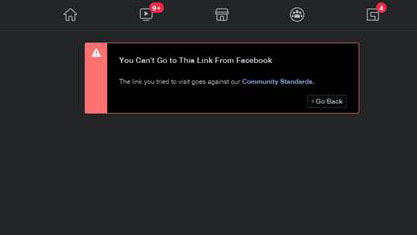
It’s not that hunters want to give up the connectivity, it’s that Big Tech, specifically Facebook (FB) and its subsidiary, Instagram (IG), have recently clamped down on one of the most prominent companies in the hunting industry. Rob Kern, vice president of the Hunting Consortium booking agency, was dumbfounded to learn in late July that his virtual library of 60 photo albums bearing hundreds of images was suddenly inaccessible. Users attempting to log into the albums would get a darkened-screen popup claiming the contents violate “community standards.” Then Kern noticed that he was blocked from using FB’s message function, and that anything bearing his company’s URL, email, or his personal emailed was dead-ended.
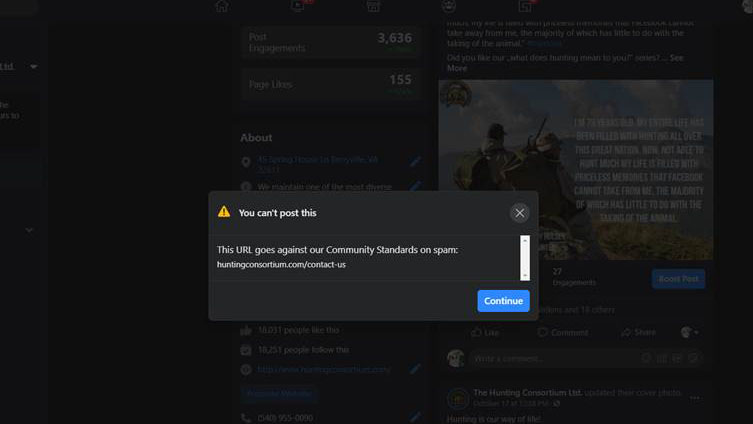
Included were the albums, representing some 60 countries where Hunting Consortium has sent clients over the years. “There was nothing bloody or in poor taste,” reports Kern. “And there were plenty of photos besides hunters with their game. There was scenery from wild places, camp photos, local people, conservation projects, and even images from an African village school built with hunters’ dollars. We were always mindful and proud of what we posted. Then … it was all gone.”
Kern immediately went to FB with questions, but got nothing in return. And though he’s continued to pound on the giant’s door … just crickets. Determined to reclaim his seat at the global table, Kern created #stophuntingcensorship. While that hasn’t cracked open access to the Hunting Consortium’s social-media pages, it did garner some attention and bring a few allies to the fight; and along the way Kern’s learned some troubling things about what he may be up against.
“I’ve been told we’re the ‘canary in the coal mine,’” says Kern, recapping conversations he’s had with the conservative Media Research Center, a watchdog group that exposes fraud and ethical misconduct in media. “[MRC] thinks we are being singled-out partly because we’re influential and successful. That they are making an example of us. But besides wanting to hurt our business, to shut us down, they want to see what kind of response they’ll get from the general hunting community. And if it’s not much, I’ve been told, they will step up efforts to go after other hunting-based pages, gun-based pages, conservation pages, who knows what else?
“I’ve also learned that this probably didn’t start with any of the higher-ups, but instead that the screeners are low-level employees who apparently have the power to blackball something they don’t like; even legitimate users highlighting activities that are completely legal, that contribute to local economies in places where people are poor and need help; activities that are the lifeblood of wildlife conservation and management. But as yet, no one from FB has done anything or even responded.”
In recent weeks, Kern has been proactive, reaching out to hunting and conservation groups and outdoor media in hopes of drumming up support in pressuring FB. “After the pandemic hit, we were getting great traffic to our page, which was crucial, since we were campaigning to encourage hunters who’d booked trips in 2020 to postpone rather than cancel their hunts. And it was working; more than 90 percent of them did choose to postpone, and that prevented many outfitters from going under. If not, hunting and conservation around the world would have been devastated. We’re happy we could do our part, but now, since the censorship shut down our pages, our business has been crushed.”
NRAHLF.org and other NRA Publications outlets have previously reported on social-media bias and its troubling implications for all Americans who cherish their right to self-protection, and the Second Amendment safeguards that make it possible. Now this same social rot is threatening the nation’s hunting tradition.
What gives, Facebook? Nearly a decade ago, a newly minted hunter named Mark Zuckerberg shared the satisfaction of his new-found challenge on his own FB page, and earlier this year confirmed, “I still go hunting.” Can you help out your fellow hunters?