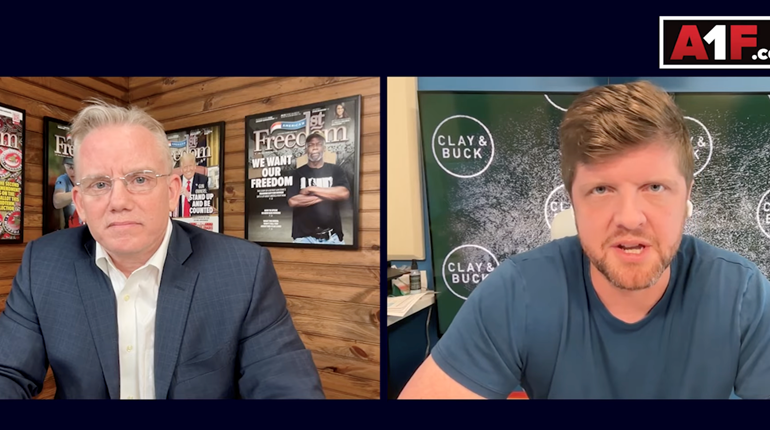
To go by the criticism of Judge Lawrence Van Dyke’s now-famous “video dissent” in the case of Duncan v. Bonta, one might have assumed that the man had stripped naked in his chambers and set fire to himself while singing the Macarena. As is its wont, the mainstream media dived into its thesaurus to find some useful poisonous words: VanDyke, they told us, “slammed,” “attacked” and “whacked” the court for its decision—and he did so in a manner unbefitting of the judicial temperament. If one did not bother to watch the video in question, one could have been forgiven for falling for this line.
But if one did? Well, then one understands both how silly the freakout was, and why VanDyke felt the need to use that medium in the first instance.
In effect, the video served as a supplement to his written opinion, that, like a drawing or photograph or blueprint, helps to substantiate the argument he offered in writing. In VanDyke’s view, the majority opinion from which he dissented was fatally flawed. And that fatal flaw was the result of a fundamental misunderstanding as to how firearms actually work.
“I share this [video],” VanDyke says at its outset, “not to supplement the factual record that we’re using to decide this case,” but “because a rudimentary understanding of how guns are made, sold, used and commonly modified makes obvious why California’s proposed tests and the one my colleagues are adopting today simply does not work.”
The holding to which VanDyke was objecting—and I am not making this up!—was that magazines that hold 10 rounds or fewer count as “arms” that are protected by the Second Amendment, whereas magazines that hold more than 10 rounds are “accoutrements” or “accessories” that can be regulated at will. There are all manner of serious legal problems with how the majority reached this view—including that it ignored Bruen’s ban on interest balancing and its requirement that gun laws have a historical analogue, and that it subverted Heller’s “in common use” provision—but, those problems aside, its conclusion is entirely unworkable. In essence, the court created a standard in which the only parts of a firearm that are covered by the Second Amendment are those that are necessary to make it fire just once. That being so, there is nothing within this decision that stops the government from banning almost anything it wants to—including grips, sights, triggers, holsters, stocks and magazines—or even from banning semi-automatic guns entirely. As VanDyke correctly concludes, this grants any government that is covered by the order an “on/off switch for fundamental constitutional protections.”
In a separate dissent, VanDyke’s colleague, Judge Patrick Bumatay, noted that the majority’s decision is the equivalent of telling a writer that, if he has access to a newspaper, his right to speak on the internet can be limited.
VanDyke agreed with this, describing the majority’s approach as “unprincipled.” But, above all, VanDyke rejected the underlying premise, which is that a magazine is an “accessory,” rather than a fundamental component of a type of commonly owned gun. Many judges, he observed, “know next to nothing about how guns actually work,” and many lawyers and legislators exhibit a “basic misunderstanding of how firearms work.” As such, he concluded, it “occurred to me that in this instance, showing is much more effective than telling.”
Interestingly, when complaining about his video, one of his colleagues described him as an “expert,” which, in law, is not supposed to be a pejorative.
That California routinely passes laws that reveal flagrant ignorance about the subjects being regulated is bad enough. That the Ninth Circuit has responded to these laws by awarding the state an unconstitutional, impractical and limitless standard of review is an outrage. Absent sweeping political change—or the intervention of the U.S. Supreme Court—there will be no immediate fix to this problem. But, Judge VanDyke’s patient demonstration of the flaw at the heart of the scheme is a good start.