The spring of 1775 was proving a desperate time in the American colonies. While December 1773’s Boston Tea Party is mainly remembered as the match-to-tinder event of the American Revolution, it was only the culmination of Jefferson’s “… long train of abuses and usurpations …” Political maneuvering on both sides of the Atlantic was intense to resolve many issues.

British subjects in the colonies were becoming more and more skeptical of the chance for peaceful resolution to the many problems of distant, unrepresented governance. By 1774, the Stamp Act, the Quartering Act and the Tea Act (among many others) brought about Patriot shadow governments (like Massachusetts’s Provincial Congress), and these saw to the forming and training of local militias throughout the colonies. The vast majority of these citizen-soldiers reported with their own arms.
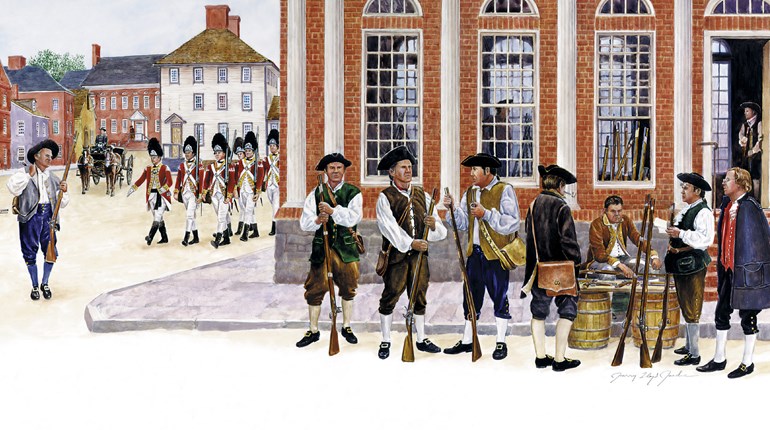
All pretense and maneuver ended on April 19, 1775. British Gen. Thomas Gage dispatched Lt. Col. Francis Smith and Maj. John Pitcairn from Boston with 700 British Regulars to confiscate arms in both Lexington and Concord. The British triumphed initially, but found few weapons. At Concord Bridge, however, the Redcoats were decisively turned back. The now-assembled Minutemen harried them all the way back to Boston, and they were only saved from annihilation by reinforcements from Boston, and waning American powder and shot.
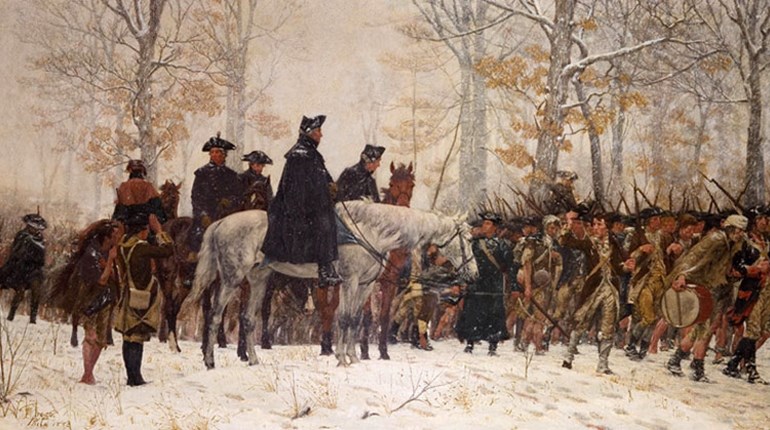
The Second Continental Congress convened that May in Philadelphia. As desperate as things now stood, the majority of delegates still hoped for a rapprochement with King George III. Precautionarily, Congress formed the Continental Army in June, appointing George Washington to the grade of major general and commander-in-chief.
The King rejected the Olive Branch Petition in August, and the Continental Congress grew correspondingly less moderate. The engagement of Hessian mercenaries to restore British control was ominous. No options remained by the summer of 1776, when Thomas Jefferson penned the Declaration of Independence and the colonies made clear their irrevocable intention to break away from England.
Over the next five years, the Continental Army would suffer and dare greatly. Inexperienced soldiers compared to their English counterparts, Washington and his staff nevertheless rallied their troops time and again against a numerically, organizationally and logistically superior foe. They learned quickly, made allies where they could (notably von Steuben and General Rochambeau), and maneuvered many facets of the conflict to their strengths and British weaknesses (or even the reverse, as at the Battle of Cowpens). While most major engagements went to the King’s forces, years of hit-and-run, guerilla tactics and noted marksmanship took their toll. It was an exhausted and demoralized English Army that Charles Cornwallis surrendered on Oct. 19, 1781. Through the lens of time, our nation’s first fighting force remains importantly similar to that which protects the nation today
It’s interesting to note the Continental Army did not entrench and bureaucratize itself after the Revolution; indeed, it was disbanded. Though Washington lobbied for a small permanent force, the new nation’s distrust of standing armies won out. Washington resigned his commission—having never asked for or been paid for his service—to return to Virginia and his beloved Mount Vernon in 1783.
Through the lens of time, our nation’s first fighting force remains importantly similar to that which protects the nation today. For one, it was a racially integrated, all volunteer force, and African American soldiers received their liberty at the end of their enlistments. One in every five soldiers in the Continental Army was not of European descent. Such integration would not be seen again until Korea.
Then, as now, a significant proportion of service members were also not full-time soldiers. Though National Guard and Reserve troops are certainly better trained and equipped than they were in Revolutionary times, the ideal of the citizen-soldier under civilian authority remains very much intact.
The Army has waxed and waned through the subsequent 230 years, dramatically growing for WWI, WWII, the Korean War and Vietnam. Roughly stable in size since the 1990s, it has durably fought the Global War on Terror for more than a decade, and continues as an unmatched bulwark and mirror of those original Continentals.
This Independence Day, it is also worthwhile to recall that a major element of pre-Revolutionary discord, eventual Colonial victory and of U.S. constitutional construction following the war were English attempts to deprive American colonists of individually owned arms. It was not merely East India Company tea in Boston Harbor, but also General Gage’s raid on the Charlestown powder house that made British intentions of disarmament clear.
If not for the nascent United States Army in the form of every man with a rifle (paraphrased from Gage’s aid John Andrews), King George would have made good that intention, and our Nation would never have been.