Not too long ago, American Warrior looked at a strange confluence of events in Southeast Asia. Little did we expect to find another quite so soon, nor in the same locale, but the calendar is what it is: The second week in January (the 10-17, actually) was a big one in the history of Vietnam, and for United States involvement there.

Several weeks in Jan. 1946 saw the first Vietnamese election: In it, Ho Chi Minh’s “Viet Minh” in northern and central Vietnam sought to assert its autonomy from France. Another January—that of 1950—saw it recognized by the Soviet Union and the People’s Republic of China as the official government of Vietnam, though expulsion of the French would take nearly four more years in the wake of the Battle of Dien Bien Phu. After a period of consolidation, the North Vietnamese Communist Party approved a “people’s war” on the South (Jan. 1959). Though the Sept. 1959 ambush of two South Vietnamese companies is considered the start of the war, the struggle for control of the Mekong River delta—just a few tens of miles from the southern capital of Saigon (now Ho Chi Minh city)—started in January, too: Jan. 1960.
In Dec. 1962, 82 U.S. Army H-21 “Shawnee” helicopters arrived in South Vietnam. A few days later, and 54 years ago this week, they went to work in a notably successful, early air cavalry operation. More than 1,000 South Vietnamese paratroopers attacked and defeated Viet Cong strongholds west of Saigon. While the Army had been using helicopter-borne troops since 1952, this early, larger-scale success was a building block for cavalry deployment during and after Vietnam.
That same day (Jan. 12), the United States Air Force launched Operation “Ranch Hand,” which over the next nine years would defoliate between 10 and 20 percent of South Vietnam. The goal was to unmask Viet Cong activity against South Vietnamese troops and civilians (and particularly along the “Ho Chi Minh Trail” in the dense jungle) and was partially successful. Even at the time, however, use of the defoliating agents—mainly “Agent Orange” (so named for its container)—was controversial, and later blamed for many health problems among both U.S. veterans and Vietnamese who were exposed.
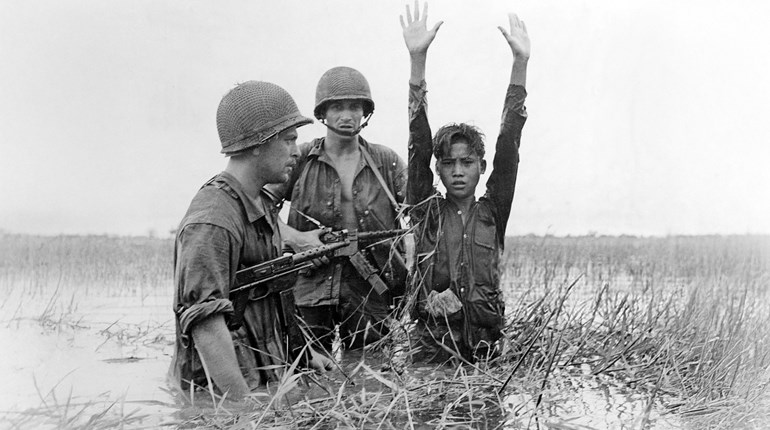
Jan. 13 saw the beginning of a third operation, “Farm Gate.” Approved by President John F. Kennedy a month earlier, it would see 229 sorties flown by USAF pilots against Viet Cong targets in only 18 days. They were the first nearly 5.25 million eventually flown by U.S. pilots during the war. Interestingly, at a Jan. 15 press conference, President Kennedy was asked if U.S. soldiers were fighting in Vietnam. His reply, unexamined by the star-struck press corps of the day, was “No.”President John Kennedy was asked if U.S. soldiers were fighting in Vietnam. His reply, unexamined by the star-struck press corps of the day, was “No.”
Fast-forward two years, and the springboard for the Gulf of Tonkin “Incident” and Resolution also occurred this week—President Lyndon Johnson’s approval of “Oplan” 34A. This action was meant to take the war north (since the Viet Cong were already actively attacking in South Vietnam), and permitted U.S. Navy monitoring of South Vietnamese commando raids against Communist coastal and island installations in the Gulf. By August, this placed the USS Maddox in the sights of North Vietnamese patrol boats, and she came under attack. Charges were bandied back and forth in the wake of a second—and disputed—attack, but in the long run, the damage was done: The Gulf of Tonkin Resolution would pave the way for American ground troops to enter the conflict (Aug. 10, 1964).
Eight years later (Jan. 13, 1972), President Richard Nixon stated 70,000 U.S. soldiers would leave Vietnam in three short months, cutting by half the remaining troop strength. By May, only 69,000 U.S. service men and women would remain—roughly an eighth of the number of troops present at the height of the war in 1968.
At least for the United States, the end was only a merciful year away, and a final January anniversary: In the wake of Operation Linebacker II, President Nixon ordered combat operations to cease on Jan. 15. Less than two weeks later, the Paris Peace Accords were signed.
Sadly, the abandoned South Vietnamese faced another almost two-and-half disastrous years fighting the Communist North. At noon on April 30, 1975, People’s Army of Vietnam T-54/55 tanks broke through the gates of Independence Palace, and the war was over.