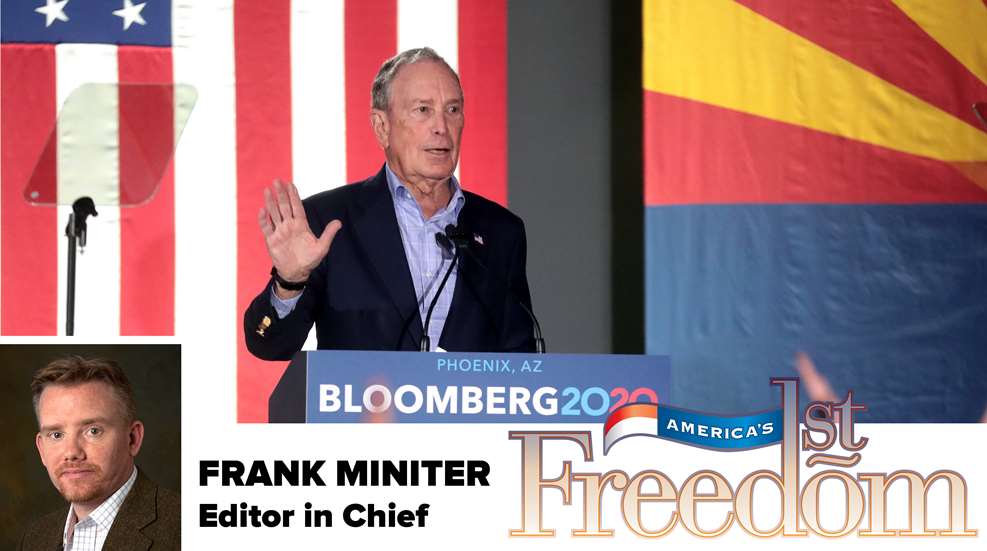
Photo: Gage Skidmore courtesy Flickr under Creative Commons CC BY-SA 2.0
Clips from a 2015 speech Michael Bloomberg gave at the Aspen Institute should be playing on mainstream news channels just as often as Bloomberg’s campaign ads.
“95 percent of your murders—murderers and murder victims fit one M.O. You can just take the description, Xerox it, and pass it out to all the cops,” Bloomberg said. “They are male, minorities, 16 to 25. That’s true in New York. That’s true in virtually every city…. And the way you get the guns out of the kids’ hands is to throw them up against the wall and frisk them.”
Bloomberg also said, “And then they start … ‘Oh, I don’t want to get caught,’ so they don’t bring the gun. They still have a gun, but they leave it at home.”
Such is the tough New York talk Bloomberg uses in safe spaces like Aspen.
“If you can stop them from getting murdered, I would argue everything else you do is less important,” Bloomberg said. And that’s a good point, but it comes with a deceptive premise he expects us to buy into. Bloomberg, you see, often argued that the “stop-and-frisk” policy New York City used while he was mayor was necessary, and there is little doubt it saved lives in New York City’s toughest neighborhoods. But the thing is, when you take away one constitutional right—in this case, our Second Amendment right to keep and bear arms—you end up in a position in which you need to diminish another constitutional right—in this case, the Fourth Amendment “right of the people to be secure in their persons, houses, papers, and effects, against unreasonable searches and seizures…”—in order to keep people safe.
Bloomberg’s associates knew what he said at the Aspen Institute wasn’t politically correct; as a result, after he gave the speech, representatives for Bloomberg’s team actually asked the Aspen Institute not to let people hear or see the video footage, according to the Aspen Times.
Bloomberg might be the $61 billion man, but buying an election in a free society still means controlling your image. In this case, however, the audio leaked out.
As this just isn’t a position today’s Democrats favor, just before Bloomberg entered the race for president last November he tried to sidestep his record. “I can’t change history. Today, I want you to know that I realize back then I was wrong, and I am sorry,” said Bloomberg, referring to the stop-and-frisk policy he’d bragged about just a few years before.
To put this in context, Bloomberg, when he was mayor of New York City, tried to be one of the common folk by riding the subway to work (in this case, City Hall), but, regardless, it’s a safe bet that he was never stopped and frisked—mayors, especially those with security details, just don’t get that treatment.
It is also a safe bet that he never needed a self-defense gun, as security details are paid to handle all that.
Now Bloomberg is running for president. If he somehow wins the presidency, the first thing he’d like to do is disarm every average American citizen. He mistrusts the individual American so much that he doesn’t even think the everyday hero named Jack Wilson, a concealed-carry permit holder and member of the West Freeway Church of Christ in White Settlement, Texas, who stopped a murderer, should have the right to carry a self-defense gun.
“It’s the job of law enforcement to have guns and to decide when to shoot. You just do not want the average citizen carrying a gun in a crowded place,” said Bloomberg just after Wilson had saved lives in that church.
Presidential races are filled with hyperbole and pageantry, but it’s revealing things like these statements from Bloomberg that build or destroy candidacies.