In the realm of self-defense, they say the fastest reload is the one that didn’t happen. Moreover, most gunfights don’t require a second magazine—this is part of why revolvers are still a viable carry option. To that end, if the shooting community can cite six rounds as being enough for most scenarios, then 21 ought to be plenty. This was the thought process behind the development of KelTec’s PR57, a modern spin on one of the founder’s first pistols.
George Kellgren’s P-10 was quite innovative for 1988, as it featured polymer construction and a capacity of 10 rounds of .380 ACP, which was revolutionary for a pistol of its size in those days. As eye-grabbing as these features were, they paled in comparison to its use of an internal magazine. By eliminating the parts needed to allow for a detachable box, several potential failure points were eliminated, as well as a substantial amount of girth. Today, mainstream gun culture has turned slightly away from the .380, as we’ve figured out ways to make pistols chambered in 9 mm Luger nearly the same size; nevertheless, at the same time, the zippy 5.7 x 28 cartridge is gaining legitimacy.
Like its predecessor, the PR57 does not have the capability to take a removable magazine. Instead, it is loaded through the ejection port. It holds 20 rounds, plus one in the chamber. Loading it can be performed one round at a time by hand or through the use of the two included stripper clips that hold 10 rounds each. These clips do a good job of retaining the cartridges, so carrying one in a pocket as a speed loader isn’t unrealistic.
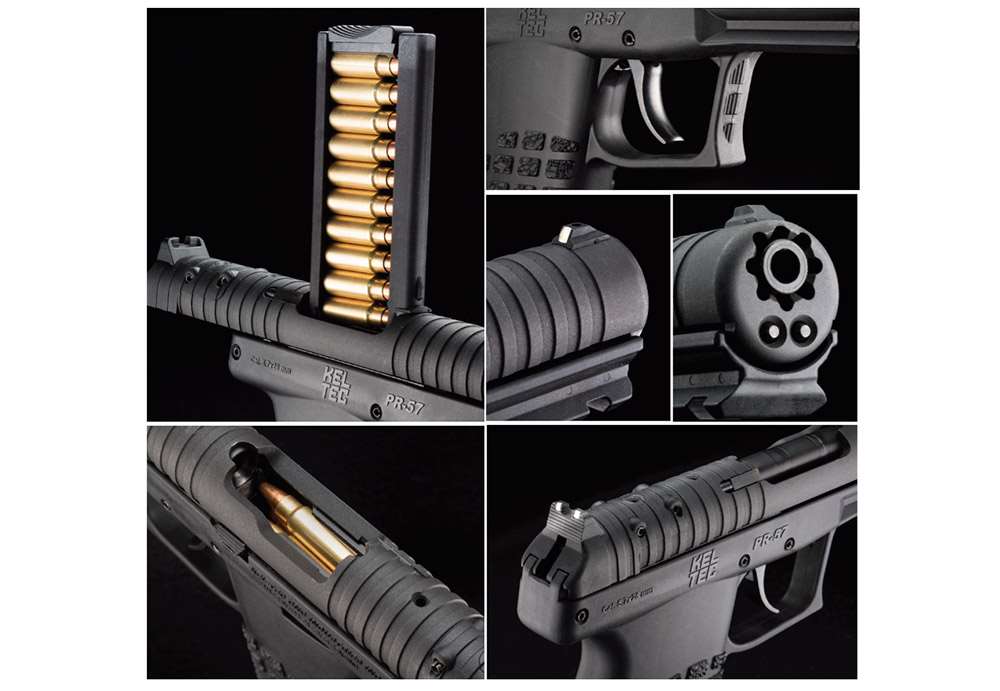
The 5.7 x 28 mm cartridge generates more pressure than average pistol ammo, so measures needed to be taken to ensure the action can handle it. KelTec met this challenge by designing a rotating barrel system that unconventionally locks into the muzzle end instead of the breech. This is an effort to simplify the design to pack more barrel length into a more-compact footprint, so you get full-size accuracy and velocity out of a pistol that is extraordinarily easy to conceal.
KelTec’s PR57 was designed from the ground up to be a reliable self-defense gun, which also translates into its control suite. No detachable magazine means no magazine release—one snag point is then eliminated. The gun is also devoid of a manual safety; it relies on its long double-action trigger mechanism and a deenergized semi-internal hammer to make the gun as safe to carry as a revolver.
 A minimalist slide stop is present, but it is not joined by a takedown lever. Disassembly of the gun is instead initiated by pressing the trigger forward—a process that I found to be easy.
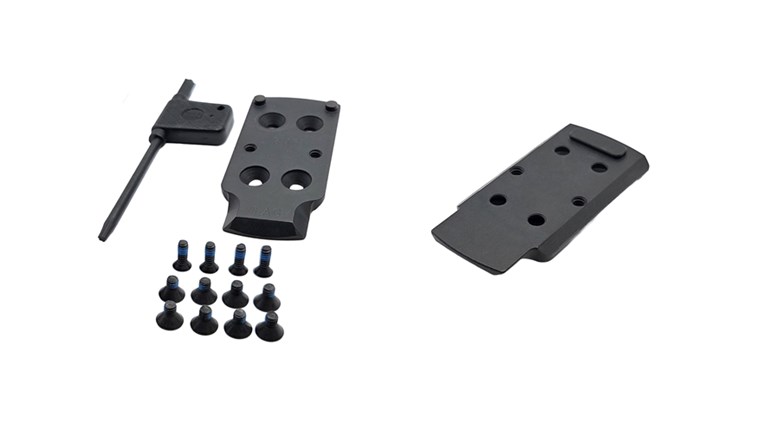
Those looking to add an optic are afforded all of the necessary hardware.
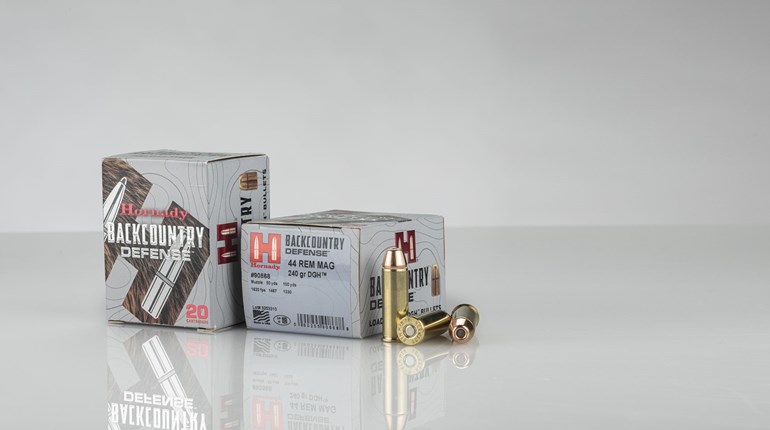
There is a lot of ammunition available for this chambering. As previously mentioned, the 5.7 x 28 cartridge has experienced substantial growth over the past few years, so there are now at least a dozen different offerings. Hornady has expanded its Critical Defense line to include a 40-grain load that is built with the same protected FTX projectile as much of the rest, so I decided to include it. I paired this with two loads from Fiocchi, the company largely responsible for this cartridge’s current popularity. With that, I included its frangible 35-grain load as well as its heavy subsonic offering. I then made my way to the range to see what KelTec was able to accomplish with this funky pistol design.
I was delightfully surprised by how well the PR57 accepted singularly loaded ammunition. The first 200 rounds went off without a hitch. The only malfunctions to speak of were with the subsonic load, which I predicted, as these almost always need a suppressor to generate enough push to fully cycle the action. After the first 60 rounds, I started working with the stripper clips, which were surprisingly easy to use.
I appreciated being able to pause the action to top off the magazine, something that isn’t always possible or easy with fixed-mag designs. Moving on, I fabricated some stoppages, including stovepipe, misfire and failure-to-feed incidents, and confirmed that the conventional immediate action procedure of Tap-Rack-Bang pertains to the PR57. Locking back the open-top slide also offers enough clearance to work out a double-feed situation, should one ever arise.
The gun was just too much fun to shoot fast, as recoil was on par with most rimfire pistols of the same size; however, work is work. Firing from the bench-rest revealed just how smooth the trigger movement on this pistol is, which was downright impressive. At a shade under 4.5 pounds, it’s remarkably light for a double-action-only handgun designed for this purpose. One oddity is that you must return the trigger fully forward to make the gun ready to fire again; the hammer won’t reset and the gun won’t fire otherwise. For a personal-protection firearm, the resultant test groups were more than acceptable and were consistent enough for general target practice, allowing me to make the claim that the gun is useful, no matter how you plan to employ it.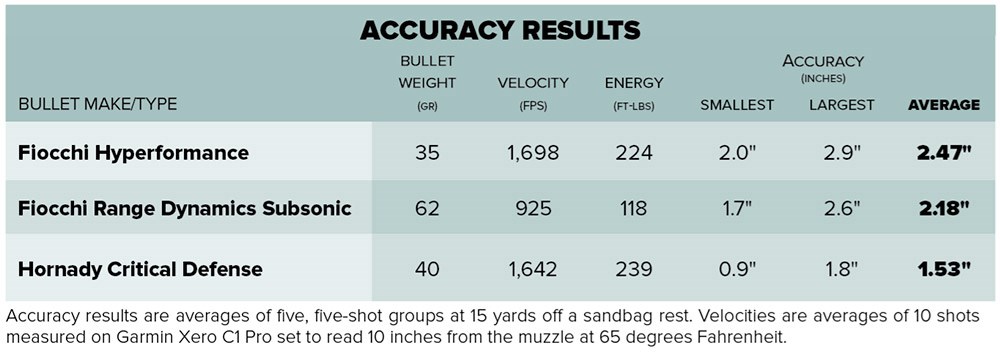
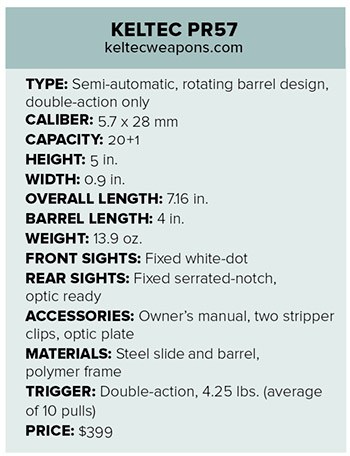
I finished—and pondered how much it might be to keep my sample. In keeping with its roots, KelTec prices this gun affordably with an MSRP of $399. At this amount, it qualifies as a “just cool to have” kind of gun, particularly if you have yet to delve into 5.7.
I do have one gripe, which is that the gun doesn’t have a button to dump the internal magazine, and hand cycling 20 rounds out of it is an arduous process, but, you can always dump them by firing into the berm at the range, which I find to be far more enjoyable. And, in so doing, you’ll also remind yourself how endless a 20-round magazine can feel.