Back when I was a new gun owner, I drilled in a habit of checking to be sure my firearm was unloaded, which was also a terrific opportunity to work on gun-handling skills like racking the action and activating the controls. I decided to adopt a mindset to perform this status check at such a frequency that an onlooker might consider me paranoid—yet this “paranoia” has kept me safe, whereas pride might have gotten me hurt. Eventually, and under instruction, I gained the confidence to carry a firearm on my person, and with that, I had to modify my habits. Although I’d spent a lot of time building the habit of ensuring a firearm was unloaded, I hadn’t spent a lick of time building the skills to ensure one was loaded properly when that was my intention.
If you had a good instructor, then the concept of constantly checking to ensure that a gun is unloaded is likely deeply embedded as a vital skill for you, too. But were you trained to verify that a round is indeed in the chamber before you stake your life on your firearm’s loaded status? We tend to blindly believe that the slide stripped a round off the magazine when the action was released, but that’s not always true.
For example, if the magazine didn’t seat properly, a round probably didn’t load, so the loading process must start by aggressively slamming the magazine into the well. (New shooters are often timid during this process—usually out of fear that they’ll damage the gun or the magazine. I can proudly state that I have yet to see that happen, even when a beast of a person pounds a polymer magazine into a polymer-framed firearm.) Next, if time allows, you then need to give the magazine a tug to ensure it clicked into place, and then you are ready to chamber the first round. To chamber, you need to firmly pull back on the slide or charging handle until it reaches its rearmost position before allowing it to slam itself closed without any interference. (Trying to guide it forward denies the return spring the inertia it needs.)
As fast as all this happens, it can be difficult to tell whether a round was successfully chambered. You can easily verify if you have an inspection window that lets you see the brass through it, or if you have another loading indicator, but it’s a good habit to check the chamber every time you’ve racked the slide after inserting a magazine. If you don’t have a loaded-chamber indicator or window, you’ll need to manually verify your loaded status. This is where the press-check comes in.
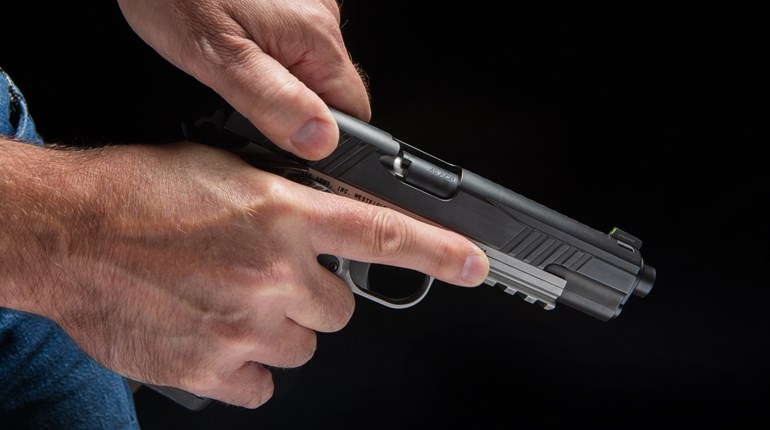
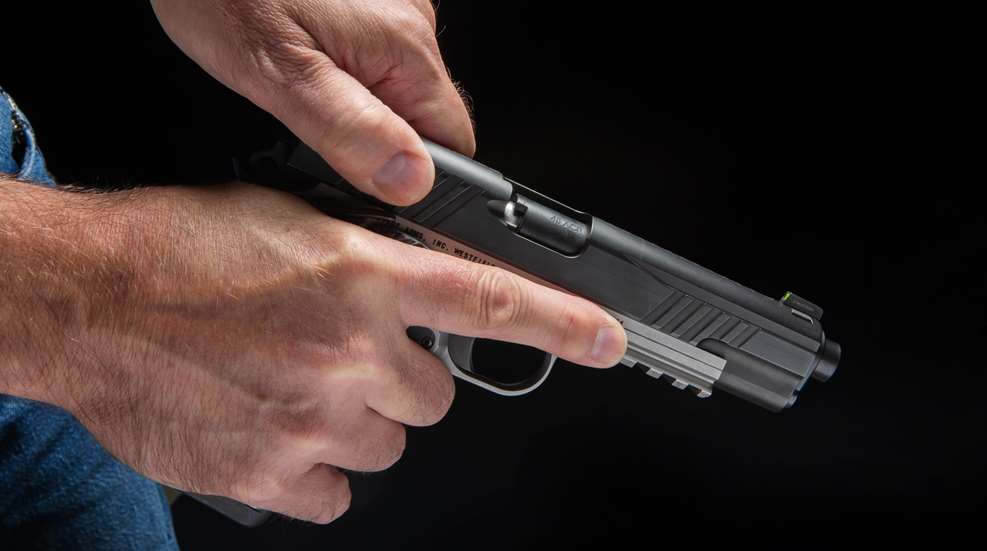
In the case of the pistol, we can reach assuredness by pulling the slide back just a crack. Envision how long your given cartridge is, and don’t exceed half of that length when pulling the slide back. The reason we don’t want to go too far is because we could begin the ejection process, and then we’d have to start over again and likely clear a stoppage before doing so. After pulling the slide back a fraction, what you should see is a shiny case body that is within the grasp of the extractor but has yet to completely leave the chamber. If this is so, simply let go of the slide and confirm the gun went back into battery by observing whether the rear of the slide is flush with the frame. If it isn’t, simply tap it closed, and you are ready to carry (just remember to engage your safety if needed).
The process doesn’t change for most rifles unless they have a non-reciprocating charging handle—models like the AR-15 come to mind. In this instance, we’d chamber the round the same way and crack the breech that same half-cartridge amount. From here, we release the charging handle and hopefully observe the action close. If not, we’ll need to rap on the forward assist a few times to complete the process. If the rifle doesn’t have a forward assist, and the action isn’t closed, you must start fresh. This time, keep your eyes on the action and ensure that you can see your first round slide off the magazine as the bolt comes home.
Press-checking your firearm is a critical step to self-defense and can be aided by several factors, such as ammunition with nickel-plated cases. This finish doesn’t dull over time as brass does, hence retaining its shine for greater visibility. Practicing these techniques at the range—every time you’ve loaded the gun—will help to make them second nature and help ensure you really are prepared in the event you encounter a life-threatening situation.