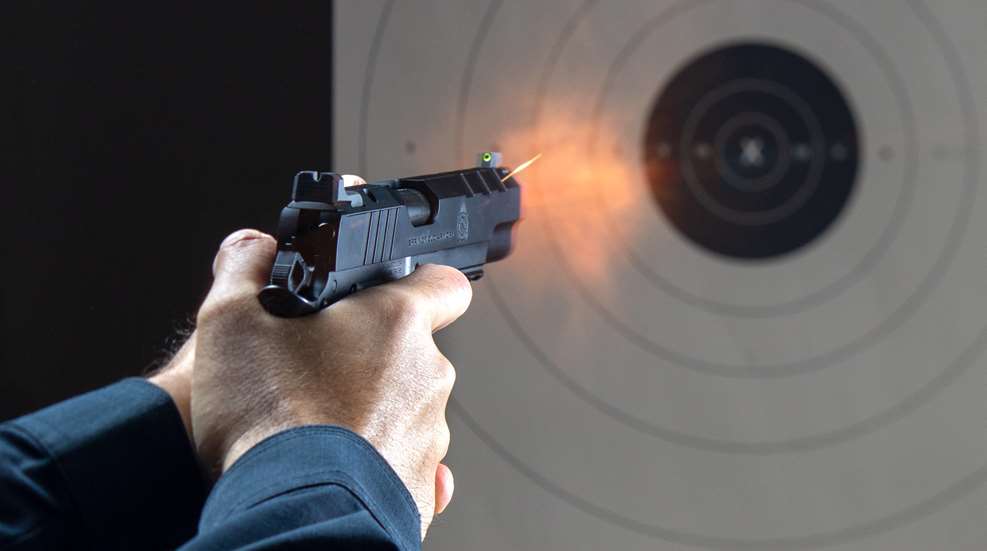
Defensive handgun skills and tactics go hand in hand, but they’re not the same thing. A skill is the ability to perform a task effectively. Tactics are plans or methods used to achieve a specific result. Separating skills from tactics allows you to master one so you can effectively apply the other. We’ll break down the primary defensive handgun skills you should develop, but first, let’s further differentiate between skills and tactics.
Firing two rapid shots center mass of a threat is a common tactical response. The skill required is the ability to make those shots accurately and quickly. Another tactic is transitioning to a head shot if the initial shots fail to stop the threat. This requires a different skill: the ability to swiftly transition to and hit a smaller, more precise target. In both cases, your ability to perform tactically depends on effective skill execution. We can identify these skills—and, most importantly, isolate them to perfect them.
Core Defensive Handgun Skills
There are two often-undervalued skills we must integrate throughout all handgun-skill development, which are proper handgun maintenance (so your gun functions reliably) and adherence to safety practices (so you don’t accidently shoot yourself or negligently harm someone else.) Beyond those, defensive handgun skills may be placed into five primary categories that include stance, grip, presentation, trigger control and manipulation. Let’s examine each to help you train more effectively.
Safety & Maintenance
There are four tenets of firearms safety: 1) Treat all guns as if they’re loaded; 2) Place your finger on the trigger only when the gun is on the target; 3) Never point a gun at anything you’re not willing to destroy; 4) Always be sure of your target and what is around/beyond it.
It’s important to learn the safety rules, but your ability to recite them is not as vital as your complete adherence to them when you’re handling a gun.
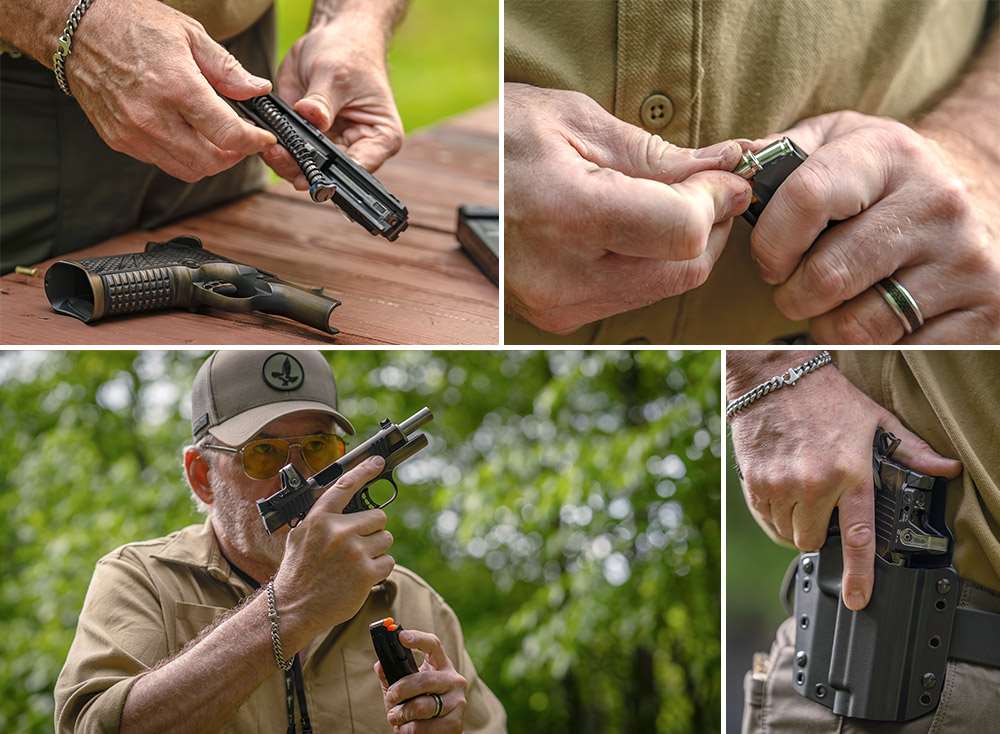
Gun maintenance is a skill too, because if you perform it incorrectly, your gun may malfunction. You need to know how to field strip, clean and lubricate your handgun so it will work. Good gun maintenance can save your life, but it also allows you to train uninterrupted. Take care of your handgun, and, as with safety, dovetail its care into your every interaction with it.
Stance
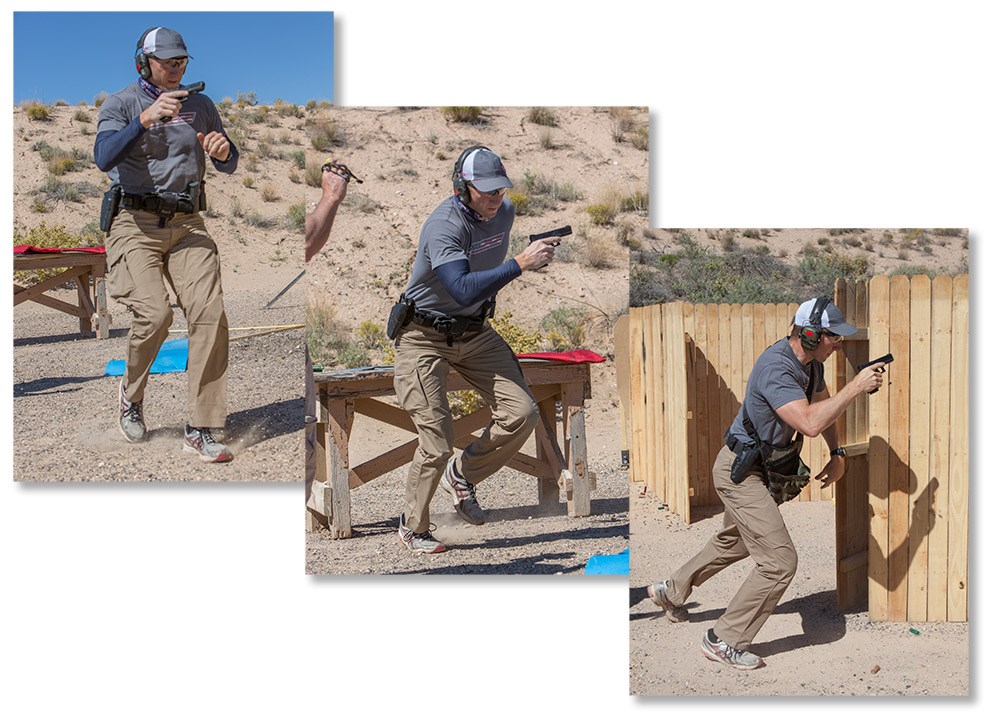
A good stance supports marksmanship by providing a stable platform, allowing you to focus on other skills. While many debate the merits of the Weaver, isosceles or some hybrid stance, the type of stance is not as important as its mechanics and your ability to let it evolve. Beyond providing balance, your shooting position must be adaptable to the situation. I learned this through both competition and real-world experience as a police officer.
In a dynamic self-defense situation, you may not be able to assume a textbook stance. You may need to shoot while seated, while on your back or while moving. Starting with dry practice, work from varied positions. Once you are comfortable, incorporate them into live-fire training.
Grip
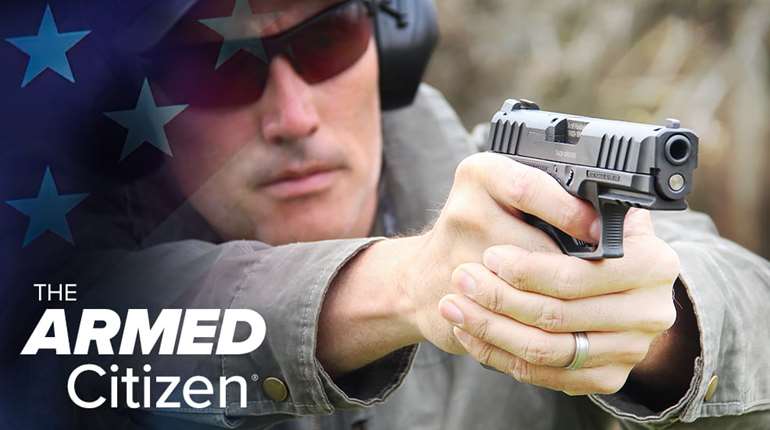
It’s possible to shoot accurately without a good grip, but you cannot shoot accurately, repeatedly and quickly, with a poor grip. Hold your handgun so the barrel is in line with your forearm, with your hand as high as possible on the grip, holding the gun firmly like a good handshake. Once you know what a correct grip feels like, learn to establish it upon first contact with the handgun. You can improve the establishment of a good grip during dry practice.
Also, practice transferring the handgun to your support hand and obtaining a correct grip. Tactics might require shooting with your support hand. After progressing to live fire, fine-tune your grip for comfort and control, and then, if you cannot find both, assess whether you may need a different gun.
Presentation
Dry practice is the best way to develop handgun presentation. Some years back, I committed to learning to shoot—including drawing from the holster—with my left hand. Initially, I was so terrible at presenting the handgun that I felt unsafe with live fire. A week of five-minute dry-practice sessions each day solved this.
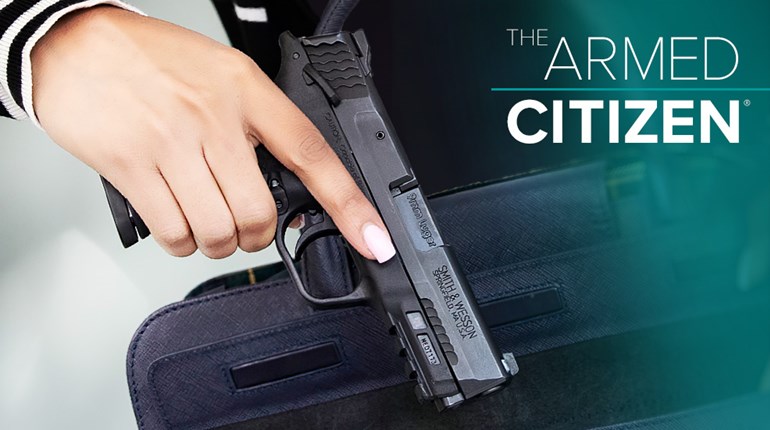
Proper presentation requires establishing a proper grip and pulling the handgun straight up out of the holster. Then, rotate the handgun 90 degrees and push it toward the target. Don’t use an upswept motion, like when bowling or raise the handgun high and cast it, like you’re fishing. Push it straight to the target while raising it to eye level. Don’t duck your head down or turtle it out; bring the sights up in front of your eyes.
As this push to the target is happening, add your support hand. Placing your support hand flat against your sternum as you establish your grip, then combining it with your shooting hand as the handgun moves forward is an effective technique to prevent you from inadvertently muzzling your support hand. Safety!
Trigger Control
You have probably heard the secret to accurate shooting is proper sight alignment and trigger control. That’s mostly true, but while you must conduct both simultaneously, one needs only to be understood and the other needs tremendous practice. Once you’ve learned correct sight alignment, you’ll likely never need it demonstrated again. On the other hand, people may struggle with proper trigger control forever.
With sight alignment—regardless of whether you use standard or red-dot sights—you must learn what is acceptable wobble. No one can hold a handgun perfectly still. Work to establish an intuitive understanding of how much wobble is acceptable, given the distance to and the size of the target. You can get by with more wobble on an eight-inch target at five yards than you can on the same target at 15 yards. This is why it’s good to vary distance during training.
You control the trigger by learning to manipulate it without moving the handgun. This takes thousands of repetitions before you obtain even marginal competency. Dry practice is the key, and not just for the novice. It lays a foundation that you’ll ultimately temper with live fire and it should be an ongoing—lifelong—skill-development tool. As a minimum, it should occur before, during and after every live-fire session.
Firing multi-shot strings is where the mastery of sight alignment and trigger control really come together, but the sight picture—with acceptable wobble—and trigger press remain the same. What changes is how fast you reset and repress the trigger. Ultimately, you’ll dictate that speed by the size of and distance to the target, as you develop the proper shot cadence for each situation.
Manipulation
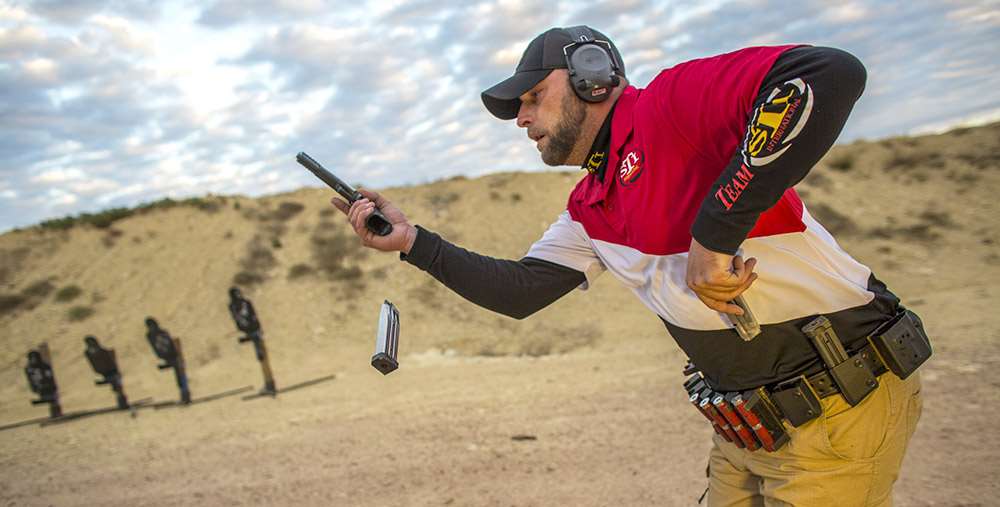
This is one of the most-overlooked defensive handgun skills. It covers all other physical interactions with a handgun. You must be able to load your magazines or cylinders and be able to conduct a reload. You should be familiar with slide manipulation on a pistol or with cylinder control on a revolver. Magazine and cylinder controls often require the repositioning of the hand and thus require practice. Reloads and safety manipulation must be positive and tactics-driven. You must also know how to keep your gun in the fight—that is, to make a handgun that will not shoot start shooting again.
Fortunately, you can learn these skills with dry practice; for example, while learning correct handgun presentation, work on safety manipulation. As for stoppage (jam) correction, set up stoppages with dummy rounds or empty cases and practice sorting the problem. The same is true with reloads. Use dummy rounds and dry practice the process. Manipulation skills are key indicators of handgun proficiency and are paramount to not only situational survival but also to safety.
Dry Practice
Most shooters avoid dry practice. When I was teaching defensive handgun skills to my wife and our young son, everyday range time was impractical. I implemented a five-minute, daily dry-practice regime. In a week, both markedly improved live-fire performance. As their training progressed, they continued dry-practice training, but they changed up the focused skills. Within a couple of months, they were safe and competent handgunners.
Dry practice might seem to be about as much fun as taking out the trash, but to be beneficial, it only requires a short amount of time each day. For more enjoyment, you can include laser-training tools, but with or without those cool tools, it is a process you must embrace. Ignoring or avoiding dry practice substantially prolongs your progression and causes you to waste lots of ammunition.
Drill Selection/Conduct
There are hundreds of training drills for isolating skills, establishing comprehensive mastery or for qualification. There are also a lot of different drills to break training monotony. Drills isolating single skills are best for initial and dry-practice training. As aptitude increases, add live fire that combines skills. I prefer to mostly use a single, comprehensive, live-fire drill, so I can maintain an ongoing register of progress and performance. I also like a drill I can manipulate to isolate skills when they need additional work.
My favorite is what I call the “step-back drill.” I’ve found it offers the best multi-faceted evaluation tool, and I even use it when evaluating handguns. It includes and demands perfection of all the basic skills associated with a self-defense handgun, and its familiarity lets me isolate and work on individual skills as necessary.
It works like this. For stage one, you start five yards from an eight-inch target and draw and engage with two shots. Use a shot timer—the goal is to get both hits within two seconds. To do so, you must expertly execute each basic skill. Initially, you’ll fail, and this is where you must identify and isolate the individual skills you are lacking.
When you can conduct the first stage with no misses and within or nearly within the time limit, move to stage two. It’s the same, but it is conducted at 10 yards with a three-second time limit. Now, the target appears smaller, and you must temper acceptable wobble and adjust your shot cadence. Stages three, four and five are at 15, 20 and 25 yards. They’re the same, too, but you’re allotted four, five and six seconds, respectively. Your ultimate goal is 10 hits within 20 cumulative seconds with no misses. Throughout the drill, reloading is at your discretion; reload between stages or on-demand as needed.
Skill Isolation
After conducting each stage of the step-back drill—or your chosen drill—critique your performance honestly. Look at the target, examine the shot timer and note the time it took to fire the first shot and the follow-up shots, and make a general assessment regarding the smoothness and deliberateness of your actions. As you identify weaknesses, revert to dry practice or temper the execution of the drill to focus on the skill that’s lacking.
Did you feel off balance during recoil? Adjust your stance.
Are you too slow to get on target? Work on grip and presentation.
Did you miss the target? Tweak acceptable wobble and refine the trigger press.
Did you run out of ammo between the first and second shot on a stage? Focus on ammo management.
Did you fail to disengage the safety? Retrain manipulation skills.
The Big Mistake
The most common training mistake defensive handgun shooters make is failing to integrate dry practice with live fire. Just because you’re on a range does not mean you cannot dry practice. When you identify a skill that needs work, stop shooting and dry practice that single skill. Start out slow and increase speed as you develop comfort. Then, and only then, live-fire the drill again.
Becoming competent with defensive handgun skills is no different than becoming a good soccer player. You must learn and continue to develop the basic skills—dribbling, passing and shooting—before you can integrate tactics and navigate a game or a complex real-world self-defense scenario.