Gun writer tip of the day: If you want to feel competent and professional, do not, repeat do not, go to Defense Training International’s website and read DTI founder John Farnam’s curriculum vitae. It’s a pre-fabbed dose of inadequacy that has few equals. Sigh.

On the other hand, Farnam is a gentleman of the old school, and generous with his time. So the correct mindset may allow some repair of (occasionally considerable) inadequacies, and all you have to do is shut up and listen. We had just such an opportunity this week. Our topic was the “patrol rifle,” an arm seeing increasing deployment in law enforcement circles and, as Farnam discusses, with good reason.
American Warrior: Is there a back story to the fielding of patrol rifles by an ever-increasing number of police departments, or is it more of a natural evolution?
John S. Farnam: As you might expect, some of both. When I first became a police officer in 1970, we had a “patrol rifle” that was provided to departments essentially free by the federal government: the M1 carbine. It had lots to commend it. It was light and maneuverable, had low recoil, and often came with pallets of ammunition. Even by modern standards, it wouldn’t be a bad choice. Choosing to use it, and to equip patrol units with it, was another matter, as shotguns—mostly 12-gauge pumps—had a lot to recommend their use, too, and were already established as the patrol long arm. They were very common.
There were some expectations about officers that started to make shotguns problematic, though. Mainly, they related to physique: Departments had standards that made a 12-gauge reasonable, but in the ’70s more women and medium-statured men were entering law enforcement, and recoil made it difficult for those physically smaller officers to master the 12-gauge. Enough practice to really become proficient was too punishing. Different loads (“light” recoil formulas, 20-gauge, #4 buck, etc.) were all tried, but 00 buck or slugs proved difficult to beat.
This left a lot of police chiefs with a problem: The compressed downrange danger area that protected civilians and bystanders was essentially unavailable due to the training issues (with shotguns).
The 1997 North Hollywood, Calif., bank robbery and shootout changed all that. The two bad guys—essentially wearing “trench coats” sewn together out of body armor—were both hit multiple times by pistol rounds and shotgun pellets but weren’t incapacitated. The arrival of LAPD SWAT and the commandeering of several weapons from a nearby gun store were necessary to end the incident. Clearly, the arming of patrol units needed to be rethought, including issuing weapons that could penetrate this sort of target.
AW: So a centerfire rifle took the place of the shotgun?
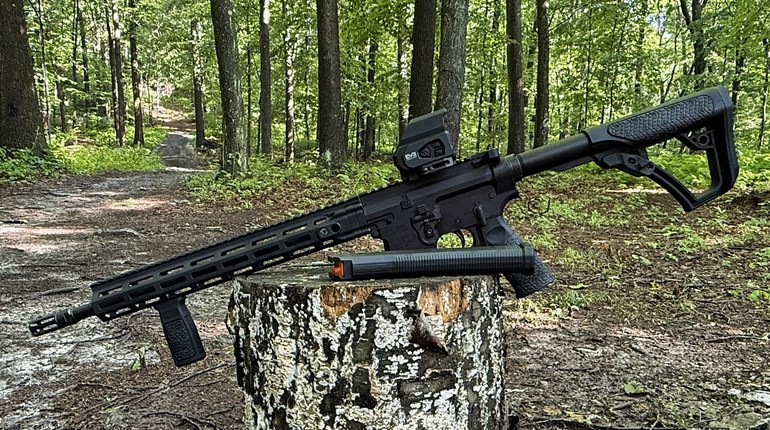
JSF: Yes, they’re pretty rare now. My training for departments now focuses mostly on M4 carbines in .223/5.56 or Beretta pistol caliber carbines (like the CX4). Both are compact (easy to get in and out of vehicles and use in buildings) and easy to learn to shoot due to very low recoil. Both of them are reliable and accurate, too, and neither presents problems for physically smaller officers.It’s my belief that the stopping power of .223 is somewhat overstated, and this goes all the way back to my experience in the Marines in Vietnam.
There are also some training advantages for departments that have a higher percentage of officers with previous military experience—lots of commonalities with issue M16s and other Stoner variants. If officers don’t have that background, naturally it can take more time and effort to get them ready for duty with a patrol rifle due to the confines in which they’re used—cars and buildings.
AW: Any thoughts or observations on caliber in a rifle for the “patrol” role?
JSF: It’s my belief that the overall utility of the .223 round (5.56x45) is checked by limited range and penetration, and this goes all the way back to my experience in the Marines in Vietnam. Out to 150 yards, our 55-grain “ball” was a reliable stopper. Beyond that, though, you would knock enemy soldiers down only to see them get up and carry on. In a patrol rifle, this may actually be a good thing in terms of that “compressed downrange danger area”: Over-penetration and the risk of unintended downrange hits goes down. Those may be problems in the military application of the round, but don’t translate into serious issues for law enforcement. I know of precious few law-enforcement engagements where lack of long-range capability was an issue.
That said, the .223 remains weak on things like car doors. It’s actually only slightly better than 9 mm on layered barriers. It’s also inconsistent on windshields.
Some of these shortcomings can be negated by ammunition choice, with projectiles like the COR®BON DPX and Federal’s bonded-core loadings giving considerably better performance.
AW: And heavier calibers? .308 or … ?
JSF: There you’re back to the shotgun problem to some extent: heavier recoil and smaller ammunition load-out. (They have) great effectiveness on vehicles and barricaded suspects, but at the cost of heavier weight and more recoil. The .223 gives very nearly a 2-to-1 advantage in round count (over a .308), and there are times when that can matter. I know of rural departments that equip patrol officers with 20 30-round magazines so that their endurance in a situation where backup may be a long time coming doesn’t put them at such a dangerous disadvantage.
In terms of other calibers, we heard a lot about 6 mm and variants for a while, but I think that phase is over. .300 Blackout may have better success. It has more range and penetration than .223, without adding a lot of recoil. Still, you know, it’s a heavier round; better barrier effectiveness, even penetrating cinder block, but not always. That would be useful for officers on occasion, but nobody wants to go back to shotgun-like recoil.
We’ll finish our chat with DTI’s John Farnam next week, when he concludes his thoughts on the patrol rifle: optics considerations, NFA versions and his own rendition—the Farnam “Signature” M4.