When it comes to making things people want, there’s nothing like a free-market economy. Today, we are able to carry 9mm pistols that are no larger than the .380s we used to carry, and the new 9s have more features and better functionality than the .380s ever had.
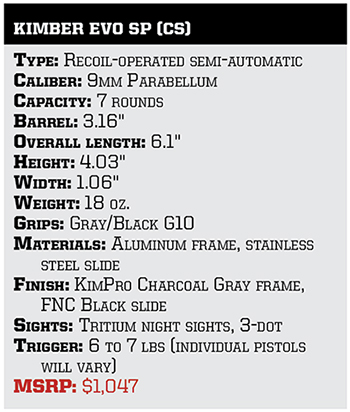
The exemplar of this is the Kimber EVO SP (CS) (the “CS” is for “Custom Shop”). The EVO SP (CS) is basically Kimber’s EVO with extra features. The basic EVO (if there is such a thing since Kimber makes five models of it) is a seven-shot 9mm with a barrel just over 3 inches long. It is a single-stack, striker-fired pistol with a trigger pull built to be between six and seven pounds.
It has a stainless slide, stainless barrel and aluminum frame, so the weight, at 18 ounces empty, will not drag down your belt. And yes, you should be carrying it on your belt—no pocket carry here.
The frame receives the Kimber KimPro II finish in charcoal gray, while the slide is given a ferritic-nitrocarburizing treatment, which both hardens the surface and gives the slide greater corrosion resistance. Thanks to this coating both wear and rust are delayed and made less of a problem.
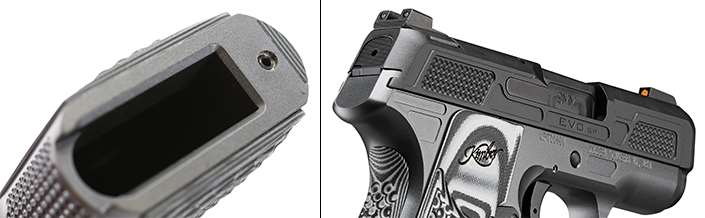
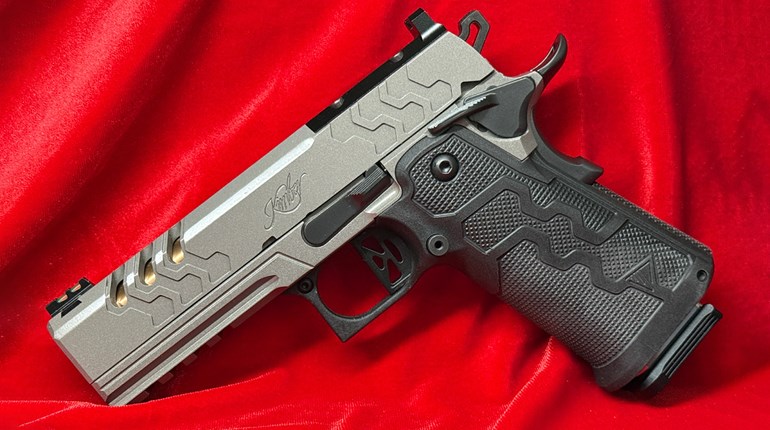
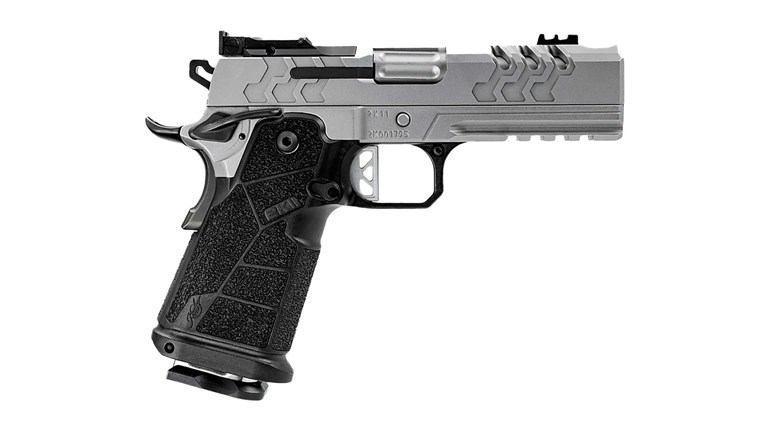
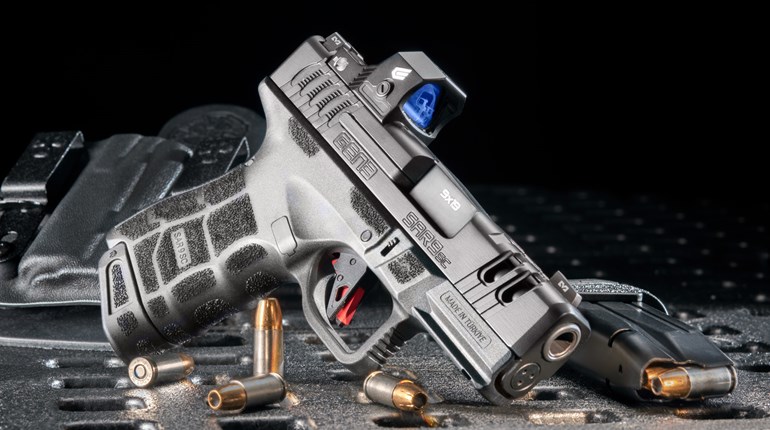
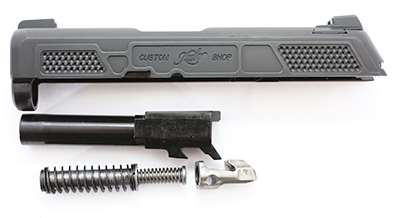
Where the standard EVO (the CDP) has vertical serrations on the slide for retracting the slide, the EVO SP (CS) has golf-ball-like indentations, fore and aft, created with a milling machine. The slide is treated to a sculpting-machine program that highlights its contours and takes a small amount of its weight off. The SP, like the regular EVO CDP, comes with tritium night sights made by Truglo. The front sight is the now-standard blade with a slight forward angle to the rear face. The rear sight has been machined so the front edge of it is more vertical; as a result, it can be (carefully) used as a cocking ledge in an emergency.
The back face of the slide has the assembly plate for the striker system, which protrudes from the plate when the striker is cocked, letting you know visually and by touch that the action is ready.
Also, the G10 grips and backstrap on the SP are gray and black. The alternating gray and black layers of the G10, when cut and contoured for the SP, create an interesting pattern that is quite distinctive. The grips, backstrap and frame have also been given the golf ball-like pattern, which Kimber calls “Stiplex.” The Stiplex pattern has also been applied to the slide stop and the magazine button.
The single-stack magazines hold seven rounds with the basepad acting as a magazine extension. Each EVO ships with two of these magazines, so you have the ammo on-board, plus a reload, without having to order extra magazines.
The barrel locks up in the slide in the time-tested Browning method. The slide does not have a bushing; the barrel is fitted to the front opening in the slide; and the barrel sports a deep crown to protect the edges of the lands and grooves.
The EVO does not require you to press the trigger in order to field-strip any of the five models. There are no grip screws; instead, you loosen the hex nut on the bottom of the frame with a 1/16-inch Allen wrench in order to slide out the backstrap and then pull the grip panels off of the frame. Left-handed shooters can use that same 1/16-inch wrench to remove the magazine catch and flip the insert the other way.
In testing, the EVO SP (CS) never failed to function. Every round fed, fired and ejected as expected. The magazines locked the slide back when empty without fail. This is the standard we have come to expect in self-loading pistols, and Kimber delivers.
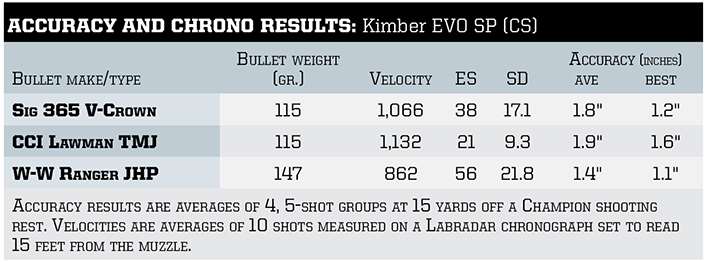
Also, ammunition manufacturers have accepted that many people now carry pistols with short barrels and have formulated their loads to account for this; as a result, the velocities recorded were much better than expected, almost as fast as these loads would have been out of duty-sized pistols in the past.
 The accuracy testing also demonstrated both the advances in design and manufacturing that have happened, and the need to test your pistol for what it likes. The usual standard is 25 yards, but for a pistol this small, 15 is a more appropriate distance. Based on the promising results of the Winchester Ranger 147s, I used the rest of that ammo plinking on the one-foot-square gongs at the 100-yard line of my gun club. I was into the third magazine before I missed.
Despite being a new model, the Kimber EVO is supported by holster manufacturers. You will be able to source a variety of styles as well as locations on your person to carry them.
If you want a compact, handy, powerful and accurate pistol for everyday carry, the Kimber EVO should be at the top of your list. The SP (CS) model is striking-looking to boot.