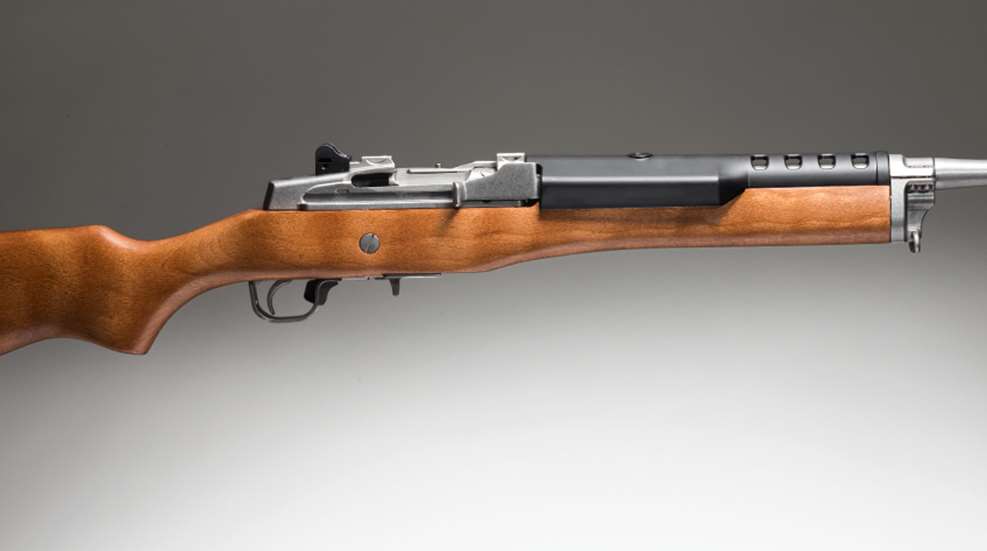
The early 1970s were a different time. While the new .223 Remington cartridge was gaining ground, Bill Ruger had no interest in making a rifle that was a clone of—or anything like—the AR-15. Instead, he looked back (which then wasn’t back very far) to the M14.
Ruger then enlisted the aid of Jim Sullivan, who had been instrumental in designing the AR-15 from the AR-10. The result was the Mini-14, a handy .223 carbine that pleased the eyes of those raised on M1 Garands, M14s and M1 carbines.
Fast forward to the mid-1980s and, suddenly, ammunition in 7.62x39 was available for what seemed like not much more than the cost to ship it from overseas. This enabled Ruger to reassess the caliber of the Mini-14, which had been problematic in two ways: first, many state regulations prohibited the use of a .22-caliber rifle in deer hunting; and second, some shooters were simply not content with the ballistics of the .223 Remington.
So, in 1987, Ruger rolled out the Mini Thirty, which is identical to the Mini-14 except for its 7.62x39 chambering and magazines.
The Minis are gas-operated, self-loading rifles that feed from detachable box magazines. In designing them, Ruger and Sullivan simplified all previous gas-operated designs. Instead of the long and unsupported operating rod of the Garand, the Mini has a short and sturdy one. Instead of the sliding internal piston of the M14 gas system, the Mini has no moving parts. The M1 carbine uses a short, tappet piston that travels half an inch and drives the operating rod. On the Minis, the gas “piston” is simply a spigot that protrudes from the gas block, which is itself clamped securely to the barrel.
When the action is closed, the operating rod encloses the “piston” (which is what Ruger calls it, even though it is simply a spigot). On firing, the bullet passes the gas port in the barrel, where gas is diverted off to the gas system. It enters the spigot, and the pressure pushes the operating rod off the spigot, driving it on its cycle. The operating rod has a cam on the inside face—at the charging handle—and that cam lifts the two-lugged bolt, then carries it back. The extractor, having pulled the empty from the chamber, carries the empty back to the ejector, and hitting that, is thrown clear of the receiver.
The ejector is also the bolt hold-open, and the Mini locks open when the last round has been fired. The recoil spring, having been compressed by the travel of the operating rod, now pushes the rod forward, where it pushes the next round out of the magazine into the chamber and cams the locking lugs to engage the receiver abutments. The Mini is now ready to fire again.
The design of the gas system of the Mini is particularly beneficial when using 7.62x39. Unlike .223 ammunition, you are much more likely to encounter corrosively primed 7.62. The spigot is easily reached for cleaning, and the tunnel for it in the operating rod is easily cleaned with a bore brush on a portable drill.
Nothing on the Mini Thirty is petite or fragile, and from a recent visit to the Ruger factory, I can tell you their engineers obsess over the best way to make each part going into their firearms.
The barrel is made in-house by Ruger, and the bore must meet a specification of .310 to .311 of an inch. In my discussions with the barrel-making crew at Ruger, they stay very close to .3105 of an inch. This means the Mini Thirty will work just fine with all the various foreign imports and their .311-inch bullets, as well as good old American ammunition and their .308-inch bullets.
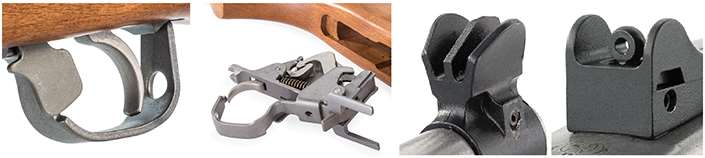
The trigger mechanism of the Mini is one area that neither Ruger nor Sullivan felt the need to modify or “improve.” If you’ve ever seen the trigger mechanism of an M1 Garand or M14/M1A out of the stock, you will recognize that Ruger and Sullivan simply scaled that entire package down to fit the .223-sized carbine they were making. The trigger design is a two-stage hammer (originally designed by Browning, adapted by Garand and now adopted by Ruger) that, when released, pivots to strike a firing pin inside of the rotating bolt.
The Mini system, in its nod back, has a detail that might seem odd to those familiar with thumb-operated or push-button safeties. The Mini’s safety is a pivoting tab that rides at the front of the trigger guard. When the safety is back and protrudes into the trigger guard hoop, the carbine is on safe and will not fire. To the latest generation of shooters—who've been drilled to always keep their finger outside of the trigger-guard—this seems a strange choice; however, it is neither unsafe nor bad manners to insert your trigger finger into the trigger guard to push the safety to fire. (It is, as always, unsafe and bad manners to have your finger resting there.) One last note on the safety: Its lever does not merely block the mechanism, but cams firing parts out of engagement, so the Mini Thirty is drop-safe.

The best part is that Ruger upgraded the Mini system in 2005. All subsequent rifles were made to the Ranch Rifle design. The Ruger scope-ring base system became an integral part of the receiver. To mount a scope, you simply use the included 1-inch rings. If you need higher rings, or 30 mm rings, Ruger has them on its website.
The Mini Thirty comes with a flush-mount, five-round magazine. Ten and twenty-round magazines are also available.
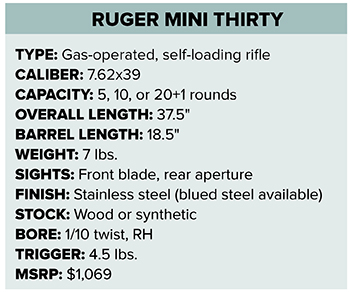 As a hunting rifle, the Mini Thirty fits the niche of “woods rifle” very well. The 7.62x39 cartridge is perhaps a half-step behind the venerated .30-30 in power, and no one has ever complained about the performance of .30-30 on whitetail. As a potential home-defense tool, it offers more bullet weight than the .223 and moderate recoil.
In all, the Ruger Mini Thirty is a handy tool and one that will last for generations. Looking again at the accuracy stats, it shot better than any .30-30 I have ever tested. Perhaps I should not have sent it back to Ruger.