Like the Continental Army and Navy, the service that became the United States Marines was created before our nation. In the era of their founding, they were considered a nearly exclusive adjunct to the Navy. But a little history presages many of their modern roles: For the most part, the only difference is one of scale. Their doctrine and leadership were often far-sighted too: 13th Commandant John LeJeune anticipated the need for amphibious operations and techniques before they were needed for the Pacific.
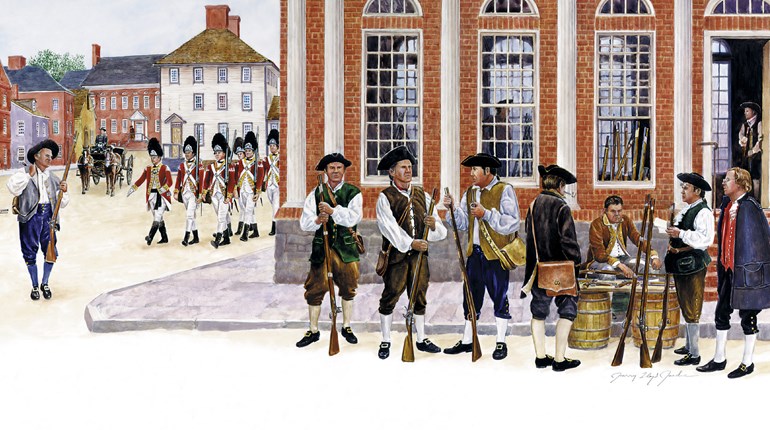
Following the Army (June) and Navy (October), Captain Samuel Nichols was ordered by a resolution of the Second Continental Congress (November 1775) to create the third military arm of the colonies in the form of two battalions of Marines. In the Revolutionary era, Marines had two roles. When naval engagements evolved to close-quarters battle—boarding the enemy’s ship or repelling their boarders—Marines used rifles from the deck or “fighting tops” (platforms on the masts) against their opponents. The other role was regrettably common but just as serious—protecting officers from mutinous sailors.
Spread among the fledgling Navy, two battalions met the Navy’s requirements, though not without distinction: In March of 1776, Marines stormed and took the English Forts of Montagu and Nassau in New Providence, Bahamas—the first of many amphibious assaults.
Following the Revolution, the fortunes of the Marines followed those of the Continental Army and Navy. The new nation simply did not have the money to support a standing military, so the Marines were disbanded in April 1783.
But Marines were needed again before the end of the century. American commercial shipping was facing growing harassment as the 1790s ended, and Congress commissioned 13 frigates to defend U.S. interests. Marines were recruited to fill out the complement of the new crews.
One of the most famous Marine actions soon followed, when eventual U.S. Army General William Eaton and Marine 1st Lieutenant (later Captain) Presley O’Bannon led eight Marines and 500 local troops from Alexandria, Egypt, to capture Tripoli, Tunisia. After a 600-mile march through the North African desert, the force attacked the city of Derna, raising the U.S. flag for the first time over a foreign conquest. Winning the Battle of Derna was key to bringing about the end of Barbary Coast pirating.
The fortunes of the Marines rose and fell largely alongside those of the Navy through the 19th century, though they were far from inactive. The Seminole War of 1835, the Mexican-American War (of “Halls of Montezuma” fame) and Commodore Perry’s Pacific exploits all benefited from Marine Corps support.
The 20th-century Marine Corps continued in the footsteps of its revolutionary forebears in the Bahamas: Marines were often the first into America’s conflicts when rapid deployments were the key to success, and ground had to be held by light, mobile forces until generally heavier Army units could arrive. From the turn-of-the-century Spanish-American War and Boxer Rebellion to Belleau Wood in WWI, the Corps steadily built a reputation for tenacity and soldier-to-soldier readiness that was envied by ally and enemy alike. From the original two battalions and amphibious/ship-borne infantry duties of Revolutionary days, approximately 190,000 men and women (and 40,000 reservists) now comprise the modern Marine Corps.
The Corps’ doctrine and leadership were often far-sighted too: 13th Commandant John A. LeJeune anticipated the need for amphibious operations and techniques before they were needed for the Pacific phase of WWII. While the likes of Guadalcanal, Tarawa and Iwo Jima were still costly, they could perhaps have been far worse.
In WWII, an air arm for the Marine Corps also conspicuously appeared and acquitted itself with particular distinction, producing 118 aces (five or more enemy aircraft downed) and nine Medal of Honor winners.
It may seem odd that Marine success during World War II was very nearly the end of the Corps. In the vast drawdown at the end of the war, a serious cannibalization of the Marine Corps was contemplated (we’ll be discreet about the “by whom” part). But statutory protection came in the form of the National Security Act of 1947. Not long after, the commandant of the Marine Corps gained an equal voice on the Joint Chiefs of Staff.
From the original two battalions and amphibious/ship-borne infantry duties of Revolutionary days, approximately 190,000 men and women (and 40,000 reservists) now comprise the modern Marine Corps. Their roles are incredibly diverse: Navy-transported MEUs range the globe from their amphibious assault carriers, and Marine aviators can stalk our nation’s enemies from ship or shore. They protect our embassies abroad, short-hop the president of the United States aboard “Marine One,” and even provided the first Earth-orbiting astronaut (and later U.S. Senator) John Glenn.
Now, nearly 240 years—almost a quarter of a millennium—of service down the line, only one question remains: If that isn’t Semper Fidelis, what is?