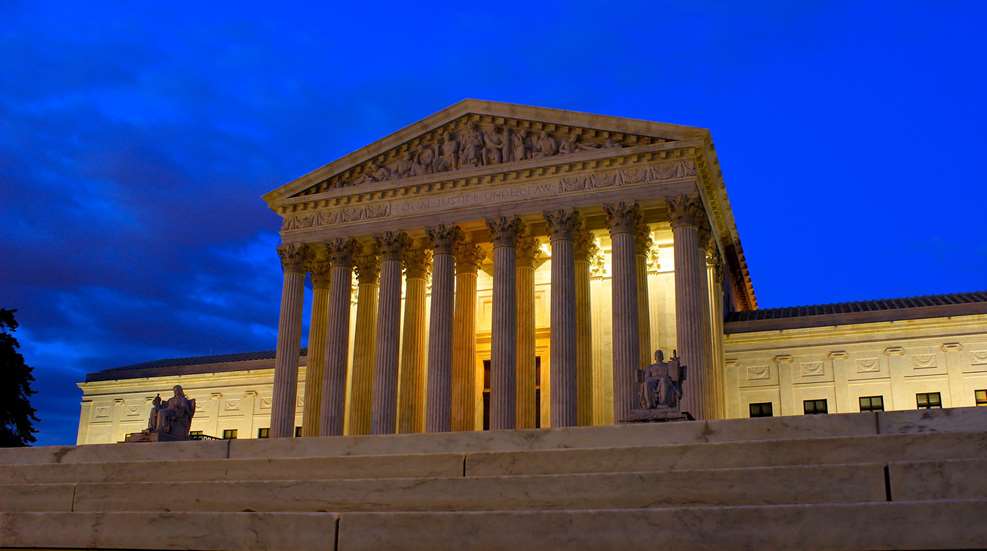
FAIRFAX, Va. – The National Rifle Association of America (NRA) commented today on the United States Supreme Court accepting National Rifle Association of America v. Maria T. Vullo for review. The decision is a landmark development in one of the most closely watched First Amendment cases in the nation.
“This is a historic step forward for free speech, the NRA’s millions of members, and for all who believe in freedom,” says NRA CEO & EVP Wayne LaPierre. “The NRA’s fight for justice continues – this time in the highest court in the land. At a time when free speech is under attack as never before, it is important that government officials be sent a message that they cannot use intimidation tactics to silence those with whom they disagree.”
In a May 2018 lawsuit, the NRA alleged that Vullo, at the behest of former New York Gov. Andrew Cuomo, took aim at the NRA and conspired to use the regulatory power of the New York Department of Financial Services (DFS) to “financially blacklist” the NRA – coercing banks and insurers to cut ties with the Association to suppress its pro-Second Amendment speech. The NRA argues that Vullo’s actions were meant to silence the NRA – using “guidance letters,” backroom threats, and other measures to cause financial institutions to “drop” the Association. The NRA's First Amendment claims withstood multiple motions to dismiss. But in 2022, after Vullo appealed the trial court’s ruling, the Second Circuit struck down the NRA’s claims. The court ruled that in an era of “enhanced corporate social responsibility,” it was reasonable for New York's financial regulator to warn banks and insurance companies against servicing pro-gun groups based on the supposed “social backlash” against those groups’ advocacy. The court also ruled that Vullo’s guidance – written on her official letterhead and invoking her regulatory powers – was not a directive to the institutions she regulated, but rather a mere expression of her political preferences.
On February 7, 2023, the NRA petitioned the U.S. Supreme Court, seeking review of the Second Circuit decision.
The Court granted review on the following question: Does the First Amendment allow a government regulator to threaten regulated entities with adverse regulatory actions if they do business with a controversial speaker, as a consequence of (a) the government’s own hostility to the speaker’s viewpoint or (b) a perceived “general backlash” against the speaker’s advocacy?
“The Second Circuit’s opinion…gives state officials free rein to financially blacklist their political opponents – from gun rights groups, to abortion-rights groups, to environmentalist groups, and beyond,” the NRA states in its petition. The Association argues that the Second Circuit erroneously opened the door to unrestrained harassment of advocacy groups by state officials, and seeks to have it closed.
“We are grateful the Supreme Court will review this First Amendment case and excited by the opportunity to argue to the Court that a government regulator cannot take adverse action against its political enemies,” says William A. Brewer III, counsel to the NRA. “The ruling from the Second Circuit condones public officials having unbridled power to attack those with whom they disagree.”
Seven amicus briefs representing 40 individuals and organizations were filed in support of the NRA.
The amicus briefs include those from state attorney generals from Montana and 17 other states, in addition to a brief filed jointly by Texas and Indiana. Various business and legal scholars, the Foundation for Individual Rights and Expression (FIRE) and the Gun Owners of America, among others, also submitted briefs.
The NRA observes this is not the first time state officials have leveraged their regulatory power to suppress a disfavored civil rights organization or choke off disfavored speech. The NRA's petition to the Court emphasizes a long line of First Amendment cases – from seminal decisions involving the NAACP, to the Supreme Court's storied Bantam Books decision – that forbid such tactics.
The American Civil Liberties Union (ACLU) has voiced its support for the NRA.
In August 2018, ACLU Legal Director David Cole wrote that, “…they [New York public officials] cannot use their regulatory authority to penalize advocacy groups by threatening companies that do business with those groups. And here the state has admitted, in its own words, that it focused on the NRA and other groups not because of any illegal conduct, but because they engage in ‘gun promotion’ – in other words, because they advocate a lawful activity.” The ACLU wrote that dismissing the NRA’s case “would set a dangerous precedent for advocacy groups across the political spectrum. Public officials would have a readymade playbook for abusing their regulatory power to harm disfavored advocacy groups without triggering judicial scrutiny.”
Eugene Volokh joins Brewer in representing the NRA, along with Brewer Partner Sarah B. Rogers and firm counsel Noah Peters.