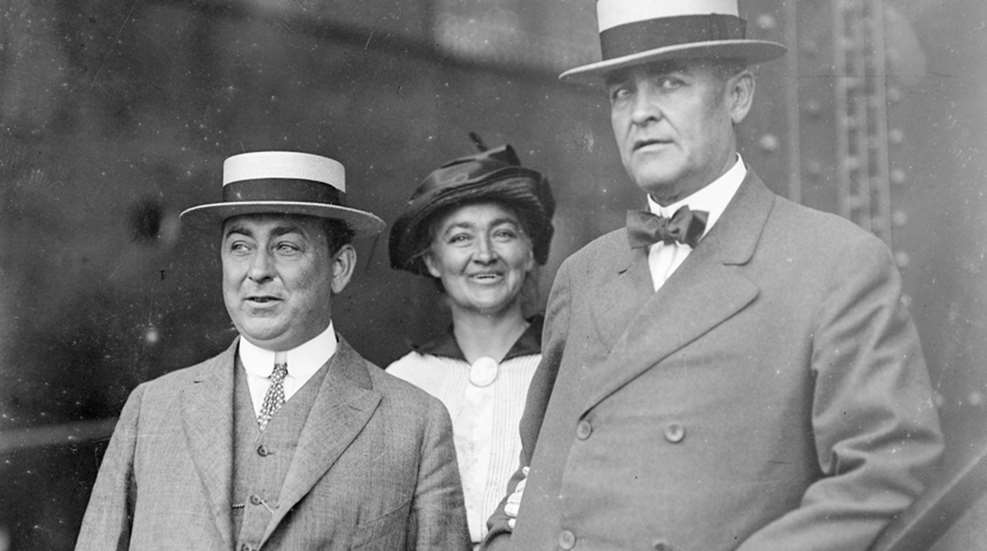
Timothy “Big Tim” Daniel Sullivan (1862-1913) (right), a New York City politician, in 1911, pushed the Sullivan Act through the City’s legislature-an unconstitutional infringement on our rights.
“I grew up at a time when people were not afraid of people with firearms. I used to travel on the subway from Queens to Manhattan with a rifle. Could you imagine doing that today in New York City?” So recalled U.S. Supreme Court Justice Antonin Scalia about his days as a schoolboy on a rifle team.
Scalia’s experience reflected a long tradition. For example, Gen. George W. Wingate, president of the N.Y. Public Schools Athletic League, wrote an essay titled Why School Boys Should Be Taught to Shoot? (1907). President Teddy Roosevelt wrote an afterword for it congratulating the New York pupil who was the best shot of the year.
The National Rifle Association was chartered in New York in 1871 by Gen. Wingate and Col. William Church for the purpose of promoting marksmanship. The New York legislature accommodated the NRA by funding a range at Creedmoor, Long Island.
The right to bear arms was respected in those days. The 1828 N.Y. Civil Rights Law, which is still on the books, states: “A well regulated militia being necessary to the security of a free state, the right of the people to keep and bear arms cannot be infringed.” The state did not forbid carrying unlicensed, concealed pistols until 1881, while open carry went unregulated.
The Sullivan Law of 1911 was the first law in any state to require a license just to keep a pistol in the home. Carrying was banned without a license—and commoners need not apply. When the law could not be repealed, the NRA turned to the courts.
In Moore v. Gallup, a veteran appealed the denial of a license to carry a pistol for lack of “good cause.” The New York appeals court affirmed the denial in 1943. An amicus brief was filed by New York attorney and former NRA president Karl T. Frederick on behalf of the NRA, and another amicus brief was filed for the Forbes Rifle & Pistol Club (which still exists today).
The judge who denied the license said it would be a bad precedent “if all citizens of good moral character were to be licensed to carry pistols” for target practice. The appeals court held that the Second Amendment protects “weapons of warfare to be used by the militia,” including “rifles and muskets ... but not pistols,” which “are habitually carried by ... gangsters.”
Of course, if pistols were not habitually carried by law-abiding citizens, it was because it was illegal to do so.
A dissenting judge opined that the law violated the right to bear arms. Referring to the danger of an enemy attack—German U-Boats had sunk scores of ships off the coast and landed saboteurs on Long Island—he said that “a man of the type of this petitioner who could shoot with accuracy, would be a more useful citizen than one who, if attacked, could only throw a bootjack at his assailant.”
While the NRA amicus brief in the above case could not be located, it undoubtedly made arguments based on the Second Amendment and the need to train citizens to shoot, as the NRA long advocated.
A New York court held in 1958 that the Sullivan Law did not restrict rifles because of the Second Amendment and the Civil Rights Law. Fast forward to 1991, when New York City banned “assault weapons” like the M1 Garand. In Richmond Boro Gun Club v. City of NY, an NRA-supported challenge, the City admitted that banned rifles had not been used in crime in the City. That made no difference to the U.S. Court of Appeals for the Second Circuit in upholding the ban.
The NRA supported a challenge to NY State’s “SAFE Act” in NY State Rifle & Pistol Ass’n v. Cuomo, relying on the Heller decision holding that the Second Amendment protects firearms in common use. In 2015, the Second Circuit upheld the ban without a word about why these rifles presented any more danger than others.
That brings us to NYSRPA v. City of N.Y., another NRA-supported case, in which the Second Circuit upheld the City’s ban on transporting a handgun away from home. The right to bear arms was trumped by speculation about possible road rage. When the U.S. Supreme Court agreed to hear the case, the City made a stingy amendment to the law, inducing the Court to then decline the case.
For decades, the NRA has fought New York diktats tooth-and-nail, always against anti-Second Amendment courts. But, as a result of President Donald J. Trump’s judicial appointments, the Second Circuit has been flipped to a majority of Republican-appointed judges. And the appointment of Amy Coney Barrett to the U.S. Supreme Court fuels hope that the Second Amendment might not continue being treated as a second-class right, even in New York.
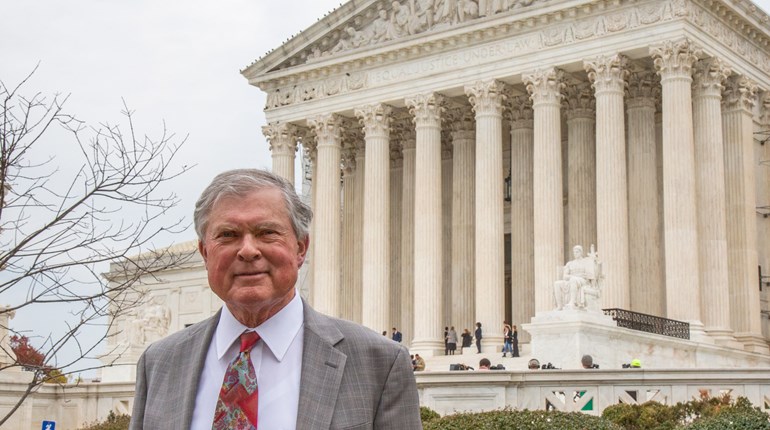
Attorney Stephen Halbrook has won gun cases in the U.S. Supreme Court, is a senior fellow with the Independent Institute and is author of The Founders’ Second Amendment and Gun Control in Nazi-Occupied France.